Beginner Guide to Zodiac Archetypes
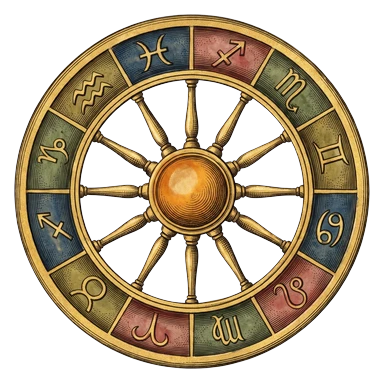
Zodiac archetypes are twelve symbolic styles arranged around the ecliptic. They become useful when read through element, modality, planetary ruler, chart placement, and mature expression, not as twelve fixed personality types.
Direct answer
Short version
Learn each sign with a six-part frame: element, modality, ruler, core function, common excess, and mature expression. Then ask which planet or angle occupies the sign. “Aries” by itself is an archetype; Mars in Aries, Moon in Aries, and Aries rising describe different functions.
The Instruments
Ten readings, worked out from your own birth chart
An instrument is a reading this house works out for you. Give your birth date, time and place once, and each one reads today’s real sky against the chart you were born under. Eight are personal; two are calendars anyone can open. A free account opens one instrument a day. The plans open every instrument, every day.
- Natal Chart Every planet, house and aspect in your chart
- Active Transits Where the planets are now, read against your chart
- Daily Counsel What to pursue today, and what to leave alone
- Personal Timing Your best days to decide, weeks ahead
- Fellowship Your chart and another, read side by side
- Theme of the Day The one thing today is asking of you
- Sacred Numbers Your life path, your cycles, your name in numbers
- Aeolian Harmonics Classical music chosen to match your chart
- Mercury Retrograde Every Mercury retrograde this year, with its dates Open to all
- Void-of-Course Moon When the Moon is between signs, hour by hour Open to all

Quick facts
| Element | Signs | Shared symbolic emphasis |
|---|---|---|
| Fire | Aries, Leo, Sagittarius | Initiative, vitality, conviction, expression, and the risk of excess heat or certainty. |
| Earth | Taurus, Virgo, Capricorn | Material reality, craft, continuity, discernment, and the risk of rigidity or overcontrol. |
| Air | Gemini, Libra, Aquarius | Language, relationship, concepts, networks, and the risk of abstraction or detachment. |
| Water | Cancer, Scorpio, Pisces | Feeling, memory, bonding, imagination, and the risk of flooding, secrecy, or blurred limits. |
Archetype does not mean stereotype
An archetype is a recurring symbolic pattern broad enough to appear through many lives and situations. A stereotype reduces people to a short list of traits. “Leo concerns creative visibility” is archetypal language; “Leos always need attention” is a stereotype. The first opens questions about expression, courage, audience, and pride. The second ignores placement, culture, biography, and every other factor in the chart.
The zodiac is a system of twelve equal 30-degree signs used in astrology. Astronomical zodiac constellations are unequal regions of the sky with boundaries defined for astronomy. They share historical names but are not the same object. Knowing the distinction prevents a beginner from treating symbolic sign divisions as modern astronomical constellations.
Element supplies substance; modality supplies rhythm
Elements group signs by symbolic substance. Modalities group them by phase. Cardinal signs (Aries, Cancer, Libra, and Capricorn) initiate. Fixed signs (Taurus, Leo, Scorpio, and Aquarius) stabilize and sustain. Mutable signs (Gemini, Virgo, Sagittarius, and Pisces) adapt, distribute, and transition. Every sign is one unique element-modality combination, so no two signs perform the same job.
Compare Aries and Capricorn: both are cardinal, but fire begins through impulse, courage, and direct ignition, while earth begins through structure, strategy, and material responsibility. Compare Taurus and Virgo: both are earth, but fixed Taurus consolidates and preserves while mutable Virgo edits and adjusts. This two-axis method teaches more than disconnected adjectives.
Planetary rulers connect the signs to chart functions
Traditional rulership assigns Mars to Aries and Scorpio, Venus to Taurus and Libra, Mercury to Gemini and Virgo, the Moon to Cancer, the Sun to Leo, Jupiter to Sagittarius and Pisces, and Saturn to Capricorn and Aquarius. Modern astrology often adds Pluto to Scorpio, Neptune to Pisces, and Uranus to Aquarius. State which scheme you use instead of quietly mixing systems.
A ruler acts like a routing instruction. If Cancer rises, the Moon becomes chart ruler; its sign, house, and aspects help describe how the chart’s outward approach is organized. If Venus is in Scorpio, the condition and position of Mars (Scorpio’s traditional ruler) adds context. Rulership is a relationship among placements, not a reason to declare one planet the person’s entire identity.
The twelve signs as a developmental sequence
One learning device reads the wheel as a sequence: Aries initiates, Taurus stabilizes, Gemini differentiates and exchanges, Cancer protects, Leo creates and displays, Virgo refines, Libra meets the other, Scorpio binds and transforms, Sagittarius seeks wider meaning, Capricorn structures, Aquarius distributes or reforms, and Pisces dissolves and completes. This is a mnemonic, not a historical proof or hierarchy.
Each function can mature or distort. Aries courage can become reactivity; Taurus steadiness can become refusal; Gemini curiosity can become scattering; Cancer care can become control; Leo expression can become performance; Virgo discernment can become perfectionism; Libra reciprocity can become appeasement; Scorpio depth can become coercion; Sagittarius vision can become exaggeration; Capricorn responsibility can become domination; Aquarius independence can become detachment; Pisces compassion can become boundary loss.
A sign changes meaning according to what occupies it
The Sun in Aquarius concerns identity and creative direction expressed through an Aquarian style. The Moon in Aquarius concerns emotional regulation and belonging through that style. Venus in Aquarius concerns attraction, value, and relationship. Mars in Aquarius concerns pursuit, conflict, and effort. Aquarius rising concerns immediate approach and places Saturn, and in modern practice Uranus, in a special interpretive role. The archetype is constant; the function changes.
Houses and aspects then specify the arena and dynamics. Venus in Aquarius in the fourth house can value freedom inside home and family, while the same Venus in the tenth may express unconventional taste or relationships publicly. A square from Saturn and a trine from Jupiter would modify the placement differently. Never stop at sign meaning when a whole chart is available.
A responsible way to practice archetypal reading
- Name the planet or angle before describing the sign.
- Identify element and modality, then translate both into observable verbs.
- Check the traditional ruler and its condition; note any modern co-ruler separately.
- Read house and close aspects before making claims about relationships, work, family, or character.
- Offer both gift and excess, then describe maturity as a practice rather than a flattering label.
- Ask the person what fits, what does not, and which life conditions explain the pattern more directly.
Zodiac archetypes are symbolic and culturally transmitted. They should not be used to diagnose, discriminate, excuse harm, or rank people by supposed spiritual development.
Sources and editorial method
Research and editorial references used for this page include:
- Astrodienst: A Brief Introduction to Astrology - Overview of the planets, signs, houses, rulers, and aspects used in natal-chart synthesis.
- NASA Goddard: The Path of the Sun, the Ecliptic - Astronomical explanation of the ecliptic and the zodiac constellations along the Sun’s apparent path.
- NASA Night Sky Network: Constellations and Astrological Signs - Explains why equal astrological signs should not be confused with unequal astronomical constellations.
These references support the factual, historical, textual, or interpretive claims on this page. Interpretive traditions are identified as such, and factual claims are kept separate from symbolic claims.
Related reading
Common questions
What is a zodiac archetype?
It is a symbolic pattern associated with one of the twelve astrological signs. It describes a style of expression, not a complete person or scientifically validated personality type.
Are zodiac signs the same as constellations?
No. Astrological signs are twelve equal 30-degree divisions; astronomical constellations are unequal sky regions. They share names through historical development but use different boundaries.
What is the easiest way to learn the twelve signs?
Learn the four elements and three modalities first. Each sign is one unique combination, then its ruler and place in the wheel add detail.
Can one zodiac archetype describe me?
No. A chart contains every sign and multiple planets, houses, and aspects. A prominent sign may be useful, but it cannot summarize a whole person.