

Using Transits for a Career ChangeTiming Your Next Move
Transits can organize reflection during a career pivot, but they cannot choose an occupation or prove that quitting is timely. Use them beside skills, values, labor-market information, finances, health, obligations, and small real-world experiments.
$0 today, then $12/month after 7 days. Cancel anytime.
Direct answer
Short version
For a career pivot, first define the actual decision and collect career evidence. Then note slow transits to the Sun, Midheaven, chart ruler, and rulers of the 2nd, 6th, and 10th houses. Convert each symbolism into a question and a reversible test. Do not resign, invest, relocate, or retrain solely because a transit looks important.

What could this mean for your working life?
Explore your strengths, what matters at work, and a next step to consider. Your reading uses your own birth details.
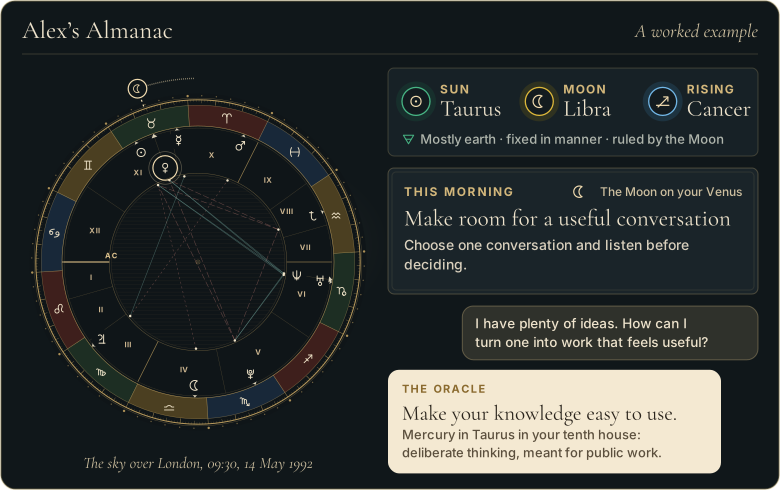
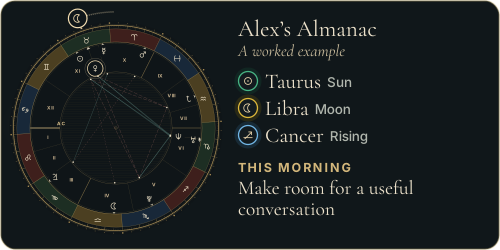
Walk through Alex’s whole example first
 The Road of AgesSee the turning points of your whole life, from your birth date
See your road's shape
The Road of AgesSee the turning points of your whole life, from your birth date
See your road's shape
Prefer to explore first?
 The Road of AgesThe turning points of your whole life, from your own chart
Walk my road
The Road of AgesThe turning points of your whole life, from your own chart
Walk my road
Free, by email
Your daily Almanac letter
One short letter at 7 each morning: the day’s theme read for your own chart, and one thing to do with it.
Quick facts
| Chart area | Career question | Real-world evidence |
|---|---|---|
| 2nd house | What resources, skills, values, and income floor matter? | Savings runway, debt, compensation, transferable skills, and non-negotiable values. |
| 6th house | What work conditions and routines are sustainable? | Tasks, schedule, health needs, commute, team practices, and daily energy. |
| 10th house / MC | What public role, responsibility, or direction is changing? | Occupation requirements, reputation, leadership scope, portfolio, and market demand. |
| 11th house | Which networks and long-term aims support the change? | Mentors, professional groups, referrals, audience, and future opportunities. |
| Transits | When is a natal career factor under symbolic emphasis? | Exact dates, retrograde repeats, concurrent deadlines, and observed developments. |
What transits can and cannot contribute
A transit compares a moving planet with a natal planet or angle. In career reflection, slow contacts to the Midheaven, Sun, Saturn, chart ruler, or vocational house rulers may describe a period when public identity, responsibility, autonomy, meaning, or work structure receives more attention. That can help a person name the question. It cannot determine whether a particular job is available, safe, financially viable, or suited to their skills.
Treat the chart as a question generator. Saturn might ask what responsibility must be accepted or what structure has become unsustainable. Uranus might ask where experimentation or autonomy is overdue. Neptune might ask whether a vocation is meaningful or merely idealized. Pluto might ask about power, control, and irreversible commitments. Jupiter might ask where growth is possible and where scale exceeds capacity. The answers come from life evidence.
Build the career evidence file before reading the timing
- List transferable skills and attach one example or work sample to each.
- Identify interests and work values, then compare them with the actual tasks and conditions of possible occupations.
- Research required credentials, training time, wages, demand, geographic limits, and realistic entry routes.
- Calculate a minimum income floor, transition budget, benefits needs, debt obligations, and emergency runway.
- Interview people doing the work and ask what occupies an ordinary Tuesday, not only what makes the career inspiring.
- Define health, disability, caregiving, family, legal, immigration, and location constraints that the plan must respect.
A chart method for career questions
Start with the natal picture. Read the Midheaven sign and ruler, planets near the Midheaven, the tenth house, and the condition of its ruler. Add the second house for income and values, the sixth for tasks and working conditions, and the eleventh for professional networks and long-range aims. The Sun can describe authorship and visibility; Saturn can describe mastery and duty. No single placement supplies a job title.
Next, calculate only the closest relevant transits. Record aspect, orb, exact dates, retrograde repeats, and houses ruled. A transit to the tenth-house ruler may be more vocationally specific than a dramatic transit elsewhere. Secondary progressions, solar returns, and profections are optional layers; do not pile them on until the natal and transit evidence is coherent.
Turn symbolism into low-risk career experiments

A Saturn period can become a credential audit, portfolio schedule, or boundary around unpaid labor. A Uranus period can become a short contract, new tool, remote-work test, or informational interview outside the usual field. A Neptune period can become volunteer exposure to a meaningful sector plus strict attention to pay, scope, and written agreements. A Pluto period can become a review of authority, ownership, equity, and dependence before any power move.
Experiments create information. Take a course before enrolling in a degree, shadow before resigning, freelance before assuming demand, build a small portfolio before announcing a new identity, and negotiate within the current role before concluding that departure is the only path. A useful transit interpretation changes what you test, not the standard of evidence required to commit.
Worked career-pivot example
Suppose transiting Uranus approaches the Midheaven while Saturn crosses the second house. The symbolic story could be “public reinvention under financial discipline.” A reckless reading says quit immediately because freedom is destined. A practical reading separates two assignments: explore roles with more autonomy and protect the income floor. The person interviews five practitioners, tests contract work on weekends, inventories benefits, and sets a savings threshold.
If the experiment reveals strong demand, enjoyable tasks, and a workable budget, the move gains evidence. If it reveals that only the fantasy was attractive, that is also valuable. Uranus did not fail; the symbolism prompted an experiment. Saturn did not block the future; the financial test prevented a costly leap. The decision remains human and revisable.
Decision gates before a major move
- Role fit: Have I observed the real tasks, culture, and constraints rather than only the title?
- Capability: Do I have evidence of skill, a credible training plan, or a route to supervised practice?
- Market: Is there demand at the location, schedule, and compensation level I require?
- Runway: Can I absorb delays, training costs, benefit changes, taxes, and a failed first attempt?
- Support: Have qualified advisers, trusted people, and affected household members reviewed the plan?
- Timing: Does the real opportunity have a deadline, and am I using astrology to clarify the response rather than invent one?
Career changes can affect income, health insurance, immigration status, family stability, and professional licensing. Use appropriate financial, legal, vocational, and clinical advice where those stakes apply.
Sources and editorial method
Research and editorial references used for this page include:
- Astrodienst Astrowiki: Transit - Defines a transit as a moving body aspecting a natal factor and discusses exactness, recurrence, and practical orb choices.
- CareerOneStop: What is a career assessment? - U.S. Department of Labor resource explaining how skills, interests, and values assessments can support career exploration without making the decision alone.
- Astrodienst: The House System - Explains how houses depend on birth time and location and describes the chart axes used in vocational interpretation.
These references support the factual, historical, textual, or interpretive claims on this page. Interpretive traditions are identified as such, and factual claims are kept separate from symbolic claims.
Related reading
From the reference page to your own chart
Every word here
is in your own chart.
- A personal reading about love, work or purpose, written from your chart
- A practical next step to consider
- It opens with 7 days free, with the AI Oracle and daily guidance
$0 today, then $12/month after 7 days. Cancel anytime.
Common questions
Which transits are associated with career change?
Astrologers often watch slow contacts to the Midheaven, Sun, Saturn, chart ruler, and rulers of the 2nd, 6th, and 10th houses. The actual career evidence remains more important than the symbolism.
Does Uranus on the Midheaven mean I should quit?
No. It may frame questions about autonomy, innovation, or public direction. Test those themes through research and reversible experiments before making a high-cost move.
Can astrology tell me which career to choose?
No. A chart may organize interests, tensions, and timing questions, but occupations require evidence about skills, values, tasks, access, health, money, and labor-market conditions.
What if the opportunity arrives outside an ideal transit?
Evaluate the opportunity on its merits. Real deadlines, evidence, readiness, and consequences should not be subordinated to waiting for a preferred chart pattern.
More from the journal
Free, by email
The Almanac, in your inbox at 7
One short letter at 7 each morning: the day’s theme read for your own chart, and one thing to do with it.
