How to Use Your Birth Chart for Self-DiscoveryA Practical Method
A birth chart becomes more useful for self-discovery when each symbol is treated as a question to test in real life rather than a label to accept on sight.
Direct answer
Short version
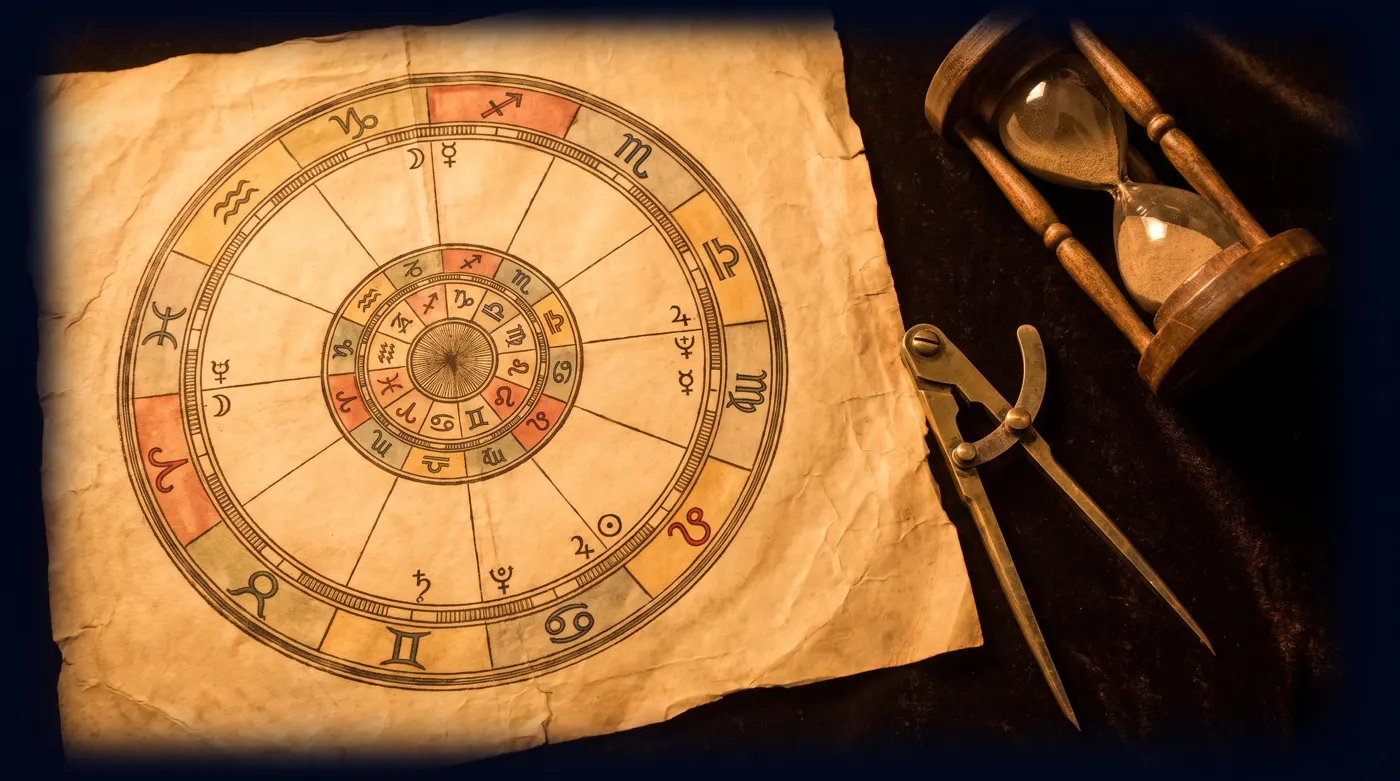
A birth chart can support self-discovery by providing symbols for examining identity, emotional needs, relationships, action, and responsibility. Use an interpretation as a hypothesis: compare it with real behavior, look for evidence against it, and try one small change. Do not use it as a fixed identity, an excuse, or a substitute for qualified assessment. Astrology has not been scientifically validated as a personality test or predictive system, so the responsible goal is reflection rather than proof. Start with accurate birth data, prioritize repeated patterns over isolated placements, and finish with an observable practice you can review.
The Instruments
Ten readings, worked out from your own birth chart
An instrument is a reading this house works out for you. Give your birth date, time and place once, and each one reads today’s real sky against the chart you were born under. Eight are personal; two are calendars anyone can open. A free account opens one instrument a day. The plans open every instrument, every day.
- Natal Chart Every planet, house and aspect in your chart
- Active Transits Where the planets are now, read against your chart
- Daily Counsel What to pursue today, and what to leave alone
- Personal Timing Your best days to decide, weeks ahead
- Fellowship Your chart and another, read side by side
- Theme of the Day The one thing today is asking of you
- Sacred Numbers Your life path, your cycles, your name in numbers
- Aeolian Harmonics Classical music chosen to match your chart
- Mercury Retrograde Every Mercury retrograde this year, with its dates Open to all
- Void-of-Course Moon When the Moon is between signs, hour by hour Open to all






Quick facts
| Question | Direct answer |
|---|---|
| What does a birth chart contain? | Planetary positions, zodiac signs, houses, angles, and aspects calculated for a particular time and place. |
| What data do I need? | Birth date, exact local birth time, and verified birthplace provide the strongest basis for the Ascendant and houses. |
| Where should a beginner start? | Start with the Sun, Moon, Ascendant, chart ruler, angular planets, and patterns that repeat across several placements. |
| Is it a personality diagnosis? | No. A chart is a symbolic interpretive framework, not a validated psychological or medical assessment. |
| How do I avoid vague conclusions? | Write a specific hypothesis, record evidence for and against it, and review an observable behavior or experiment later. |
| What is the goal? | Greater honesty, choice, and responsibility, not certainty, prediction, or a permanent identity label. |
Begin with the most accurate chart you can make
The recorded local time and birthplace anchor the chart to the local horizon used for the Ascendant, Midheaven, and houses. Astrodienst notes that the Ascendant moves quickly enough for a small time difference to affect the result. Use a birth record when possible and let the calculator handle historical time-zone corrections.
If the exact time is unknown, do not invent one and interpret houses or angles as precise. Study placements that remain stable across the possible day and mark uncertain factors clearly.
Read the chart in layers instead of collecting labels
1. Sun, Moon, and Ascendant
Ask about identity and purpose through the Sun, emotional regulation through the Moon, and approach and embodiment through the Ascendant. None is the whole personality.
2. Chart ruler and angular planets
Find the ruler of the Ascendant sign and inspect its sign, house, and aspects. Note planets near the Ascendant, Midheaven, Descendant, or IC.
3. Repeated patterns
Look for several placements emphasizing the same element, modality, house axis, planet, or aspect. Repetition is more useful than one dramatic label.
4. Houses
Use houses to locate the life arena: self, resources, communication, home, creativity, work, partnership, shared obligations, worldview, vocation, community, or retreat.
5. Major aspects
Treat a trine as a possible resource and a square or opposition as a possible tension to investigate, not as automatic ease or damage.
6. Synthesis
Connect the strongest repeated themes in one paragraph. If it could describe almost anyone, make it specific or admit that the evidence is weak.
Turn every interpretation into a testable hypothesis
The safest unit of self-discovery is not “I am this placement.” It is “This placement suggests a pattern I can examine.” A hypothesis should name a situation, a behavior, and an outcome. For example, replace “Mars in the 10th makes me ambitious” with “When my work is publicly evaluated, I tend to act quickly and become argumentative; I will track whether that happens in the next three high-stakes meetings.”
| Worksheet field | What to write |
|---|---|
| Chart factor | The exact planet, sign, house, and aspect being considered. |
| Possible pattern | A specific behavior or need, not a flattering or frightening adjective. |
| Evidence for | Two concrete examples with dates, settings, actions, and consequences. |
| Evidence against | At least one occasion when the predicted pattern did not occur. |
| Gift and cost | What the pattern can contribute and what it can damage when overused. |
| Small experiment | One behavior to try for seven days, followed by a review date. |
Protect the process from vague feedback and confirmation bias
Research on the Barnum effect shows that people readily accept broad personality statements as uniquely accurate, especially when feedback feels favorable or relevant. Flexible symbolic language is vulnerable to this effect. Feeling seen is meaningful, but it does not prove that a statement is specific or true.
Ask what would show an interpretation is wrong. Judge flattering and unflattering readings by the same standard, keep the original wording after the outcome, and ask a trusted person to describe the behavior without astrological language.
- Reject statements that fit nearly everyone, such as being independent but sometimes needing approval.
- Look for base-rate explanations: stress, culture, family learning, age, incentives, sleep, and circumstance.
- Do not count a hit without also recording misses and ambiguous cases.
- Prefer behavior that can be observed over claims about hidden destiny or essence.
Three worked examples
Moon in the 4th House
Hypothesis: emotional steadiness may depend strongly on home conditions, privacy, or family contact. Evidence to track: mood before and after time at home, conflict around belonging, and the effect of a predictable evening routine. Alternate explanations include current housing stress, caregiving, or family history.
Mars in the 10th House
Hypothesis: public work may activate initiative and conflict. Track who starts difficult conversations, how quickly decisions are made, and whether urgency improves or damages results. A useful experiment is pausing before one high-stakes reply without suppressing the underlying point.
Saturn in the 7th House
Hypothesis: close relationships may raise strong questions about duty, boundaries, commitment, or fear of dependence. Track actual agreements and recurring avoidance. Do not assume loneliness, delayed marriage, or a difficult partner from the placement alone.
Use transits only after you know the baseline
A natal chart describes the symbolic baseline; transits describe current contacts to it. First write how the natal pattern usually appears. Then track the event, feeling, choice, and result. This prevents every mood from being assigned to the sky.
Do not confuse sequence with cause. If an event occurs during a transit, it is accurate to say the two coincided. A stronger causal claim requires evidence astrology does not provide. The reflective question is whether the timing prompt helped you notice and handle something more responsibly.
A 30-minute self-discovery practice
- Five minutes: verify the birth data and mark any uncertain chart factors.
- Ten minutes: circle the three strongest repeated patterns rather than the three most dramatic descriptions.
- Ten minutes: complete the hypothesis worksheet for one pattern, including evidence against it.
- Five minutes: choose one seven-day experiment and schedule a review.
At review, keep, revise, or discard the interpretation based on what happened. Discarding a weak interpretation is successful discernment, not failure.
Know when the chart is the wrong tool
- Do not use a chart to diagnose mental or physical health conditions.
- Do not use it to decide whether abuse occurred, whether someone is safe, or whether emergency help is needed.
- Do not replace medical, therapeutic, pastoral, legal, financial, educational, or career expertise with an interpretation.
- Do not stereotype a child, partner, employee, or family member by a placement.
- Do not use symbolism to excuse harmful conduct or avoid a repair that real behavior requires.
A faith-aware reader may add prayer or spiritual counsel after the evidence review. Keep spiritual reflection accountable to truth, conscience, consent, and care rather than using the chart as an authority.
Sources and editorial method
Research and editorial references used for this page include:
- Astrodienst FAQ: Charts: General - Explains the chart drawing, Ascendant, houses, and aspects for a particular time and place.
- Astrodienst FAQ: Birth Time - Explains why recorded time matters for the Ascendant and houses and why hypothetical times remain uncertain.
- Psychological Reports: The Barnum Effect in Personality Assessment - Reviews why people accept vague, general, and favorable personality feedback as personally accurate.
- Nature: A Double-Blind Test of Astrology - Tests claims that natal charts can accurately describe personality traits.
These references support the factual, historical, textual, or interpretive claims on this page. Interpretive traditions are identified as such, and factual claims are kept separate from symbolic claims.
Related reading
Common questions
Which placements should a beginner read first?
Start with the Sun, Moon, Ascendant, chart ruler, angular planets, and repeated patterns. Add Venus, Mars, Saturn, houses, and major aspects afterward.
What if I do not know my exact birth time?
Do not treat the Ascendant, Midheaven, or houses as precise. Use stable placements and label uncertainty instead of presenting a substitute time as exact.
Can my birth chart change?
The natal chart for the recorded time and place does not change. Interpretation and life context can change, while transits describe later periods.
How many placements should I study at once?
One repeated theme is enough. Too many isolated placements make vague matches easier and useful evaluation harder.
How do I avoid confirmation bias?
Record the interpretation first, list contrary evidence, count misses, compare ordinary explanations, and define what would make you reject the claim.
Can a birth chart replace therapy or a personality assessment?
No. Astrology is not a validated clinical assessment and cannot diagnose or treat a condition. Use qualified care and evidence-based tools for those purposes.