
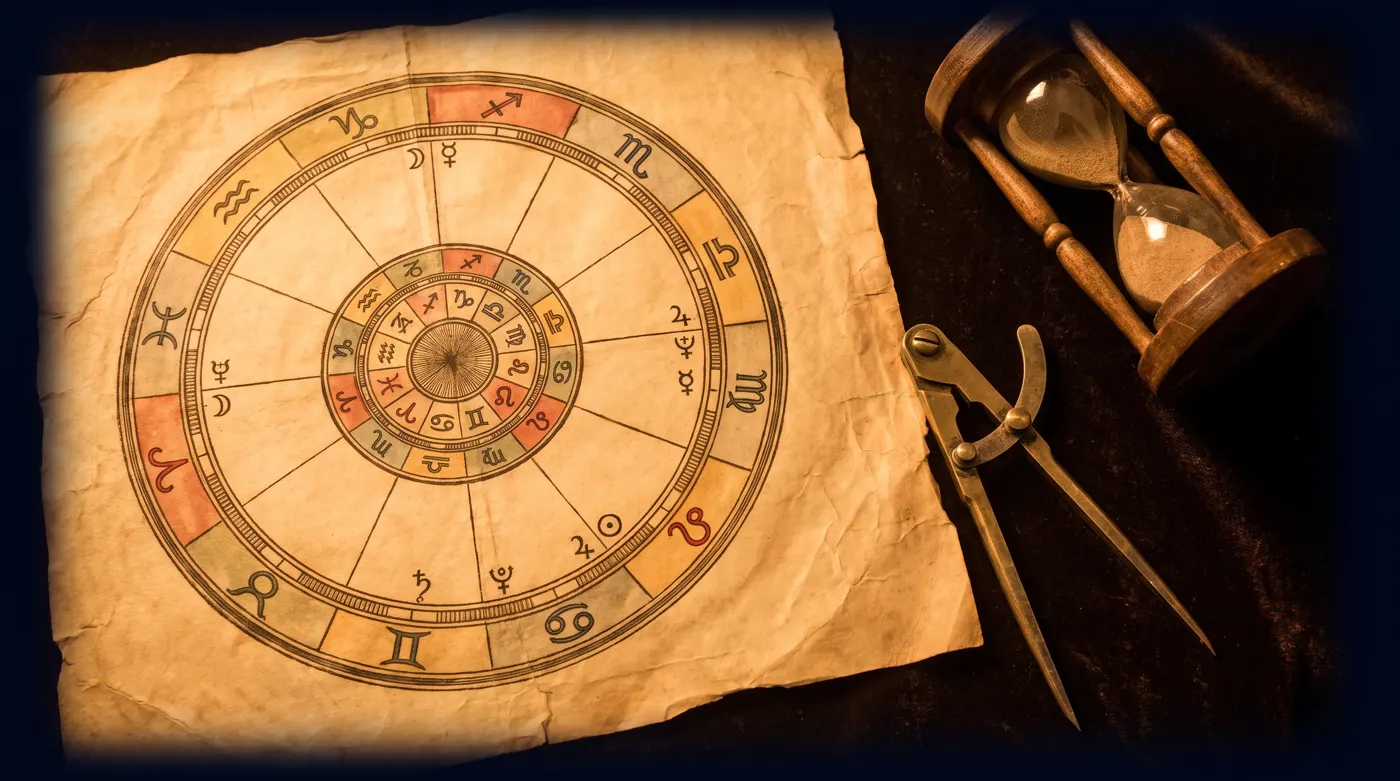
Reading a Chart Without a Birth Time
Most of a chart survives a missing birth time. The houses and the angles do not, and any reading that gives you a rising sign without an hour has invented it.
$0 today, then $12/month after 7 days. Cancel anytime.
Direct answer
Short version
Without a birth time you can still read every planet by sign, almost every aspect between them, the whole of your numerology, and current transits to those planets. You cannot read the Ascendant, the Midheaven, or any house placement, because all three depend on the exact minute the Earth had turned to. A reading that reports them anyway is guessing and should say so.

What does your own chart say about you?
Choose love, work or purpose. Your reading is written from your chart. Your reading uses your own birth details.
Walk through Alex’s whole example first


 The Road of AgesSee the turning points of your whole life, from your birth date
See your road's shape
Prefer to explore first?
 The Road of AgesThe turning points of your whole life, from your own chart
Walk my road
Free, by email
Your daily Almanac letter
One short letter at 7 each morning: the day’s theme read for your own chart, and one thing to do with it.
Visual guide
Reading a Chart Without a Birth Time
What the hour actually decides
The Earth turns once in roughly twenty four hours, which moves the Ascendant through all twelve signs in a day, about one sign every two hours. That is why the hour matters so much: it is not a detail of the chart, it is the frame the whole chart is hung in. Every house cusp follows from it, and so does every statement about which area of life a planet runs through.
What does not depend on the hour at all
The Sun moves about a degree a day, so its sign is certain unless you were born within a day of a cusp. The same holds for Mercury, Venus, Mars and every slower body: their signs and the angles they make to each other barely shift across a whole day. The bulk of a natal reading is built from exactly this material.
The Moon is the honest exception
The Moon travels roughly thirteen degrees a day, so across an unknown twenty four hours it can move half a sign or cross into the next one. A noon chart gives you a Moon that is usually right and occasionally wrong at the boundary. A careful reading names that uncertainty rather than smoothing it over.
How to spot an honest reading
It tells you which parts are unavailable and why. It gives you the signs and the aspects in full rather than padding the gap with generalities. It never reports a house placement from a date alone. And if it offers to rectify the time from life events, it presents that as an interpretive method with a wide margin, not as a recovered fact.
Concrete examples
| Example | What it means in practice |
|---|---|
| A chart with no hour on record | Read the signs, the aspects and the numbers in full, and leave the houses blank rather than filling them. |
| A birth near midnight | Even the date can be uncertain across a time zone. Confirm the civil record before building anything on it. |
| A Moon near a sign boundary | Read both possibilities plainly. Two honest options beat one confident guess. |
Prayerful reflection
Let me be willing to say what I do not know, and let what I do know be enough to act on.
Related Almanac guides
More from the journal
Sources and editorial method
Research and editorial references used for this page include:
- Astrodienst: Transits - Used for the basic definition of transits as current planetary passages over birth positions.
- Astrodienst: The four Elements - Used for the traditional grouping of zodiac signs by element.
This guide distinguishes traditional symbolism from calculated positions. Examples illustrate possible reflections, not predictions about a particular person.
From the reference page to your own chart
Every word here
is in your own chart.
- A personal reading about love, work or purpose, written from your chart
- A practical next step to consider
- It opens with 7 days free, with the AI Oracle and daily guidance
$0 today, then $12/month after 7 days. Cancel anytime.
Common questions
Can I still get a useful reading without my birth time?
Yes. The signs, the aspects, the numerology and current transits are all available and are most of what a reading is built from.
What is chart rectification?
An interpretive method that estimates a birth time from dated life events. It is a reasonable exercise, but the result is an estimate and should never be presented as the recorded hour.
Is a noon chart wrong?
It is right about everything the hour does not decide, which is most of the chart. It is unreliable only for the angles, the houses, and sometimes the Moon.
Free, by email
The Almanac, in your inbox at 7
One short letter at 7 each morning: the day’s theme read for your own chart, and one thing to do with it.


