Best live map
An auroral oval or view-line product, not Kp alone.
Use current Kp as context, then learn why aurora visibility requires an oval forecast, darkness, weather, geomagnetic latitude, and a clear horizon.
$0 today, then $12/month after 7 days. Cancel anytime.
Aurora appears when energetic particles and Earth’s upper atmosphere interact along magnetic-field regions. Kp can indicate broad geomagnetic disturbance, but a useful local plan also needs a current auroral-oval forecast, darkness, weather, and an unobstructed poleward view.
An auroral oval or view-line product, not Kp alone.
Darkness, cloud, haze, light pollution, Moon, and horizon determine practical visibility.
Aurora borealis occurs in the north and aurora australis in the south.
Physical space weather · refreshes hourly
Current instrument readings with their observation time. No personal, medical, or spiritual state is inferred.
Kp is planetary context, not a local aurora forecast. GOES X-ray class is not a geomagnetic-storm forecast. Use the linked NOAA products for operational decisions.
Solar-wind energy can enter Earth’s magnetosphere and accelerate charged particles along magnetic-field lines. Collisions with oxygen and nitrogen high in the atmosphere produce light at characteristic colors. Green is common, while red, violet, and other colors can appear depending on altitude, species, energy, and camera sensitivity.
Auroral occurrence follows magnetic geometry rather than ordinary geographic latitude. Two cities at the same geographic latitude can have different aurora prospects. During stronger geomagnetic activity the oval may broaden and move equatorward, but that is a statistical relationship rather than a fixed promise tied to one Kp number.
Open an official oval or view-line product and confirm its valid time. Check that astronomical twilight has ended or the sky is otherwise dark enough. Review cloud, haze, smoke, and precipitation; identify a safe site away from bright city glow with a clear poleward horizon. Recheck near departure because forecasts and weather can change.
Modern cameras can accumulate faint light and reveal saturation or color that unaided eyes do not see. Use a stable support, manual focus near infinity, a moderately wide lens, and short test exposures. Report honestly whether a view was visual, camera-assisted, or strongly processed so an image does not become a misleading visibility claim.
Aurora and geomagnetic activity are physical phenomena. They can inspire cultural, artistic, or spiritual reflection, but a live Kp value does not establish a cause for a person’s symptoms or emotions. Follow medical guidance for health concerns and official space-weather guidance for operational risks.

Choose love, work or purpose. Your reading is written from your chart. Your reading uses your own birth details.
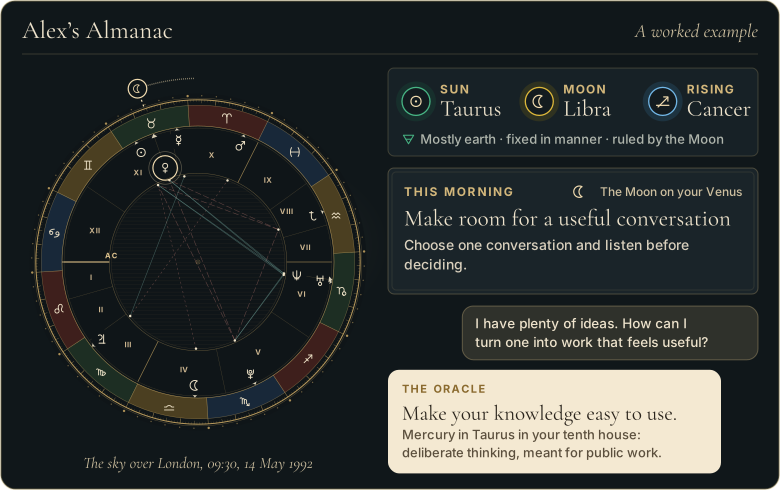
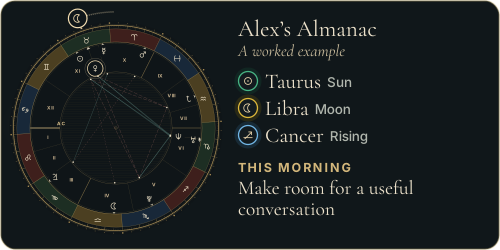
Walk through Alex’s whole example first
 The Road of AgesSee the turning points of your whole life, from your birth date
See your road's shape
The Road of AgesSee the turning points of your whole life, from your birth date
See your road's shape
 The Road of AgesThe turning points of your whole life, from your own chart
Walk my road
The Road of AgesThe turning points of your whole life, from your own chart
Walk my road
Free, by email
One short letter at 7 each morning: the day’s theme read for your own chart, and one thing to do with it.
From the reference page to your own chart
$0 today, then $12/month after 7 days. Cancel anytime.
No. Your geomagnetic latitude, the oval position and valid time, darkness, cloud, Moon, light pollution, and horizon all matter.
A camera can collect light over an exposure and is sensitive differently from low-light human vision, so faint aurora may appear more colorful in an image.
No. It supplies current planetary context and links to NOAA’s location-relevant forecast imagery; it does not have your location or weather.
Free, by email
One short letter at 7 each morning: the day’s theme read for your own chart, and one thing to do with it.

Read more
Keep moving through the archive: signs, compatibility, chart timing, faith-aware discernment, and practical daily guidance.