
Range
Kp 0 is very quiet and Kp 9 is extremely disturbed.
See the current planetary Kp reading and understand its 0-9 scale, three-hour cadence, NOAA storm threshold, and limits for local aurora viewing.
$0 today, then $12/month after 7 days. Cancel anytime.
Kp is a global, planetary index summarizing geomagnetic disturbance in three-hour intervals. Values run from 0 to 9; NOAA geomagnetic storm conditions begin at Kp 5, but a single current Kp value is not a city-level aurora forecast.
Kp 0 is very quiet and Kp 9 is extremely disturbed.
NOAA G-scale geomagnetic storms begin at Kp 5.
Kp represents a three-hour planetary interval rather than an instantaneous reading at one magnetometer.
Physical space weather · refreshes hourly
Current instrument readings with their observation time. No personal, medical, or spiritual state is inferred.
Kp is planetary context, not a local aurora forecast. GOES X-ray class is not a geomagnetic-storm forecast. Use the linked NOAA products for operational decisions.
Kp combines standardized disturbance measurements from a network of mid-latitude geomagnetic observatories into a planetary index. It is valuable because one number offers a broad view of global geomagnetic activity. That compression also removes local detail, so Kp should be read as context rather than a direct measurement over the user’s town.
Low values generally correspond to quiet geomagnetic conditions. Kp 4 is active or unsettled but below NOAA’s G1 storm threshold. Kp 5 corresponds to G1, and higher Kp supports higher G levels through G5 at the extreme end. The exact operational impact language should come from NOAA’s scale, not from invented emotional adjectives.
Stronger geomagnetic disturbance can expand the auroral oval toward lower geomagnetic latitudes. Yet visibility still depends on where the oval is at the relevant time, local darkness, cloud, moonlight, and a clear poleward horizon. Camera sensors may record color where unaided eyes see only a faint pale arc.
A live product may be a recent estimate or nowcast, while later processing can produce a definitive value. Forecasts describe possible future conditions and carry uncertainty. Always retain the product timestamp and label; do not present today’s observation as a guarantee for tonight or tomorrow.
Kp matters to aurora observers and to professionals concerned with satellites, navigation, radio, and power systems. For operational decisions, follow official alerts and procedures. The index does not diagnose headaches, sleep changes, anxiety, or spiritual states, and this almanac does not attach a medical conclusion to it.

Choose love, work or purpose. Your reading is written from your chart. Your reading uses your own birth details.
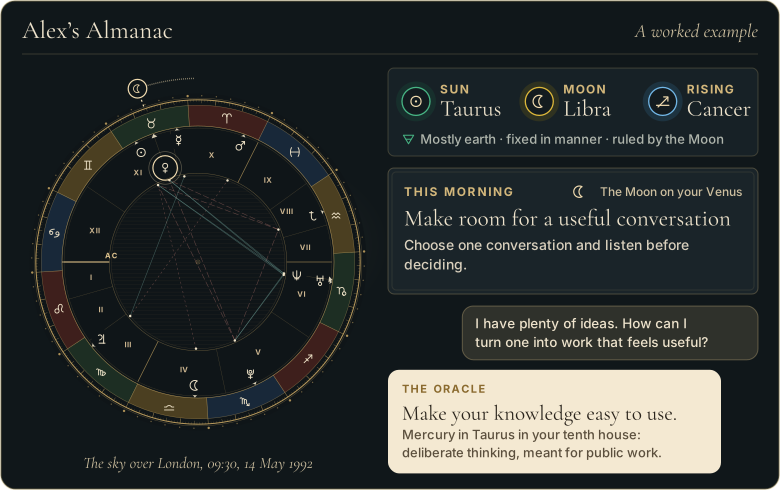
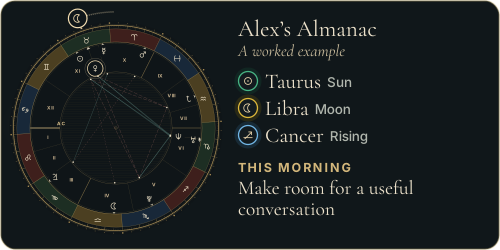
Walk through Alex’s whole example first
 The Road of AgesSee the turning points of your whole life, from your birth date
See your road's shape
The Road of AgesSee the turning points of your whole life, from your birth date
See your road's shape
 The Road of AgesThe turning points of your whole life, from your own chart
Walk my road
The Road of AgesThe turning points of your whole life, from your own chart
Walk my road
Free, by email
One short letter at 7 each morning: the day’s theme read for your own chart, and one thing to do with it.
From the reference page to your own chart
$0 today, then $12/month after 7 days. Cancel anytime.
NOAA’s G scale begins at Kp 5 for G1 conditions. Kp 4 is active but below that storm threshold.
Products may provide recent estimates, but Kp is defined for three-hour intervals and definitive values can be processed later. Check the product label and timestamp.
There is no universal city threshold. Geomagnetic latitude, auroral oval position, darkness, cloud, Moon, and horizon all matter.
Free, by email
One short letter at 7 each morning: the day’s theme read for your own chart, and one thing to do with it.

Read more
Keep moving through the archive: signs, compatibility, chart timing, faith-aware discernment, and practical daily guidance.