
Francis Bacon
1561 to 1626
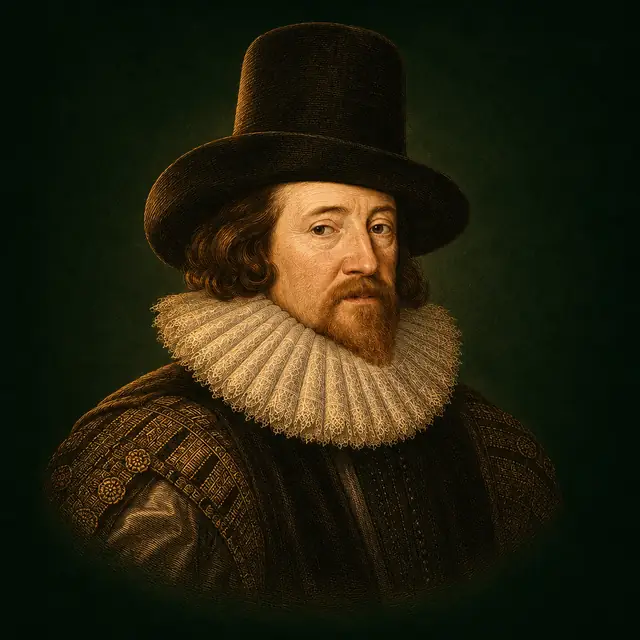
Who was Francis Bacon, and what is truly known of them?
What is known
English lawyer, statesman and philosopher, born in London. He sat in Parliament from 1581, rose under James I to be Attorney General and, in 1618, Lord Chancellor and Baron Verulam, and in 1621 fell: charged with taking gifts from suitors, he confessed, was fined, held briefly in the Tower and barred from office. His Essays (1597), The Advancement of Learning (1605) and Novum Organum (1620) argued that knowledge of nature must be built from ordered experiment and not from old authorities. New Atlantis, printed the year after his death, pictures an island whose college, Salomon’s House, searches out the causes of things. He died in April 1626; John Aubrey’s story is that he took a chill while stuffing a fowl with snow to see if cold would keep it.
The teaching
Taught from his own books, above all the Novum Organum, The Advancement of Learning, the Essays and New Atlantis.
Knowledge and power meet in one
Bacon begins with the purpose of knowing. “Human knowledge and human power meet in one; for where the cause is not known the effect cannot be produced. Nature to be commanded must be obeyed.” Knowledge is to be sought not for argument or for fame but for the glory of the Creator and the relief of man's estate, and it must be governed by charity. His reading of the fall, by the proud knowledge of good and evil and not by the knowledge of nature, is taught on What they share.
The idols of the mind
Four kinds of idols, false images, beset the mind. The idols of the tribe are in human nature itself: the mind is like an uneven mirror that mixes its own nature with the nature of things, sees more order than there is, and is moved more by what affirms than by what denies. When a man was shown in a temple the pictures of those who had made their vows and escaped shipwreck, and was asked whether he did not now own the power of the gods, he asked in turn where they were painted that were drowned after their vows.
The idols of the cave belong to each person: their own nature, education and reading, and the authors they admire. The idols of the market place come from words, which are made for common talk and give names to things that do not exist, or name real things badly. The idols of the theatre are the systems of philosophy, so many stage plays showing worlds of their own invention.
The ant, the spider and the bee
Those who have handled the sciences have been either men of experiment or men of dogmas. The men of experiment are like the ant: they only collect and use. The reasoners are like spiders, who make webs out of their own substance. The bee takes a middle course: it gathers its material from the flowers of the garden and the field, and transforms and digests it by a power of its own. True philosophy works like the bee.
Weights, not wings
The mind leaps from a few particulars to the most general laws and then argues down from them; that is the anticipation of nature, quick and wrong. The interpretation of nature climbs by steps, from particulars to lesser axioms, then to middle ones, and only at the last to the most general. So the understanding must not be given wings but hung with weights, to keep it from leaping and flying. And truth is rightly called the daughter of time, not of authority.
The tables of heat
His method is shown on heat. First comes a table of presence, of every instance in which heat is found: the rays of the sun, lightning, flame, boiling liquids, quicklime sprinkled with water, the insides of animals, horse dung. Then a table of absence in proximity, of cases like these in every way but without heat, such as the rays of the moon. Then a table of degrees, in which heat is more or less. Then exclusion: every nature that is sometimes absent where heat is present, or present where it is absent, is struck off. What remains gives the first vintage of the inquiry: heat is a motion, expansive, held back, and working in the smaller parts of bodies.
Where two causes are both possible, the inquirer looks for a crucial instance, like the finger-post set up where two roads part, which shows by one trial which way the truth lies.
Of prophecies
His essay on prophecies weighs the famous predictions of his time and judges that they ought all to be despised, and serve but for winter talk by the fireside. They have won belief for three reasons: men mark when they hit and never mark when they miss, as they do with dreams; probable guesses and obscure traditions turn themselves in time into prophecies; and almost all of them have been made up by idle and crafty brains after the event.
Natural magic reformed
Natural magic as it stood in his day he finds full of credulity, of tales of sympathies, antipathies and hidden properties, with few works to show for them. A true natural magic would be the working part of the knowledge of forms, bringing about real wonders from real causes. Astrology too should be reformed rather than abolished: let it throw out the fortunes told from nativities and the choosing of lucky hours, and keep the study of what the heavens truly do to the bulk of things, to seasons, weather and the like. His Sylva Sylvarum sets down reports of sympathy, of the force of the imagination and of the weapon salve, and asks of each that it be tried before it is believed.
The wisdom of the fables
The old fables, he holds, were veils over the knowledge of the first ages. Pan is nature: his horns reach to the heavens, his body is shaggy with the things of earth, and his pipe is the harmony of the world. Proteus is matter: bound fast and held, he changes into every shape and at last returns to his own, as matter put under constraint by art shows all its changes and its true nature. Daedalus is the mechanical arts, wonderful and dangerous, which built the labyrinth and gave the thread to find the way out of it.
Salomon's House
New Atlantis pictures such learning organised. On the island of Bensalem stands Salomon's House, and its Father tells the visitors: “The End of our Foundation is the knowledge of Causes, and secret motions of things; and the enlarging of the bounds of Human Empire, to the effecting of all things possible.”
Its fellows divide the work. Merchants of Light sail abroad for books and patterns of experiments; others gather experiments from books and from the mechanical arts, try new ones, draw them into tables, look in them for things of use, direct new trials of a higher light and carry them out; and at last the Interpreters of Nature raise the discoveries into general laws. They meet to decide which discoveries to publish and which to keep back, and they give thanks to God daily for his works.
Of studies
His essay on studies gives the same teaching to a single reader. Read not to contradict and confute, nor to believe and take for granted, but to weigh and consider. “Some books are to be tasted, others to be swallowed, and some few to be chewed and digested.” And “reading maketh a full man; conference a ready man; and writing an exact man.”
Orders and memberships
A member of Gray’s Inn, one of the lawyers’ societies of London, from 1576. No Rosicrucian or Masonic membership is documented. Scholars note likenesses between New Atlantis and the Rosicrucian manifestos; a likeness is all that is shown.
The legend
That he wrote the plays of Shakespeare: the claim was first argued in print in the 1850s, the ciphers offered for it have been shown to prove nothing, and no document supports it. That he was the secret son of Queen Elizabeth, founded the Rosicrucians and the Freemasons, and staged his own death to live on abroad.
Their works
- Novum OrganumBook, printed 1620
The New Instrument, a guide to building knowledge of nature from ordered experiment instead of old authorities. It names the idols of the tribe, the cave, the market and the theatre, the habits of mind that lead us astray, and became a founding text of modern science.
Ask the Oracle about it - EssaysEssay, 1597, enlarged 1625
Short pieces on truth, death, love, envy, gardens and much else, ten at first and fifty eight by the last edition. One essay, Of Prophecies, weighs the famous prophecies of his day and finds most of them made after the event or fitted to it.
Ask the Oracle about it - The Advancement of LearningBook, printed 1605
His survey for James I of all the branches of knowledge, what each had achieved and what was lacking. He treats natural magic and astrology as arts gone astray that could be reformed into true knowledge.
Ask the Oracle about it - The Wisdom of the AncientsBook, printed 1609
A small Latin book reading thirty one Greek myths as veiled teachings about nature and politics: Pan as nature, Proteus as matter, Daedalus as the mechanical arts. It shows him taking part in the old search for meanings hidden in fable.
Ask the Oracle about it - New AtlantisNovel, printed 1627
An unfinished tale of sailors who reach an unknown island in the Pacific, where a college called Salomon’s House searches out the causes of things for the good of all. Scholars note its likeness to the Rosicrucian manifestos, and the Royal Society took it as a model.
Ask the Oracle about it - Sylva SylvarumBook, printed 1627
A natural history of a thousand experiments and observations, printed after his death, many of them on sympathy and antipathy, the force of the imagination and the weapon salve, which he records with caution.
Ask the Oracle about it
How the house tells a life
This life is told from the record, with what is documented, what is legend and what was forged kept apart. A membership in an order is stated only where documents show it. A person’s chart explains none of their deeds.
The arts it feeds
Lives near it in time
Thinkers and teachers
Niccolò MachiavelliIgnatius of LoyolaTeresa of ÁvilaJohn of the CrossTycho BraheGiordano BrunoTommaso CampanellaJohannes KeplerJakob BöhmeAthanasius KircherRobert BoyleEmanuel SwedenborgThe whole tree

