

Mystical systems
Atlantis
Direct answer
Atlantis is the island power described by Plato about 360 BCE, said to have fought an early Athens and sunk in a day and a night. No earlier source mentions it.
$0 today, then $19/month after 7 days. Cancel anytime.
At a glance
- Found in
- Mystical Systems
- Related
- Timaeus and Critias, Lemuria, The Land of Mu, Doggerland
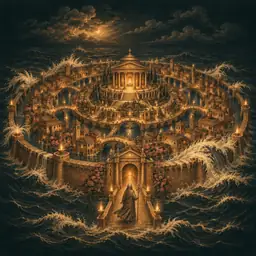

Atlantis is the island power described by Plato about 360 BCE, said to have fought an early Athens and sunk in a day and a night. No earlier source mentions it.
A lineage map for books and systems; it avoids presenting symbolic traditions as literal fact.
Understand the chapter you are in.
Your life’s turning points, measured from your birth.
Walk through Alex’s whole example first


Prefer to explore first?
 The Road of AgesThe turning points of your whole life, from your own chart
Walk my road
Was Atlantis a real place?
Atlantis first appears in two dialogues of Plato, the Timaeus and the Critias. An Egyptian priest is said to have told the Athenian Solon of an island beyond the Pillars of Heracles, larger than Libya and Asia together, ruled by kings descended from Poseidon. Nine thousand years before Solon it tried to conquer the Mediterranean, was defeated by Athens and was swallowed by the sea.
Plato tells it as part of an argument about the ideal city, and the Critias breaks off in the middle of a sentence. The Atlantis of modern books, with its crystals, pyramids and survivors, was added by later writers, most of all Ignatius Donnelly in 1882.
On the tree of the hidden arts: Lost worlds.
What sets Atlantis apart
What marks Atlantis out among lost lands is that its whole ancient record fits on a few pages, and those pages are a philosopher's set piece. Plato gives exact figures, a plain of 3,000 by 2,000 stadia, rings of water of measured width, a navy of 1,200 ships, and exactness of that kind is a habit of his invented cities. The tale also has a moral shape that real catastrophes lack: pride, a war against a virtuous city, and punishment by the gods.
- First told: Plato, Timaeus and Critias, about 360 BCE
- Date given in the tale: nine thousand years before Solon, about 9600 BCE
- Place given: beyond the Pillars of Heracles, in the Atlantic
- Modern legend: Ignatius Donnelly, Atlantis: The Antediluvian World, 1882
- Physical evidence: none: no ruins, and no sunken landmass on the mapped ocean floor
Often mistaken for something else: Doggerland is a real drowned land, covered slowly and known from finds; Atlantis is a story of a sudden end, known only from Plato.
The story behind Atlantis
Ancient writers disagreed over whether Plato meant it as history; Aristotle is reported to have said that the man who made the island also sank it. Renaissance authors placed it in the newly found Americas. Donnelly's Atlantis: The Antediluvian World of 1882 argued that all early civilisations came from it, Helena Blavatsky put it into Theosophy in 1888, and Edgar Cayce described it in trance from the 1920s. Searches have named dozens of sites, none accepted by archaeologists.
Why Atlantis matters
Atlantis is the pattern for every later lost continent, and tracing how a few pages of Plato grew into a library shows how such legends are made.
How to read Atlantis
Readers treat it as a test case: each claim about Atlantis is set beside the two dialogues to see whether Plato said it or a later author did.
Atlantis in practice: an example
A reader who hears that Atlantis had flying machines can open Plato and see that he describes triremes, horses and bronze.
Where readings of Atlantis go wrong
Placing Atlantis on a map is guesswork; no excavation has found it, and no hidden truth about it is being kept back.
Sources and editorial method
This entry summarizes the tradition in the Almanac's own words; where no source is listed, it is an editorial summary rather than a primary text, and symbolic readings are named as the tradition's, not as fact.
Atlantis is first told by Plato about 360 BC, as part of an argument, and no drowned continent has been found.
- Source
- The Great Almanac Dictionary
- Category
- Mystical Systems
- Aliases
- atlantis myth, lost city of atlantis, atlantis plato, was atlantis real
- Last updated
- 2026-09-26
See Atlantis in your personal almanac
A definition tells you what it is; your own birth chart tells you what it means for you. The Oracle casts your real chart and answers for your love, your work, and your year ahead, in conversation. It opens with the 7-day Oracle trial.
Speak with the OracleRelated terms
More in Mystical Systems
From the reference page to your own chart
Every word here
is in your own chart.
- Your life’s turning points, measured from your birth
- A practical next step to consider
- It opens with 7 days free: the AI Oracle on thirty hidden arts, and your daily horoscope
$0 today, then $19/month after 7 days. Cancel anytime.
Common questions
Was Atlantis a real place?
No evidence shows that it was. The only ancient source is Plato, who uses it in an argument about the ideal city, and no drowned continent or matching ruins have been found. Most classicists read it as a fable.
Where does the story of Atlantis come from?
From Plato's dialogues Timaeus and Critias, written about 360 BCE. Plato says the tale came from Egypt by way of the Athenian lawgiver Solon, but no Egyptian or earlier Greek text mentions it.
Did the eruption of Thera inspire Atlantis?
Possibly in part. The eruption about 1600 BCE buried a Bronze Age town on Santorini, and some scholars think memories of it coloured the tale. Others point out that the date, size and place Plato gives do not fit.


