

Mystical systems
Wicca
Direct answer
Wicca is a modern pagan religion, first made public in England in 1954, that honours a goddess and a god, keeps eight seasonal festivals and practises ritual it calls magic.
$0 today, then $19/month after 7 days. Cancel anytime.
At a glance
- Also called
- modern witchcraft religion
- Found in
- Mystical Systems
- Related
- Wheel of the Year, Witchcraft, Witch, Book of Shadows
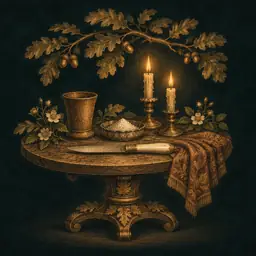

Wicca is a modern pagan religion, first made public in England in 1954, that honours a goddess and a god, keeps eight seasonal festivals and practises ritual it calls magic.
A lineage map for books and systems; it avoids presenting symbolic traditions as literal fact.
Understand the chapter you are in.
Your life’s turning points, measured from your birth.
Walk through Alex’s whole example first


Prefer to explore first?
 The Road of AgesThe turning points of your whole life, from your own chart
Walk my road
What is Wicca?
Wicca is a religion of nature and season. Most Wiccans honour a goddess linked with the Moon and the earth and a god linked with the Sun and the wild, though some treat these as faces of one divinity or as symbols. They mark the eight festivals of the wheel of the year and the full moons, in small groups called covens or alone. Ritual takes place in a circle marked out for the occasion, with invocations, shared food and often a working toward some end.
There is no central authority and no scripture. Traditions differ: Gardnerian and Alexandrian Wicca initiate by degrees, while many followers today are solitary and self-taught. A common ethical summary is the Wiccan Rede, an instruction to harm none.
On the tree of the hidden arts: Magic and protection.
What sets Wicca apart
Wicca is unusual among religions in having a documented beginning within living memory and no founder's text that binds anyone. Each coven, and now each solitary practitioner, keeps its own book of rituals, traditionally copied by hand. Its theology is equally open: members may be polytheists, pantheists or agnostics who value the rites. What holds it together is practice, the circle, the eight festivals and the phases of the Moon, more than any creed.
- Made public: Gerald Gardner, Witchcraft Today, 1954
- Liturgy shaped by: Doreen Valiente, in the 1950s
- Ethical line: the Wiccan Rede: harm none
- Working group: the coven, by tradition of up to thirteen
- To America: Raymond Buckland, 1964
- Standard history: Ronald Hutton, The Triumph of the Moon, 1999
Often mistaken for something else: The witch of the old trials was a person accused by others of harm; a Wiccan witch is a person who has chosen a religion and a name.
The story behind Wicca
Gerald Gardner announced the religion in Witchcraft Today in 1954, and Doreen Valiente shaped its liturgy with him. Alex Sanders founded a second line in the 1960s. Raymond Buckland took it to the United States in 1964, where it met the women's movement and the environmental movement and grew. The historian Ronald Hutton showed in 1999 that its rites were assembled in the twentieth century from older materials.
Why Wicca matters
Wicca is the largest of the modern pagan religions, and it changed the common meaning of the word witch from an accusation to a chosen name.
How to read Wicca
Readers meet it in bookshops, in film and among friends, and need to tell it apart from the witchcraft of the trials and from folk magic.
Wicca in practice: an example
A person who lights a candle at each of the eight festivals, and reads from a book of rituals they have gathered, is practising Wicca in its solitary form.
Where readings of Wicca go wrong
Wicca is a living faith and is told here with respect. The house performs no rite from it, and no working aimed at another person is given.
Sources and editorial method
This entry summarizes the tradition in the Almanac's own words; where no source is listed, it is an editorial summary rather than a primary text, and symbolic readings are named as the tradition's, not as fact.
- Source
- The Great Almanac Dictionary
- Category
- Mystical Systems
- Aliases
- wiccan, wiccans, wicca religion, modern witchcraft religion, gardnerian wicca, what is wicca
- Last updated
- 2026-09-26
See Wicca in your personal almanac
A definition tells you what it is; your own birth chart tells you what it means for you. The Oracle casts your real chart and answers for your love, your work, and your year ahead, in conversation. It opens with the 7-day Oracle trial.
Speak with the OracleRelated terms
More in Mystical Systems
From the reference page to your own chart
Every word here
is in your own chart.
- Your life’s turning points, measured from your birth
- A practical next step to consider
- It opens with 7 days free: the AI Oracle on thirty hidden arts, and your daily horoscope
$0 today, then $19/month after 7 days. Cancel anytime.
Common questions
What is Wicca?
A modern pagan religion that honours a goddess and a god, follows the cycle of the seasons, and practises ritual in a circle. It has no central church or scripture.
Is Wicca an ancient religion?
No. It was made public in 1954 and its rites were put together in the twentieth century, though it draws on older folklore, ceremonial magic and seasonal customs.
Is Wicca the same as witchcraft?
Not exactly. Wicca is one religion whose members often call themselves witches. Witchcraft is a far wider word that also covers folk magic and the charge made in the old trials.


