

Mystical systems
Wheel of the Year
Direct answer
Wheel of the Year: The wheel of the year is the cycle of eight seasonal festivals observed by Wiccans and many other modern pagans, spaced about six weeks apart through the year.
$0 today, then $19/month after 7 days. Cancel anytime.
At a glance
- Also called
- eight sabbats, wiccan sabbats, sabbats
- Found in
- Mystical Systems
- Related
- Wicca, Witchcraft, Book of Shadows
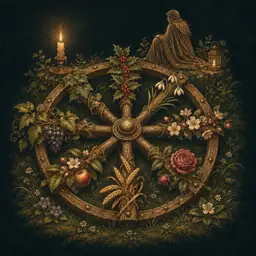

The wheel of the year is the cycle of eight seasonal festivals observed by Wiccans and many other modern pagans, spaced about six weeks apart through the year.
A lineage map for books and systems; it avoids presenting symbolic traditions as literal fact.
Understand the chapter you are in.
Your life’s turning points, measured from your birth.
Walk through Alex’s whole example first


Prefer to explore first?
 The Road of AgesThe turning points of your whole life, from your own chart
Walk my road
What are the eight festivals of the wheel of the year?
The wheel of the year joins two sets of four. The first is the turning points of the Sun: the winter solstice, the spring equinox, the summer solstice and the autumn equinox. The second is the four days that fall roughly midway between them, taken from the old Irish calendar: Samhain at the start of November, Imbolc at the start of February, Beltane at the start of May and Lughnasadh at the start of August.
Each festival has its own theme, such as the return of light at midwinter or the first harvest in August, and modern pagans mark them with a ritual, a meal or a walk. The dates given are for the northern lands where the scheme arose, and pagans in southern lands usually turn the wheel by six months.
On the tree of the hidden arts: Magic and protection.
What sets Wheel of the Year apart
The wheel is a piece of deliberate design. A coven of witches in England, which had kept four festivals, took up all eight in 1958, and a Druid order founded in 1964 did the same, giving an even rhythm of about six and a half weeks. The solar four move by a day or so each year and the other four are fixed by custom to the first days of November, February, May and August. Their themes follow the farming year of north-western Europe, which is why pagans elsewhere adapt or reverse them.
- Cross-quarter days: Samhain, Imbolc, Beltane and Lughnasadh
- Solar points: the two solstices and the two equinoxes
- Taken up as eight: by Wiccans in England in 1958, by Druids from 1964
- Names Litha and Mabon: proposed by Aidan Kelly in the 1970s
- Old sources: medieval Irish texts for the four quarter days
- Spacing: about six and a half weeks between festivals
Often mistaken for something else: The church year turns on the life of Christ and the saints; the wheel of the year turns on the Sun's course and the farming seasons.
The story behind Wheel of the Year
The four Irish quarter days are attested in medieval Irish texts, and midsummer and midwinter customs are far older than any pagan revival. The set of eight is modern. Gerald Gardner's Wiccans, who had kept four, took up all eight in 1958, and Ross Nichols adopted the same eight for the Druid order he founded in 1964. The names Litha, Mabon and Ostara for three of the solar festivals were proposed by the American writer Aidan Kelly in the 1970s.
Why Wheel of the Year matters
Wheel of the Year gives modern paganism a shared calendar, and its history shows plainly how old customs and new design were joined.
How to read Wheel of the Year
Readers keep it as a way of noticing the year, with a candle, a meal or a walk at each turn, whatever their beliefs.
Wheel of the Year in practice: an example
A household that lights a fire on the first of May and bakes bread at the start of August is keeping two points of the wheel, Beltane and Lughnasadh.
Where readings of Wheel of the Year go wrong
The eightfold wheel is a design of the twentieth century and was not the calendar of any ancient people. Fires are lit outdoors with care, or not at all.
Sources and editorial method
This entry summarizes the tradition in the Almanac's own words; where no source is listed, it is an editorial summary rather than a primary text, and symbolic readings are named as the tradition's, not as fact.
- Source
- The Great Almanac Dictionary
- Category
- Mystical Systems
- Aliases
- eight sabbats, pagan wheel of the year, wiccan sabbats, sabbats, wheel of the year festivals
- Last updated
- 2026-09-26
See Wheel of the Year in your personal almanac
A definition tells you what it is; your own birth chart tells you what it means for you. The Oracle casts your real chart and answers for your love, your work, and your year ahead, in conversation. It opens with the 7-day Oracle trial.
Speak with the OracleRelated terms
More in Mystical Systems
- Athanor
- Corpus Hermeticum
- Forbidden Fruit
- Initiation
- Metatron's Cube
- Platonic Solids
- Sedona Vortex
- Teresa of Avila
From the reference page to your own chart
Every word here
is in your own chart.
- Your life’s turning points, measured from your birth
- A practical next step to consider
- It opens with 7 days free: the AI Oracle on thirty hidden arts, and your daily horoscope
$0 today, then $19/month after 7 days. Cancel anytime.
Common questions
What are the eight festivals of the wheel of the year?
Samhain, the winter solstice or Yule, Imbolc, the spring equinox, Beltane, the summer solstice, Lughnasadh and the autumn equinox.
Is the wheel of the year ancient?
Its parts are: the Irish quarter days and the solstice customs are old. The joining of them into one wheel of eight dates from the 1950s.
Where do the names Mabon and Litha come from?
They were suggested by the American writer Aidan Kelly in the 1970s. Mabon is a figure of Welsh legend, and Litha is an Old English name for the midsummer months recorded by Bede.


