
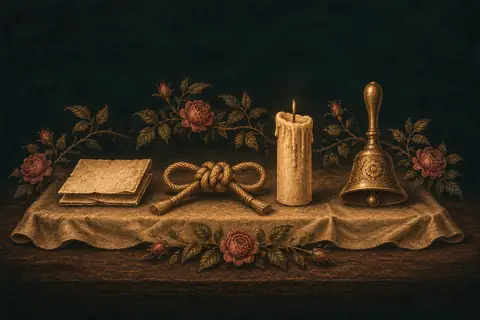
How a working is built
Intention, image, word and act, repeated: the four parts most traditions share.
How do the traditions say a spell or ritual is built, part by part?
Magic is the name the traditions give to a working of intention: an image held, words spoken, an act done. The house tells it as belief and practice, never as proven fact, and so that you are steadier, not afraid.
How workings are held to work, and how to stand steady
Ask the OracleHow do spells and rituals work, and how do I keep myself protected?
Magic, in the sense the traditions use, is a working of intention: an image held in the mind, words spoken, an act done, and often an object made to carry the wish. It runs from the curse tablets and amulets of Greece and Rome through the medieval books called grimoires to the lodges of the nineteenth century. Protection is its commonest purpose. Most of the charms that survive were made to keep harm out, not to send it.
The house tells all of this as belief and practice. Historians and anthropologists document what people did and why; no test has shown that a rite changes events at a distance. What is well shown is that fear does harm of its own, and that a familiar rite can calm the person who performs it. So these pages explain, and they are written so that a reader ends steadier and not more afraid.
As the magical tradition of the learned and the folk teaches it.
Every school of magic rests on one picture of the world: it is a single whole whose parts answer one another, so that a thing done here with intention is held to reach there. The oldest form of the idea is sympathy. In this teaching things that are alike act on one another, so that an image works on what it pictures, and things that have once touched stay joined, so that a lock of hair or a worn glove still belongs to its owner. Curse tablets, folk charms and the knotted cords sold to sailors for a wind all reason this way.
The learned magic of the Renaissance gave the same idea a ladder. Agrippa opens his Three Books of Occult Philosophy with a threefold world, elemental, celestial and intellectual, the last the world of angels and of God, in which every lower thing is ruled by a higher and receives its virtue from it. The powers of the Maker come down by degrees, through angels, heavens and stars into the elements, and so into animals, plants, metals and stones; and the wise, he teaches, may climb back up by the same degrees to the first cause of all.
From the three worlds come the three parts of the learned art. Natural magic works with the hidden virtues of stones, plants and animals; celestial magic works with the stars and with number; ceremonial magic turns to the angels and to God. Agrippa asks of anyone who would study it a grounding in natural philosophy, in mathematics and in theology, one science for each part.
Beside the learned art stand its neighbours, and a student learns early which of them a rite belongs to, because each understands its rites in its own way. The folk craft of charms, guards and customs needs no book and speaks in the words of the household's faith. The faiths keep their own rites of blessing and guarding, such as the mezuzah, holy water, the psalm said before sleep and the Throne Verse; they count these as prayers and commandments and not as workings, though popular belief has often used them as charms. And the modern religion of Wicca draws on the learned and the folk alike for its circle and its seasons.
The art teaches that the force of a working does not belong to the one who works it. The books of Solomon arm the operator with the names of God and the seals of the king, and place the power in the names, not in the mouth that speaks them. Folk charms speak in the words of the church, with Christ or a saint meeting the sickness on the road and sending it away. In the theurgy of Iamblichus the gods act through the rite and are never compelled by it. Even the modern schools, which speak of will in place of names, hold that the will must be trained before it can be trusted.
So the operator is made fit for the work: by prayer, washing and plain living in the grimoires, and by daily practice in holding the mind on one point in the lodges. The careful teachers of every school set the same limit, that no fast, vigil or exercise is pushed until it harms the body or unsettles the mind. How a working is built gives the preparation and its limits in full.
A working has four parts, and the spell books of Roman Egypt, the books of Solomon and the rituals of the lodges agree on them. There is an intention, single and plainly stated; an image that stands for it, a figure, a knot, a candle or a sign; a word said with authority; and an act that carries the rest, done at a fitting time and usually repeated. The time is read from the heavens, each planet with its day and hour, the Moon waxing for what is to grow and waning for what is to lessen. A working is opened with care, closed with thanks and a clearing, and written down afterwards, so that its maker judges by the record and not by hope.
The four parts are taught in order on the page of how a working is built. The image made into an object or a sign is taught on the page of talismans and sigils, and the long operations of the old books on the page of the grimoires.
Most of the charms that survive were made to keep harm out, and every act of protection begins with a line. A home, a body or a holy place is marked as inside, and what is unwanted is turned back at its edge: at the door and the threshold, the window, the hearth and the cradle, the places where inside meets outside. The magician's circle is the same line drawn on the floor, and the banishing of the lodges clears the space within it before any other work and after it.
Three kinds of object serve the line, and a student keeps their names exact. An amulet guards, and only guards. A talisman is made under a chosen sky to draw an influence. A sigil is a drawn sign that stands for a name or a wish. Protection and cleansing teaches the line and its rites, and the evil eye the commonest harm feared and the guards set against it.
The line every tradition draws through magic itself runs between asking and compelling. White magic, in the old telling, prays, blesses, heals and guards, and leaves the outcome to a higher will. Black magic tries to force a spirit or a person, seeks power over others or their harm, and works in hiding. Iamblichus set theurgy, god-work, against goeteia, the sorcery of the marketplace; the Torah forbids the enchanter and the necromancer; the Qur'an says of the sorcery taught at Babylon that people learned from it what harmed them and did not profit them; the Wiccan Rede allows whatever harms none.
However the schools differ, they set the black art at the same point, the attempt on another person's will. White and black magic gives the line and the tests by which each tradition tells the two apart.
The art also teaches about the harm people fear. A curse, in the old understanding, is the reverse of a blessing, a word said with the whole will in the name of a power to call harm down; the evil eye needs no word at all, only a look of envy. The faiths answer both in the same order. First comes justice: a curse without a cause does not land, as the Book of Proverbs says of the swallow and the wandering bird. Then comes blessing returned for cursing. And last the teaching that fear is itself the danger, for the sorcerers, the Qur'an says, harm no one except by God's leave.
From this the house keeps its rule. No reader is told that a curse lies on them or who might have sent one, and whoever offers to lift a curse for money has a reason to find one. Curses and fear teaches the lore and the faiths' answers in full.
Each school sets a first lesson, and none of them is a spell. Agrippa begins with study, of nature, of the heavens and of the things of God. The Golden Dawn gave its Neophytes the Hebrew letters, the symbols of the elements, planets and signs, and a daily rite of clearing. The cunning folk learned their charms from their families and from a printed book or two, and the faiths begin with prayer.
A reader can begin where the schools agree and nothing is risked. Keep a book of intentions, with the date, the wish and what followed. Write one wish as a single plain sentence about your own conduct, which is harder than it sounds and often shows what is really wanted. At the close of the day, stand at your own door and say in your own words, or in a prayer of your own faith, that this is your home and you are at peace in it. A candle is never left burning in an empty room, smoke goes with an open window, and nothing from a charm book is eaten, drunk or put on the skin.
Two rules stand over all of it. A threat from a living person goes to the lock, the neighbours and the police, as the faiths themselves teach when they tell a man to tie his camel and then trust. And fear, voices or a sense of being controlled that does not lift is a matter for a doctor.
The branches follow the art's parts and its people. How a working is built, and white and black magic, teach the frame: the parts of every working and the line through all of them. Protection and cleansing, the evil eye, curses and fear, and talismans and sigils teach the guards and the fears they answer. The grimoires, and ceremonial and chaos magic, follow the learned line from the books of Solomon to the lodges and their heirs. Cunning folk and folk magic, Wicca and the modern craft, and the witch trials tell of the people: the village craft, the modern religion, and what accusation did when neighbours turned on neighbours.
The Oracle explains these traditions as belief and practice, not as proven fact. It will never tell you that you are cursed, or name anyone as the cause. If someone is threatening you, that is for the police. If fear, voices or a sense of being controlled stays with you, please see a doctor.
Each one is a question you can ask.
Intention, image, word and act, repeated: the four parts most traditions share.
How do the traditions say a spell or ritual is built, part by part?
Salt, smoke, prayer and the threshold: what protective rites are, and what they steady.
What are the old rites of spiritual protection and cleansing, and what do they really do for a person?
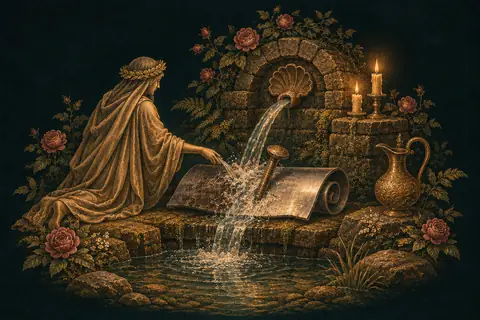
Why the fear of a curse does real harm, whether or not a curse does.
What is a curse in the traditions, and how do I stop being afraid of one?
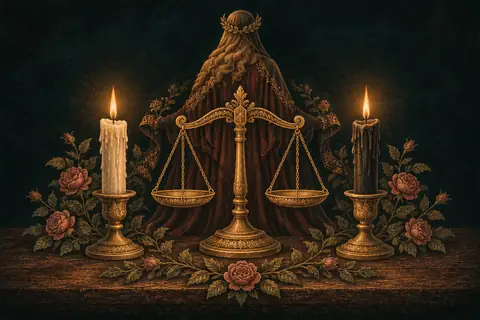
An old distinction of intent: to help or to harm, to ask or to compel.
What is the difference between white magic and black magic, and how do I recognise the black so I can stay clear of it?
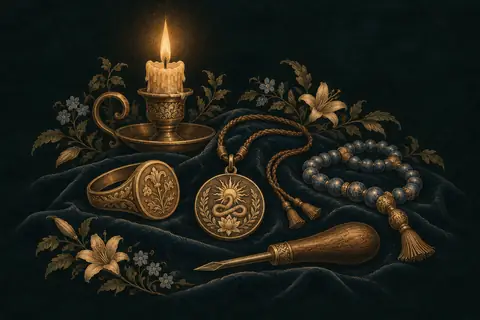
A wish made into a sign or an object: the oldest and gentlest kind of working.
What are talismans and sigils in ritual magic, and how are they held to work?
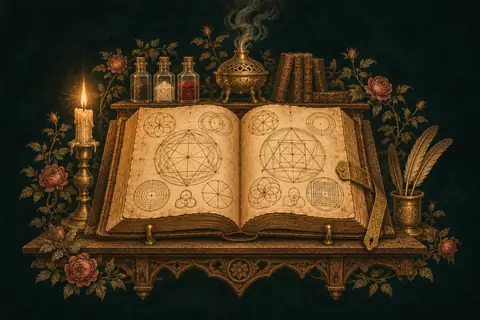
The books of magic, from the Key of Solomon to the Golden Dawn: who wrote them, and when.
What are the grimoires, the old books of ritual magic, and what is truly known of them?
Who was accused, by whom and why, in the three centuries when Europe put its neighbours on trial.
What truly happened in the witch trials, and who were the people accused of witchcraft?
A religion of the twentieth century, made public in England in 1954, and what it draws on.
What is Wicca, where does it truly come from, and what do its members believe?
The village charmers and rootworkers people turned to, long before any book of ceremony.
Who were the cunning folk, and what was folk magic in daily life?
The belief that an envious look can harm, and the beads, hands and blessings set against it.
What is the evil eye, where is the belief found, and how do people guard against it?
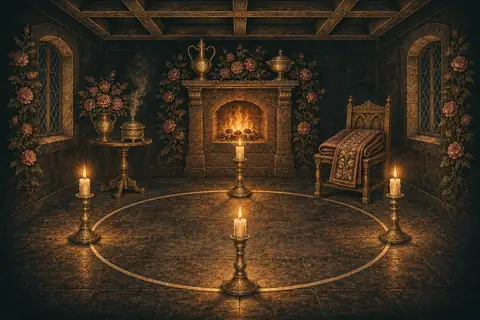
The lodge magic of the Golden Dawn, and the stripped-down school that reacted against it.
What is ceremonial magic, and how does chaos magic differ from it?
Each opens its page in the dictionary.
 Sympathetic Magic
 Theurgy
 Banishing
 Evil Eye
 Curse Tablet
 Nocebo Effect
 Talisman
 Sigil
 Grimoire
 Amulet
 Greek Magical Papyri
 Witch Trials
 Malleus Maleficarum
 Maleficium
 Wicca
 Wheel of the Year
 Cunning Folk
 Hoodoo
 Nazar
 Ceremonial Magic
 Chaos Magic
English occultist, poet and mountaineer. He wrote The Book of the Law in Cairo in 1904 and founded on it the religion of Thelema, whose law is “Do what thou wilt”. He ran the Abbey of Thelema in Sicily from 1920 until Italy expelled him in 1923. He struggled with heroin for much of his later life and died in Hastings.
French writer, born Alphonse-Louis Constant, who trained for the Catholic priesthood and left before ordination. His Dogme et Rituel de la Haute Magie (1854 to 1856) shaped modern occultism: he tied the twenty-two tarot trumps to the Hebrew letters and drew the goat-headed figure of Baphomet as an emblem of balanced opposites.
The wizard of the Arthurian stories. Geoffrey of Monmouth made him about 1136, joining a Welsh prophet-bard, Myrddin, to the tale of a wonder-child without a father. He foretells the kings of Britain, brings about Arthur’s birth, and in the French romances is at last shut away by the woman he taught, Nimue or Viviane.
English mathematician, astrologer and adviser to Elizabeth I, for whose coronation in 1559 he chose the day. He owned one of the great libraries of England. From 1582, with the medium Edward Kelley, he recorded long “conversations with angels” and the language later called Enochian. He died poor, at Mortlake or in London.
Al-KindiCornelius AgrippaFrancis BarrettMarie LaveauMacGregor MathersMargaret MurrayGerald GardnerAustin Osman SpareDion FortuneDoreen ValienteCirceMorgan le FayThe Sorcerer’s ApprenticeSimon MagusJohannes TrithemiusFranz BardonJack ParsonsAnton LaVeyIdries ShahSolomon and the demonsDraculaApollonius of TyanaApuleiusIamblichusMichael ScotAlbertus MagnusArnald of VillanovaGiacomo CasanovaPadmasambhavaLilithStanislas de GuaitaIsrael Regardie
The spirit realmTarot, runes, I ChingThe Tree of LifeOrders and mystery schoolsSacred placesSymbols
Spiritual Warfare and DeliveranceSearch the treeThe whole tree
Make today specific
The same sky reaches everyone differently. Your birth details turn a general forecast into one theme, and one thing worth doing about it.
One instrument, one answer. Explore the preview; membership opens every tool.
Read more

