
Cunning folk and folk magic
The village charmers and rootworkers people turned to, long before any book of ceremony.
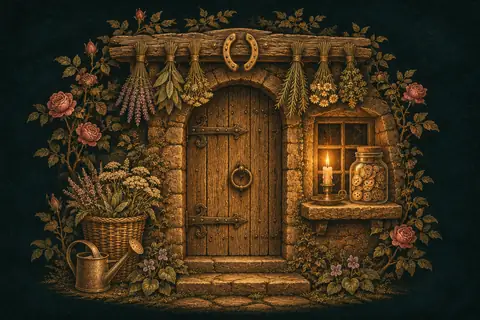
Who were the cunning folk, and what was folk magic in daily life?
What it is
Most magic in history was not learned from books of ceremony. It was the charm against a toothache, the horseshoe over the door, the hag stone hung in the stable, the words said over a burn, and the local person people went to when something was lost or someone was ill. In England such people were called cunning folk or wise women, and other lands had their own names. They found stolen goods, read fortunes, made charms and claimed to undo a witch's harm. In the American South the tradition called hoodoo, or rootwork, grew among enslaved Africans and their descendants from African, Native and European sources.
The teaching
As the folk craft of the cunning folk, the charmers and the rootworkers teaches it.
Charms in the old faith's words
Folk magic in Christian Europe spoke the language of the church. Its charms were prayers, scraps of scripture and holy names, often with a little story at their heart: Christ or a saint met a sickness on the road and sent it away, and as it was then, so let it be now. They were said three times and ended with the names of the Father, the Son and the Holy Ghost, and they were passed down by mouth, often from a woman to a man or a man to a woman, for a charm written down or told to too many was held to lose its power.
The night prayer of many English children was a charm of this kind: Matthew, Mark, Luke and John, bless the bed that I lie on. The burn charm told of figures who came from the east, one bringing fire and the others frost, and bade the fire go out and the frost come in. Blood charmers in Britain, Ireland and the Appalachians said over a wound the verse of Ezekiel, “And when I passed by thee, and saw thee polluted in thine own blood, I said unto thee when thou wast in thy blood, Live.” A burn is cooled under running water and a wound pressed, and both go to a doctor; the charms belong to the history of comfort, not of treatment.
The guards of the house
In folk belief iron guards the door. A horseshoe nailed above it, points up in most of England to hold the luck in, is held to turn away witches and fairies, and a knife or open shears under a doorstep or a cradle to do the same. Rowan, the mountain ash, with its red berries, was tied in crosses with red thread and hung over doors and in byres, and an old Scottish rhyme says that rowan and red thread put witches to flight. A stone with a natural hole, the hag stone, was hung in the stable to keep the night hag from riding the horses.
Builders worked guards into houses. Old shoes, worn and shaped by their owners, were hidden in walls and beside chimneys, and marks were cut by doors, windows and hearths: overlapping letters V for the Virgin of virgins, and circles drawn with compasses into six-petalled flowers, the daisy wheels. The witch bottle, a stoneware jar of pins and nails buried under the hearth or the threshold, was meant to turn witchcraft back on its sender, and so it belongs with the darkest work of the craft, the naming of witches.
The cunning folk's trade
The cunning man or wise woman of the village offered a set of services. They found lost and stolen goods; they told fortunes and the names of future husbands; they treated cattle and people with charms and herbs; they wrote charms to be worn; and above all they claimed to undo bewitchment, which meant telling the client whether a witch was at work, and who. That last service was the most sought and the most dangerous, for a name given by a cunning person could end in an accusation.
Their written charms mixed prayers and the names of God with signs copied from printed books of magic, folded into a small packet and worn or kept in the house, and the charm was not to be opened, for whoever read it was held to break it.
Powwow
In Pennsylvania the healing charms of the German settlers, which English speakers called powwow, rest on a small book, The Long Lost Friend. Its charms are Christian prayers said three times in the three highest names, against fire and thieves, for sick cattle and for many complaints of the body. The book itself promises that whoever carries it is safe from enemies seen and unseen and can be neither drowned nor burned: a promise the house records as the book's own.
Hoodoo
Hoodoo, also called conjure or rootwork, is the craft that grew among African Americans in the South from African, Native American and European roots. Its great book is the Bible, above all the Psalms, which are read and prayed for particular needs, the twenty-third and the ninety-first for protection. Its workers are called root doctors or two-headed doctors, and they work with roots, herbs, minerals, candles and the dust of special places, always with prayer.
Its best known tool is the mojo hand, a small bag of red flannel holding roots, herbs, stones or a written petition, tied shut, carried hidden on the body, fed now and then with a drop of whiskey or oil, and never touched by anyone else. For protection the tradition sweeps a house from the back to the front and out of the door, scrubs the front step, and lays red brick dust across the threshold, which no enemy's work is said to cross. The living communities that keep hoodoo teach it; much of it is aimed at love, luck and money, and some at others, and the house describes only its prayers and its guards.
The customs of luck
Folk magic is also a calendar of customs. In much of Britain no one began a journey or a new work on a Friday, spilt salt was thrown over the left shoulder, and a bird in the house foretold a death. The first person over the threshold at the New Year, the first foot, was best a dark-haired man bearing coal, bread and salt, and on May morning girls washed their faces in the dew. Such customs were kept as manners more than as magic, the shared courtesies of a household with its luck.
How it is practised
Folk magic is best met as family history. A reader can ask the oldest people they know what was done in their house against bad luck, storms or the evil eye, what was hung over the door and what was never done on a certain day, and write the answers down with the name of the person who gave them. Such customs can be kept as remembrance. Old remedies are another matter: nothing from a charm book is to be taken or put on the skin, and an illness goes to a doctor. Hoodoo and its kin belong to living communities and are learned from them, not from a list.
Where it comes from
Cunning folk are recorded in every English county from the Middle Ages to the early twentieth century, and one historian reckons there may have been several thousand at a time before 1850. They were seldom prosecuted as witches, since their trade was to help, though the law forbade it. Many owned a printed book or two and copied charms that mixed prayers, psalms and scraps of Latin. Hoodoo was described by the writer Zora Neale Hurston, who collected its practices from the late 1920s. In Pennsylvania a German tradition of charms called Braucherei, known from a book of 1820 called The Long Lost Friend, which copies out the Sator Square among its charms, is still remembered as powwow.
What is known, and what is not
The practices are well documented in court records, in the notebooks of the cunning folk themselves and in the work of folklorists. Whether any charm worked beyond the comfort and confidence it gave is not shown. Historians note that clients often came back, which says the service met a need, and that a cunning person's naming of a witch could begin a tragedy. Recipes sold today as traditional hoodoo are often recent, and scholars of the tradition have traced how mail-order sellers reshaped it in the twentieth century.
Its words
 Cunning Folk
- The village practitioners who found lost goods, made charms and claimed to undo harm, from the Middle Ages to about 1900.
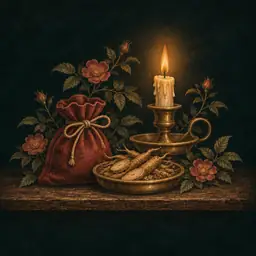 Hoodoo
- The African American tradition of folk magic, also called rootwork or conjure, formed in the American South.
- Braucherei (Pow-wow)
- The charm tradition of the Pennsylvania Dutch: short Christian prayers said over the sick, and written blessings kept in the house.
- Hag Stone
- A pebble with a hole worn through it by nature, hung over a bed, a stable door or a boat to keep off nightmares and ill luck.
- Sator Square
- Five Latin words set in a square that reads alike in every direction, found on a wall at Pompeii and copied as a charm ever since.
Ask the Oracle further
What did the cunning folk actually do, and how did their folk magic differ from witchcraft?Where does hoodoo come from, and who has written down its history?
Before you practise
The Oracle explains these traditions as belief and practice, not as proven fact. It will never tell you that you are cursed, or name anyone as the cause. If someone is threatening you, that is for the police. If fear, voices or a sense of being controlled stays with you, please see a doctor.
Its other branches
How a working is builtProtection and cleansingCurses and fearWhite and black magicTalismans and sigilsThe grimoiresThe witch trialsWicca and the modern craftThe evil eyeCeremonial and chaos magicThe whole artSearch the tree

