
Talismans and sigils
A wish made into a sign or an object: the oldest and gentlest kind of working.
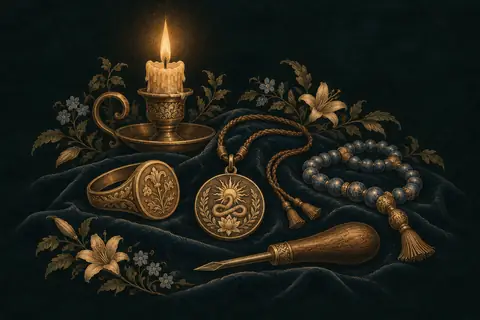
What are talismans and sigils in ritual magic, and how are they held to work?
What it is
A talisman is an object made to hold a wish. The classic kind is a small disc or ring of metal, cut with signs and made at an hour chosen by the stars, to draw a quality such as courage or favour. An amulet is simpler and only guards. A sigil is the drawn sign itself: in the old books the signature of a planet or a spirit, and in modern practice a wish boiled down to one figure. All three give an intention a body that can be seen and carried.
The teaching
As the talismanic art of the Picatrix, Agrippa and Spare teaches it.
Amulet, talisman and sigil
The tradition distinguishes three things. An amulet guards: a stone, a knot, a written verse or a little figure that turns harm away from the one who wears it. A talisman draws: an object made under a chosen sky to receive a particular influence, such as the courage of Mars or the favour of Jupiter, and to hold it for its owner. A sigil is a sign: in the old books the seal or signature of a planet, an angel or a spirit, and in modern practice a wish condensed into a single figure.
The image made under the stars
The Picatrix, the Latin form of an Arabic book called the Aim of the Sage, teaches that a talisman is the force of the heavenly bodies acting on earthly bodies, caught and held in a made thing. The maker watches the sky and chooses the moment when the planet is strong: in its own sign or its exaltation, rising or well placed, free of harm from the others, with the Moon in a fitting mansion. Then the image is cut, cast or engraved, with the perfumes and prayers of that planet, and the influence that streams down at that moment is held in the stone or metal as a soul is held in a body.
The book gives images for the planets in their signs and for each of the twenty-eight mansions of the Moon, and with each the hour, the material and the prayer. Many of them are aimed at other people, for love or for harm, and those the house leaves aside.
The tables of the planets
Agrippa's Three Books of Occult Philosophy give each planet a table, a square of numbers in which every row, column and diagonal has the same sum. Saturn's square is three by three, holding the numbers one to nine, and each line sums to fifteen. Jupiter's is four by four, each line summing to thirty-four; that of Mars five by five, to sixty-five; the Sun's six by six, to one hundred and eleven; that of Venus seven by seven, to one hundred and seventy-five; Mercury's eight by eight, to two hundred and sixty; and the Moon's nine by nine, to three hundred and sixty-nine.
Engraved when its planet is fortunate, Agrippa says, each table brings that planet's gifts, and made when it is unfortunate, the reverse. Saturn's, on a plate of lead, he gives for safety and for success in petitions to the great; Jupiter's, on silver, for gain, favour, peace and the calming of enemies; that of Mars, on iron or a sword, for strength in war and in the courts; the Sun's, on gold, for renown and favour; that of Venus, on silver, for concord and the ending of strife; Mercury's, on silver, tin, brass or virgin parchment, for gain, memory, understanding and dreams; and the Moon's, on silver, for safety on journeys and goodwill. Lead is a poison, and in this house it stays a word in the table.
Over each table stand names of God, and an intelligence for good and a spirit for evil, whose letters, counted as Hebrew numbers, give the square's key numbers. From the tables are drawn the seals of the planets and the characters of their intelligences and spirits, and later students, the Golden Dawn among them, made such signatures for any name by turning its letters into numbers and drawing a line from cell to cell across the square.
The pentacles of Solomon
The Key of Solomon carries forty-four pentacles, circles filled with divine names, verses of scripture and signs: seven each for Saturn, Jupiter, Mars and the Sun, five for Venus, five for Mercury and six for the Moon. Each is to be made in its planet's colour, black for Saturn, sky blue for Jupiter, red for Mars, gold or yellow for the Sun, green for Venus, mixed colours for Mercury and silver for the Moon, on the planet's day and in its hour, and each has its stated virtue. They are worn on the breast during the operations of the book, which holds that the spirits stand in awe of them.
The sigil of Spare
Austin Osman Spare made the sigil something anyone can draw. The wish is written out as a sentence; his own example was a wish for the strength of a tiger. The letters that repeat are struck out, and those that remain are combined into one design, simplified until it no longer reads as words. The sign holds the wish but no longer shows it.
The sigil is then charged and forgotten. Spare taught that a wish works only when it passes below conscious attention, where wanting and worrying cannot reach it, and that it passes in a moment of emptiness, which he reached in a stillness he called the death posture. Then the sign is put away and the wish deliberately forgotten, for to keep longing for the result is to hold it back. The chaos magicians made this their main method.
Amulets in the faiths
The faiths have their own amulets and argue over them. Jewish tradition knows the kamea, a written amulet of divine names and verses, which the Talmud allows when it is of proven worth, though Maimonides mocked the writers of amulets. Many Muslims wear a verse of the Qur'an in a small case; some scholars allow it so long as it holds only the Qur'an and God's names, and others forbid every amulet, citing the hadith that whoever hangs up a charm has joined a partner to God. Christians wear crosses and medals as signs of faith, and the Church teaches that their worth lies in the prayer and trust they stand for, not in the metal.
How it is practised
The gentlest form is a made reminder. A person writes one wish about their own conduct as a short sentence, reduces it to a simple figure or picks a small object to stand for it, and keeps it where it is seen: on a desk, in a pocket, by the door. Its work is to bring the intention back to mind at the moment it matters. Nothing is aimed at anyone else, and nothing depends on a right hour or a rare material.
Where it comes from
Amulets are found in the oldest graves, and a Roman medical poem of the third century prescribes the word abracadabra, written in a shrinking triangle, against fever. The learned talisman is medieval: the Arabic Ghayat al-Hakim, known in Latin as the Picatrix, taught how to make images under chosen skies, and Agrippa's Three Books of Occult Philosophy of 1533 printed planetary number squares and the seals drawn across them. The modern sigil comes from the English artist Austin Osman Spare, who in The Book of Pleasure of 1913 described writing out a wish, striking the repeated letters and combining the rest into one design.
What is known, and what is not
The objects and the instructions are well documented, from excavated amulets to printed tables of seals. That a talisman draws an influence from a planet, or that a sigil acts on events, has never been shown. Some experiments suggest that a carried charm raises confidence, though attempts to repeat them have given mixed results. The modest account, that a visible object keeps a goal in mind, is enough to explain why the practice lasts.
Its words
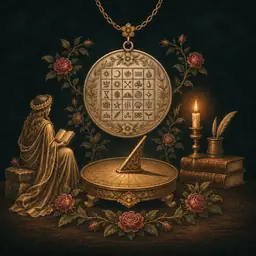 Talisman
- An object made at a chosen time to draw a particular influence, as distinct from an amulet, which only wards off.
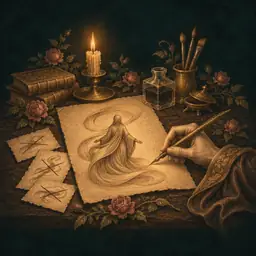 Sigil
- A drawn sign that stands for a name, a spirit or a wish; in modern practice, a wish reduced to a single figure.
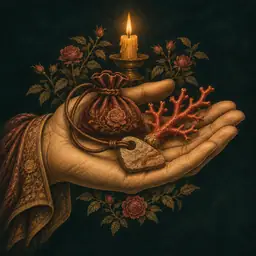 Amulet
- An object worn or carried to ward off harm. Unlike a talisman it only guards, and is not made to draw anything.
- Abracadabra
- A charm word from Roman medicine, written out in a triangle that loses a letter on each line and worn at the neck against fever.
Ask the Oracle further
How did Austin Osman Spare make a sigil from a written wish?What is the difference between a talisman, an amulet and a sigil in ritual magic?
Before you practise
The Oracle explains these traditions as belief and practice, not as proven fact. It will never tell you that you are cursed, or name anyone as the cause. If someone is threatening you, that is for the police. If fear, voices or a sense of being controlled stays with you, please see a doctor.
Its other branches
How a working is builtProtection and cleansingCurses and fearWhite and black magicThe grimoiresThe witch trialsWicca and the modern craftCunning folk and folk magicThe evil eyeCeremonial and chaos magicThe whole artSearch the tree

