
The evil eye
The belief that an envious look can harm, and the beads, hands and blessings set against it.
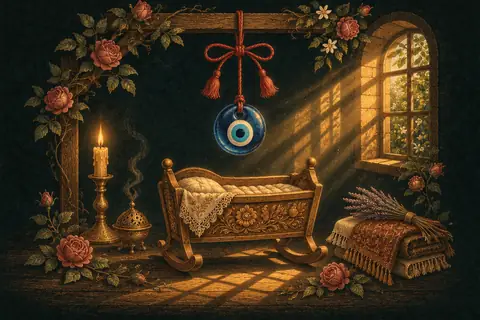
What is the evil eye, where is the belief found, and how do people guard against it?
What it is
The evil eye is the belief that a look of envy, or of too much praise, can harm: above all a baby, a bride, a fine animal or anything newly thriving. It needs no spell and often no ill will, for the admirer may not know what they have done. The belief runs from Ireland to India and is strongest around the Mediterranean and in the Middle East. Against it people wear the blue glass eye called the nazar, an open hand, a red thread, a small horn or the silver sprig of rue that Naples calls the cimaruta, or add a blessing to any compliment. Each of these is an amulet in the plain sense, a thing that guards.
The teaching
As the lore of the evil eye around the Mediterranean and beyond teaches it.
What the eye does
The evil eye is harm sent by a look. Its root is envy: a gaze that covets what another has, a child, beauty, health, a good harvest, a new house, and in coveting spoils it. It needs no spell and often no ill will, for an admirer may cast it without knowing, by praising too much. Those most at risk are those most admired and least guarded: babies and small children, brides, young mothers, fine animals, crops and anything newly thriving.
In the folk belief its signs come suddenly: a headache, yawning and heaviness, a child who cries without end or will not feed, a plant that withers, a cup that cracks, a run of small mishaps after praise. The tradition answers these signs with a rite, and in every sensible household a child who is unwell also goes to a doctor.
How the eye is held to work
The old philosophers gave it a natural account. Plutarch, in his Table Talk, explains that the eyes send out streams charged with the passions of the soul, so that a look full of envy strikes like an arrow and does harm, above all to the young and tender, and he tells of a man who bewitched himself by gazing at his own reflection in water. The teaching that admiration endangers grew from this: the look that lingers is the look that harms.
The Jewish teaching
The Talmud takes the eye seriously. Rav, visiting a graveyard, is said to have judged that ninety-nine of every hundred there had died by the evil eye and one by natural means. Blessing, the sages taught, rests only on what is hidden from the eye, and the descendants of Joseph are beyond its reach, for Jacob blessed Joseph as a fruitful bough by a well, which they read as above the eye. Against fear of it the Talmud gives a sign and a word: a person takes each thumb in the other hand and says, I am of the seed of Joseph.
Jewish custom adds its own guards: the Yiddish phrase kein ayin hara, no evil eye, said after any praise, a red thread tied on a baby's wrist or cradle, and the old care not to count people directly.
The Islamic teaching
The Prophet said that the evil eye is real, and that if anything could outrun fate, the eye would. The tradition tells how a companion admired the skin of another as he bathed, and the man fell ill; the Prophet asked why he had not said a blessing, and had the one who looked wash, and the water poured over the one he had looked at. So the first remedy is in the admirer's mouth: on seeing something fine, a Muslim says masha'Allah, what God has willed, or asks God's blessing on it.
Against the eye, as against every harm, the chapters of the Daybreak and of Humankind are recited, for the first seeks refuge from the evil of an envier when he envies. Many also hang the open hand, the khamsa, known in North Africa and among Jews as the hand of Fatima or of Miriam, though some scholars forbid every such charm and hold that recitation and trust in God are the only guard.
Around the Mediterranean
In Greece the eye is to mati, and its guard is the blue glass bead painted as an eye, the same bead that Turkey calls the nazar boncuğu and hangs on houses, cars, cradles and the doors of shops. A Greek grandmother tests for the eye with drops of oil in water: if they spread or sink, the eye is present, and she says over the person a prayer learned from an elder, in many families only at a feast such as Holy Thursday and often from a woman to a man or a man to a woman, crossing the brow with the oil. In Italy oil in water and a prayer learned in many families on Christmas Eve answer the malocchio, and a little red horn, the cornicello, is worn against it.
In Greece praise is softened with a little pretend spitting, three times, and in many lands a compliment to a baby is followed at once by a blessing or a word that undoes it.
India
In India the eye is nazar or drishti. A dot of black kohl is set on a baby's cheek or behind the ear to spoil the perfection that draws it; a lemon threaded with seven green chillies hangs at the doors of shops and on the fronts of lorries; and a mother may circle a handful of salt round a child's head and throw it away, taking the eye with it.
The manners of the eye
Beneath the charms the belief teaches manners. It tells people not to boast, to bless when they praise, to keep good fortune quiet, to share what they have and to be easy about what others have. Its remedy for the envier is a blessing and for the envied modesty. And the faiths' own remedy blames no one beyond a word: the admirer is asked to bless, and the matter ends there.
How it is practised
The traditions' own answers are mild, and a reader may keep whichever belongs to their family: a blessing added to praise, a charm on a pram, a prayer of their own faith. The useful part of the belief is its manners. It teaches people not to boast, to praise with a blessing and to be easy about what others have. A reader who fears the eye can practise the reverse of envy, and name aloud each day one good thing in someone else's life. Nobody is to be accused of casting it, and a child who is unwell is taken to a doctor.
Where it comes from
The idea is written down early. Mesopotamian incantations against the eye survive from the early second millennium BCE, Greeks and Romans wore charms against it, and Plutarch discussed how a glance could injure. The Bible, the Talmud and the sayings of the Prophet Muhammad all speak of it, and each faith has prayers said for protection. The blue eye bead is made in quantity in Turkey, where the glassmakers' craft is centuries old. Anthropologists have linked the belief to the idea of limited good, in which one person's gain is felt as another's loss.
What is known, and what is not
The belief is one of the best documented in folklore, and surveys still find it widely held in many countries. Nothing shows that a look can injure. What is real is the social fact behind it: envy exists, and communities need ways of handling it. Charms against the eye do no harm in themselves. The harm on record comes when an illness is put down to the eye and left without care, or when a neighbour is blamed.
Its words
 Evil Eye
- The old and widespread belief that an envious look can bring harm, and the charms worn against it.
 Nazar
- The blue glass bead in the shape of an eye, worn or hung in Turkey, Greece and beyond against the evil eye.
 Amulet
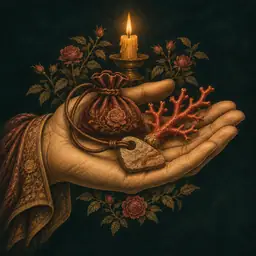
- An object worn or carried to ward off harm. Unlike a talisman it only guards, and is not made to draw anything.
- Cimaruta
- A silver charm of Naples in the shape of a sprig of rue, each branch ending in a small sign, pinned on babies against the evil eye.
Ask the Oracle further
Why is the evil eye feared for babies and brides, and what does that say about envy?What is the blue bead worn against the evil eye, and where does it come from?
Before you practise
The Oracle explains these traditions as belief and practice, not as proven fact. It will never tell you that you are cursed, or name anyone as the cause. If someone is threatening you, that is for the police. If fear, voices or a sense of being controlled stays with you, please see a doctor.
Its other branches
How a working is builtProtection and cleansingCurses and fearWhite and black magicTalismans and sigilsThe grimoiresThe witch trialsWicca and the modern craftCunning folk and folk magicCeremonial and chaos magicThe whole artSearch the tree

