
Protection and cleansing
Salt, smoke, prayer and the threshold: what protective rites are, and what they steady.

What are the old rites of spiritual protection and cleansing, and what do they really do for a person?
What it is
Protective rites are the commonest magic there is. Salt is laid across a threshold, a house is filled with scented smoke, water is sprinkled, a prayer or a psalm is said at the door, a charm is hung over a cradle against the evil eye. Scholars call such things apotropaic, from the Greek for turning away. Ritual magicians add a formal version called banishing, which clears a space before and after any other work. All of them mark a line between inside and outside and declare the inside safe.
The teaching
As apotropaic custom from Babylon to the Golden Dawn teaches it.
The line at the door
Protection, in every tradition, begins with a boundary. A home, a body or a holy place is marked as inside, and what is unwanted is turned back at its edge. The Greek word apotropaic, turning away, names every charm made for that work. The door and threshold, the window, the hearth and the cradle are the places most guarded, because there the inside meets the outside.
The oldest guards are images set at those places. In ancient Mesopotamia an expectant mother wore the head of the demon Pazuzu, who was held to drive off Lamashtu, the harmer of mothers and newborn children. Egyptians wore the eye of Horus, the wedjat, and set the dwarf god Bes and the hippopotamus goddess Taweret over childbirth. Greeks painted great eyes on their drinking cups and set the Gorgon's face on shields and on the roofs of temples, so that harm would meet a stare stronger than its own.
The mezuzah
On the doorposts of Jewish homes is fixed the mezuzah, in obedience to the command to write God's words upon the posts of the house and upon the gates. It is a small parchment, written by a scribe with two passages of Deuteronomy, the first beginning Hear, O Israel, rolled and set in a case on the right-hand doorpost, slanting inward in many communities. On its back is written the name Shaddai, read as the initials of the words Guardian of the doors of Israel, and many touch it and kiss their fingers as they pass.
Here the sources differ on its meaning. Popular belief has long treated the mezuzah as a guard of the house. Maimonides taught that it is a commandment and not an amulet, and condemned those who wrote names of angels into it, for they turned a commandment meant to keep God's oneness before the mind into a charm for their own benefit.
Salt, water and smoke
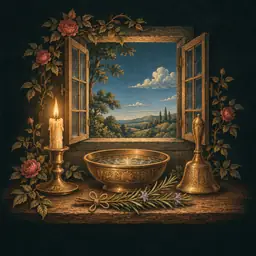
Salt keeps food from corruption, and so it stands almost everywhere for what keeps harm from spreading. In European custom a line of salt is laid across a threshold, or a pinch thrown over the left shoulder after a spill. In Japan little cones of salt are set at the doors of houses and shops, salt is sprinkled on the body on coming home from a funeral, and sumo wrestlers throw it into the ring before a bout. The old Roman rite blessed salt and water and mingled them, and holy water is still sprinkled through Catholic homes.
Smoke is held to carry prayer upward and to drive impurity out. Frankincense burns in the censers of churches and temples, and in many lands rooms are filled with the smoke of herbs or resins on feast days, after an illness or after a death. The tradition's own care goes with it: a window is opened, nothing smouldering is left alone, and anyone who finds smoke hard to breathe keeps to water and words.
Christians bless their houses at Epiphany. The priest or the family carries holy water through the rooms and writes above the door in chalk the year with the letters C, M and B, for the three kings Caspar, Melchior and Balthasar, which are also read as Christus mansionem benedicat, may Christ bless this house.
Words for the night and the road
Every faith has its words of protection. Jews and Christians say the ninety-first psalm, “He that dwelleth in the secret place of the most High shall abide under the shadow of the Almighty,” and Jewish custom says it before sleep. The Breastplate of Saint Patrick sets Christ before and behind, beneath and above, on the right and on the left. Muslims say the Throne Verse and the last three chapters of the Qur'an at nightfall. Theravada Buddhists chant the paritta, the protective discourses, among them the discourse on loving kindness, which the Buddha is said to have given to monks who were frightened in the forest.
In each faith's own understanding these words protect by setting the one who says them under God, or, for the Buddhists, under the power of truth and goodwill. They are prayers and not commands, and they ask for nothing against anyone.
The banishing of the lodge
Ritual magicians clear a space with a banishing before any other work and again after it. The standard form is the Lesser Banishing Ritual of the Pentagram, which the Golden Dawn gave its Neophytes as their first practice. It begins with the Qabalistic Cross. Facing east, the magician touches the forehead and says Ateh, thou art; the breast, Malkuth, the kingdom; the right shoulder, ve-Geburah, and the power; the left shoulder, ve-Gedulah, and the glory; and with hands clasped at the breast, le-Olam, Amen, for ever, amen: the close of the Lord's Prayer in Hebrew.
Then, turning to each quarter in turn, the magician traces a pentagram in the air and vibrates a name of God into it: YHVH in the east, Adonai in the south, Eheieh in the west and AGLA in the north. Back in the east, arms outstretched, the magician names the archangels of the four quarters, Raphael before, Gabriel behind, Michael at the right hand and Auriel at the left, and declares that about him flames the pentagram and in the column stands the six-rayed star. The Qabalistic Cross is made again to close.
The order teaches that the rite clears the space about the magician of unwanted influence, sets the self at the still centre of the four quarters and steadies the mind, and that its invoking form, traced the other way, calls the forces in. Its students are told to work it daily, and before and after every other rite.
Protection and common sense
The faiths themselves set protective rites beside ordinary care and never in its place. A man asked the Prophet whether he should tie his camel and trust in God, or leave it loose and trust in God, and he answered: tie it, and trust. The mezuzah goes on a door that also has a lock. Where the danger is a living person, the lock, the neighbours and the police come first.
How it is practised
The plain form needs nothing bought. A person tidies and airs the room, stands at the door, and says in their own words, or in a prayer of their own faith, that this is their home and that they are at peace in it. Some add a pinch of salt at the sill, or a candle that is put out before they leave the room. Done at the same hour for a week, it becomes a signal to the body that the day is closed. If the fear is of a real person, the door lock and the police come first.
Where it comes from
Protective charms are among the oldest written objects that survive. Mesopotamian households buried small figures under the floor, and in late antique Iraq the incantation bowl, inscribed in Aramaic, was set upside down beneath a threshold to trap harm. Jewish homes fix the mezuzah to the doorpost, a commandment that popular belief has long also treated as a guard. Medieval Christians used holy water, blessed salt and the sign of the cross in the same spirit. English builders of the sixteenth and seventeenth centuries left witch marks scratched or burned beside doors and hearths. The Golden Dawn of the 1890s gave ritual magic its standard clearing rite, the Lesser Banishing Ritual of the Pentagram.
What is known, and what is not
That people in nearly every culture perform protective rites is thoroughly documented. That salt, smoke or words keep away an unseen harm has not been shown. What can be observed is the effect on the person performing them: a familiar rite lowers anxiety and restores a sense of command over one's own space. That benefit is real whether or not anything was at the door, and it does not replace help when fear or a sense of being watched persists.
Its words
 Banishing
- A rite that clears a place or a person of unwanted influence, usually done before and after any other working.
 Evil Eye
- The old and widespread belief that an envious look can bring harm, and the charms worn against it.
- Incantation Bowl
- A clay bowl of late antique Mesopotamia with a spell in Aramaic inked round its inside, buried face down in a house against demons.
- Witch Marks
- Signs scratched, cut or burned into old buildings beside doors, windows and hearths, most between about 1550 and 1750, to keep harm out.
Ask the Oracle further
What is the Lesser Banishing Ritual of ritual magic, and what is it for?How can I give my home spiritual protection without becoming more afraid?
Before you practise
The Oracle explains these traditions as belief and practice, not as proven fact. It will never tell you that you are cursed, or name anyone as the cause. If someone is threatening you, that is for the police. If fear, voices or a sense of being controlled stays with you, please see a doctor.
Its other branches
How a working is builtCurses and fearWhite and black magicTalismans and sigilsThe grimoiresThe witch trialsWicca and the modern craftCunning folk and folk magicThe evil eyeCeremonial and chaos magicThe whole artSearch the tree

