
Ceremonial and chaos magic
The lodge magic of the Golden Dawn, and the stripped-down school that reacted against it.
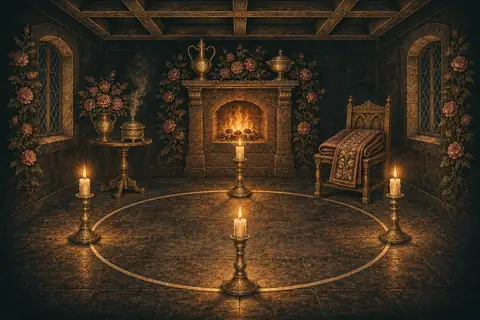
What is ceremonial magic, and how does chaos magic differ from it?
What it is
Ceremonial magic is the learned, scripted end of the art: robes, a marked circle, set hours, named powers and long prayers, worked alone or in a lodge. Its modern form was fixed by the Hermetic Order of the Golden Dawn, which joined Kabbalah, astrology, tarot and the grimoires into one graded course. Chaos magic, which appeared in England in the 1970s, threw most of this out. It holds that belief itself is the tool, to be taken up and put down at will, and that any symbols serve if the practitioner commits to them.
The teaching
As ceremonial magic from the Golden Dawn to chaos magic teaches it.
The plan of the Great Work
Ceremonial magic, as the Golden Dawn taught it, is a road of initiation up the Tree of Life of the Kabbalah. Each grade stands on one of the ten sefirot, and its number shows it: the first figure is the grade, the second the sefirah, counted down from the crown. The outer order works with the four elements, the second order with the self made whole, and the third, which the order held to belong to the Secret Chiefs, with what lies beyond human reach. The aim of the whole is to bring the soul into union with its higher self, and so with the divine.
The outer order
Neophyte, 0=0, stands outside the tree. The candidate, hoodwinked and bound with a cord, is brought from darkness into light between two pillars, one black and one white, takes an oath of silence, and is given the signs of the grade and the first lessons: the Hebrew letters, the symbols of the elements, planets and signs, and the names of the sefirot. The Lesser Banishing Ritual of the Pentagram is the Neophyte's daily work.
Zelator, 1=10, is the grade of Malkuth, the kingdom, and of the element of earth: the world as the senses receive it, the floor of the tree from which every ascent begins.
Theoricus, 2=9, is the grade of Yesod, the foundation, and of air. The candidate passes in ritual along the path of the letter Tav, the thirty-second, from Malkuth up to Yesod, the sefirah of the Moon and of the world of images.
Practicus, 3=8, is the grade of Hod, splendour, and of water. The candidate passes along the paths of Shin and of Resh, which lead to Hod from Malkuth and from Yesod.
Philosophus, 4=7, is the grade of Netzach, victory, and of fire. The candidate passes along the paths of Qoph, Tzaddi and Peh, which lead to Netzach from Malkuth, Yesod and Hod. In every grade of the outer order a lecture of correspondences is learned and an examination passed before the next.
The Portal and the second order
The Portal stands between the orders and belongs to spirit, the fifth element, which binds the four. In it the candidate approaches the veil before Tiphareth along the paths of Samekh, Nun and Ayin, and takes up the elements of the lower grades as one.
Adeptus Minor, 5=6, is the grade of Tiphareth, beauty, the centre of the tree. Its rite is held in the seven-sided Vault of the Adepti, the tomb of Christian Rosenkreutz: the candidate is bound to a cross to take the obligation of the adept, and is shown the tomb opened, with the Chief Adept lying in it in the founder's place.
Adeptus Major, 6=5, stands on Geburah, severity, the sefirah of Mars and of strength. The order counted it a further stage of the adept's own inner work, held by few.
Adeptus Exemptus, 7=4, stands on Chesed, mercy, the sefirah of Jupiter, the last grade below the Abyss; the adept who came so far stood, in the order's teaching, at the edge of the third order.
The third order
Magister Templi, 8=3, the Master of the Temple, stands on Binah, understanding, beyond the Abyss that parts the human from the divine part of the tree.
Magus, 9=2, stands on Chokmah, wisdom, the first outpouring of the divine force that the whole tree unfolds.
Ipsissimus, 10=1, the self itself, stands on Kether, the crown, the point of unity at the top of the tree. The Golden Dawn held that these three grades belonged to the Secret Chiefs and not to its human members.
The work of the adept
Practical magic begins only in the second order. The new adept makes and consecrates their own instruments: the four elemental weapons, the fire wand, the water cup, the air dagger and the earth pentacle, together with the lotus wand and the rose cross worn on the breast. They learn the supreme rituals of the pentagram and the hexagram, the consecration of talismans, the Enochian system of Dee and Kelley with its tablets of the four quarters, skrying in the spirit vision, travelling in the imagination along the paths of the tree, and the formulas that apply the pattern of the Neophyte ritual to every kind of working.
Every ceremony of the lodge follows one pattern: a banishing to clear the space, the invocation of the powers fitted to the work, the work itself, and a banishing again with thanks. The temple is laid out as a picture of the world as the order understood it, with the altar at the centre, the elements at the quarters and the officers at their stations.
Chaos magic: belief as a tool
Chaos magic keeps the method and drops the system. It teaches that no symbol has power of its own and that belief is the magician's instrument, to be taken up and put down at will: for one working a person may believe wholly in the gods of Egypt, for the next in planetary spirits, for the next in a figure from a novel, and drop each when it is done. This is paradigm shifting, and the school's best known slogan is that nothing is true and everything is permitted.
The working itself rests on gnosis, a state in which the mind is wholly stilled or wholly flooded, so that a sigil or an intent can pass beneath the thinking mind. Peter Carroll names two kinds: the inhibitory, reached by deep stillness and trance, and the excitatory, reached by dance, drumming, chanting or strong emotion. Some chaos writers list harsher means that harm the body, and the house leaves those aside. Carroll later set the idea as a formula: a working's force grows with the depth of the gnosis, the strength of the link to its object and the degree to which the wish stays out of conscious attention, and shrinks with doubt and inner resistance.
The signs and tools of chaos
The school has its own figures. Its sign is an eight-armed star of arrows taken from Michael Moorcock's novels. Carroll later divided magic into eight colours by their aims: octarine for magic itself, black for death, blue for wealth, red for war, yellow for the ego, green for love, orange for the intellect and purple for sex. Chaos magicians also make servitors, thought-forms built for a single task and dissolved when it is done, and they keep the magical record as strictly as the lodges, judging every working by what followed.
How it is practised
Both schools are read here as history and as ideas, and the house performs no rite from either. What a reader can take from ceremonial magic is its discipline of attention: a fixed time, a cleared space, words said with care. What can be taken from chaos magic is its candour that the practitioner supplies the meaning. Its own writers warn that changing beliefs at will unsettles some people, and that warning deserves respect. A working aimed at another person is refused whatever the school, and anyone left with fear or intrusive thoughts after such practices should stop and see a doctor.
Where it comes from
The Golden Dawn was founded in London in 1888 and had split apart by 1903. Its papers were published by Israel Regardie between 1937 and 1940, which made its system the base of most later ritual magic. Aleister Crowley, a former member, built a system of his own, which he spelled with a final k. Chaos magic began with Peter Carroll and Ray Sherwin, whose group, the Illuminates of Thanateros, was announced in 1978. They took the sigil method of Austin Osman Spare as their main technique. Since the 1990s the school has spread mostly online.
What is known, and what is not
The orders, their papers and their quarrels are well documented, and historians of religion have studied both movements closely. That any ceremony changes events at a distance has not been shown. Chaos magicians often describe their results as shifts in their own outlook and conduct, which needs no hidden force to explain. Claims of ancient lineage for the lodge rituals do not hold: the founding papers of the Golden Dawn named a German adept of whom no trace has been found.
Its words
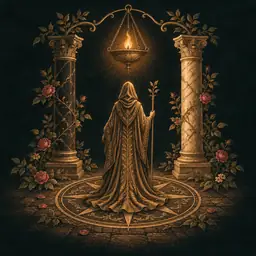 Ceremonial Magic
- The learned, scripted magic of circle, robe and set prayer, given its modern form by the Golden Dawn.
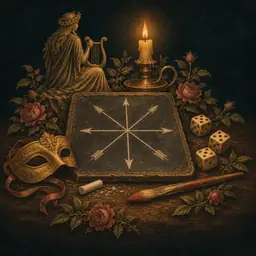 Chaos Magic
- A movement begun in England in the 1970s that treats belief as a tool and uses whatever symbols the practitioner chooses.
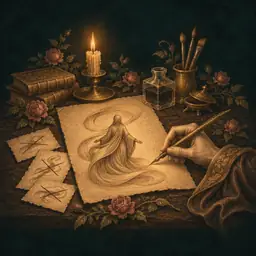 Sigil
- A drawn sign that stands for a name, a spirit or a wish; in modern practice, a wish reduced to a single figure.
 Banishing
- A rite that clears a place or a person of unwanted influence, usually done before and after any other working.
- Lesser Banishing Ritual of the Pentagram
- The Golden Dawn's short clearing rite, often called the LBRP: a gesture of the cross, a pentagram traced at each quarter and four archangels named.
Ask the Oracle further
What did the Golden Dawn teach as ceremonial magic, grade by grade?What is chaos magic, and why do its writers say belief is a tool?
Before you practise
The Oracle explains these traditions as belief and practice, not as proven fact. It will never tell you that you are cursed, or name anyone as the cause. If someone is threatening you, that is for the police. If fear, voices or a sense of being controlled stays with you, please see a doctor.
Its other branches
How a working is builtProtection and cleansingCurses and fearWhite and black magicTalismans and sigilsThe grimoiresThe witch trialsWicca and the modern craftCunning folk and folk magicThe evil eyeThe whole artSearch the tree

