
Mystical systems
Kabbalah
Direct answer
Kabbalah is Jewish mystical tradition concerned with God, creation, Torah, divine emanations, prayer, symbols, and the hidden structure of reality.
Kabbalah is Jewish mysticism and must be studied with respect for its tradition and boundaries.
$0 today, then $12/month after 7 days. Cancel anytime.
At a glance
- Found in
- Mystical Systems
- Related
- Birth Chart, Zodiac, Transit
Kabbalah is Jewish mysticism and must be studied with respect for its tradition and boundaries.
A lineage map for books and systems; it avoids presenting symbolic traditions as literal fact.
What does your own chart say about you?
Choose love, work or purpose. Your reading is written from your chart. Your reading uses your own birth details.
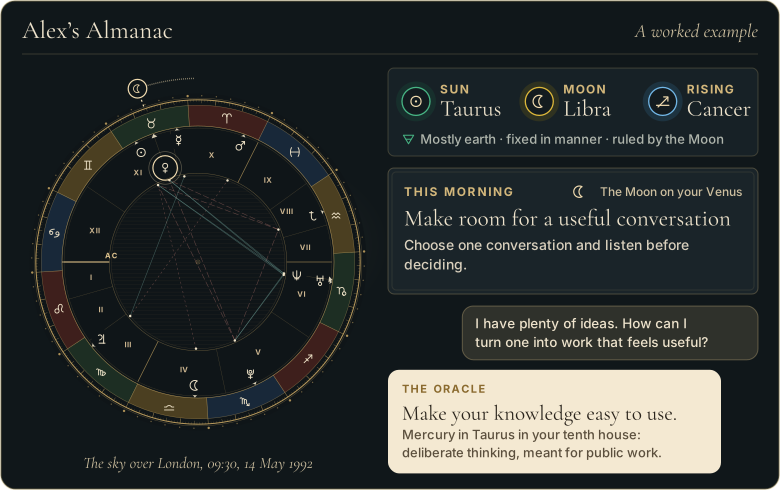
Walk through Alex’s whole example first
 The Road of AgesSee the turning points of your whole life, from your birth date
See your road's shape
The Road of AgesSee the turning points of your whole life, from your birth date
See your road's shape
Prefer to explore first?
 The Road of AgesThe turning points of your whole life, from your own chart
Walk my road
The Road of AgesThe turning points of your whole life, from your own chart
Walk my road
Free, by email
Your daily Almanac letter
One short letter at 7 each morning: the day’s theme read for your own chart, and one thing to do with it.
What sets Kabbalah apart
The Hebrew word means 'receiving': a mystical teaching held to be handed down within Judaism, studied alongside Torah and prayer. Its two best known turns are the Zohar, a Hebrew-Aramaic commentary that appeared in Spain in the late thirteenth century, and the sixteenth-century school of Isaac Luria at Safed. The tradition itself assigns the Zohar to Rabbi Shimon bar Yochai; most modern historians, following Gershom Scholem, credit Moses de León.
- Meaning: Hebrew qabbalah, 'receiving' or 'tradition'
- Early texts: Sefer Yetzirah (ten sefirot and 22 letters) and the Bahir, which surfaced in twelfth-century Provence
- Zohar: appeared in Spain in the late 1200s; attributed by tradition to Shimon bar Yochai, by Scholem to Moses de León
- Lurianic ideas: tzimtzum (contraction), shevirat ha-kelim (breaking of the vessels), tikkun (repair)
- Setting: taught within Jewish communities, grounded in Torah and halakhah (Jewish law)
Often mistaken for something else: Christian Kabbalah and Hermetic Qabalah are later non-Jewish adaptations; Kabbalah proper is a Jewish textual tradition.
The story behind Kabbalah
Kabbalah developed especially in medieval Jewish contexts, with the Zohar and later Safed Kabbalah becoming major streams.
The spiritual meaning of Kabbalah
Spiritually, Kabbalah asks whether hidden tradition is being approached with reverence and restraint.
Kabbalah in the Bible
Christian readers should approach Kabbalah humbly and avoid treating Jewish mysticism as raw material for private occult systems.
Why Kabbalah matters
Kabbalah matters because it is often appropriated as generic mysticism while belonging to specific Jewish textual, devotional, and communal worlds.
Where readings of Kabbalah go wrong
The usual misreading is to flatten Kabbalah into numerology, manifestation, or universal secret code.
Lectures on this, free to read


Sources and editorial method
This entry summarizes the tradition in the Almanac's own words; where no source is listed, it is an editorial summary rather than a primary text, and symbolic readings are named as the tradition's, not as fact.
- Source
- The Great Almanac Dictionary
- Category
- Mystical Systems
- Last updated
- 2026-09-26
Study Jewish mysticism respectfully
A definition tells you what it is; your own birth chart tells you what it means for you. The Oracle casts your real chart and answers for your love, your work, and your year ahead, in conversation. It opens with the 7-day Seeker trial.
Speak with the OracleYour year, written once from your chart alone: the Cosmic Codex reads the whole of it, month by month. Open the Cosmic Codex
Related terms
More in Mystical Systems
- Mystery Schools
- Purgative Way
- Tantra
- The Great Work
- Theosophy
- Advaita Vedanta
- Chesed
- Hermetic Order of the Golden Dawn
From the reference page to your own chart
Every word here
is in your own chart.
- A personal reading about love, work or purpose, written from your chart
- A practical next step to consider
- It opens with 7 days free, with the AI Oracle and daily guidance
$0 today, then $12/month after 7 days. Cancel anytime.
Common questions
What is Kabbalah?
Kabbalah is Jewish mystical tradition concerned with God, creation, Torah, divine emanations, prayer, symbols, and the hidden structure of reality.
Where does Kabbalah come from?
Kabbalah developed especially in medieval Jewish contexts, with the Zohar and later Safed Kabbalah becoming major streams.
What does Kabbalah mean spiritually?
Spiritually, Kabbalah asks whether hidden tradition is being approached with reverence and restraint.
What do people get wrong about Kabbalah?
The usual misreading is to flatten Kabbalah into numerology, manifestation, or universal secret code.
Free, by email
The Almanac, in your inbox at 7
One short letter at 7 each morning: the day’s theme read for your own chart, and one thing to do with it.