

Indian philosophy
Advaita Vedanta
Direct answer
Advaita means “not two,” but the tradition is more precise than saying everything is vaguely one. It develops arguments about consciousness, knowledge, language, causation, appearance, scripture, and liberation while distinguishing ultimate truth from ordinary empirical experience.
Advaita Vedanta is a major Hindu philosophical tradition teaching that the deepest self, atman, is not ultimately different from brahman, the nondual reality. Liberation is associated with knowledge that removes ignorance about this identity.
Quick facts
| Term | Concise meaning |
|---|---|
| Advaita | Nonduality or “not two.” |
| Vedanta | Traditions grounded especially in the concluding portions of the Vedas, notably the Upanishads. |
| Atman | Self; in Advaita, ultimately identical with brahman rather than a separate finite essence. |
| Brahman | Ultimate reality, approached through both affirmative and apophatic teaching. |
| Moksha | Liberation through removal of ignorance and realization of nondual knowledge. |
Advaita Vedanta means a Hindu philosophical tradition teaching non-duality of Atman and Brahman.
A lineage map for books and systems; it avoids presenting symbolic traditions as literal fact.
What does your own chart say about you?
Choose love, work or purpose for a personal insight and a useful next step. Your reading uses your own birth details.
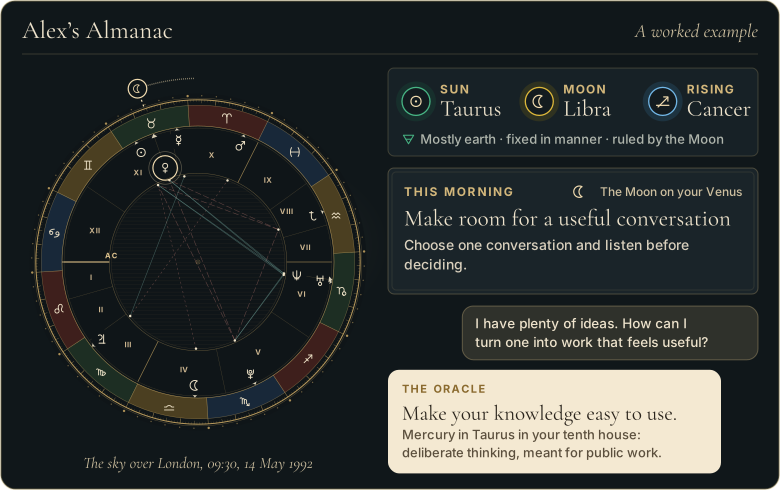
Walk through Alex’s whole example first
 The Road of AgesSee the turning points of your whole life, from your birth date
Free first look
The Road of AgesSee the turning points of your whole life, from your birth date
Free first look
Prefer to explore first?
 The Road of AgesThe turning points of your whole life, from your own chart
Walk my road
The Road of AgesThe turning points of your whole life, from your own chart
Walk my road
What nonduality claims
Ordinary experience presents separate selves, objects, actions, and causes. Advaita does not deny that this world is encountered or that practical distinctions matter. It argues that plurality is not ultimate and that the witnessing consciousness cannot finally be divided into independently existing subjects in the way ignorance assumes. Upanishadic statements such as “that thou art” receive systematic interpretation within this view. Brahman is not one large object containing smaller objects; it is the nondual reality by which subject-object experience is possible.
Shankara and the formation of classical Advaita
The eighth-century philosopher Shankara is the most influential classical systematizer, known for commentaries on the Brahma Sutra, principal Upanishads, and Bhagavad Gita, as well as independent works whose authorship must sometimes be assessed separately. He inherited earlier Vedantic debates and argued against Buddhist, Mimamsa, Samkhya, Nyaya, and other positions while sharing some vocabulary and questions with them. Advaita is therefore not one isolated revelation by Shankara, and later teachers (including important post-Shankara thinkers) developed or disputed aspects of his epistemology and metaphysics.
Ignorance, appearance, and liberating knowledge
Avidya, ignorance, involves misidentifying the self with limited body-mind conditions and taking duality as ultimately real. Familiar examples compare error to mistaking a rope for a snake: the mistaken appearance has experiential effects until knowledge corrects it, though the underlying rope never became a snake. Terms such as maya help account for appearance and dependence, but “the world is an illusion” can mislead if it suggests nothing matters. Ethical conduct, disciplined attention, inquiry, listening to teaching, reflection, and contemplation retain practical importance within the path.
What Advaita should not be confused with
Advaita differs from Vishishtadvaita’s qualified nondualism, Dvaita’s dualism, Buddhist theories of no-self, and generic New Age monism, even where dialogue or resemblance exists. It is a diverse living religious-philosophical tradition, not merely a technique for feeling interconnected. Intellectual slogans can also become “spiritual bypassing” if used to dismiss grief, injustice, bodily limits, or another person’s boundaries as unreal. Sound study uses translated primary texts, identifies the commentator, respects Sanskrit terms in context, and recognizes that philosophical realization is not proven by claims of special status.
Sources and editorial method
Research and editorial references used for this page include:
- Stanford Encyclopedia of Philosophy: Shankara - Peer-reviewed overview of Shankara’s epistemology, metaphysics, and textual context.
- Internet Encyclopedia of Philosophy: Advaita Vedanta - Academic introduction to the school’s history, key arguments, and later development.
These references support the factual, historical, textual, or interpretive claims on this page. Interpretive traditions are identified as such, and factual claims are kept separate from symbolic claims.
Related reading
See it in your own chart
A definition tells you what it is; your own birth chart tells you what it means for you. The Oracle casts your real chart and answers for your love, your work, and your year ahead, in conversation, free.
Speak with the OracleYour year, written once from your chart alone: the Cosmic Codex reads the whole of it, month by month. Open the Cosmic Codex
More in Mystical Systems
- Chesed
- Hermetic Order of the Golden Dawn
- Kabbalah
- Mystery Schools
- Purgative Way
- Tantra
- The Great Work
- Theosophy
From the reference page to your own chart
Every word here
is in your own chart.
- Your chart and numbers, read for you in about a minute
- Ask the Oracle anything about them
- Every personal tool and daily guidance
Free reading, no card needed. Optional membership: payment details required, 7 days free, then $12/month. Cancel before it renews and you pay nothing.
Common questions
Does Advaita teach that the world does not exist?
It distinguishes levels of truth and treats the experienced world as dependent rather than ultimately self-subsisting. Saying it simply does not exist obscures that nuance.
Is Advaita the same as Buddhism?
No. The traditions debated one another and may share analytical concerns, but Advaita affirms atman-brahman nonduality while Buddhist schools articulate different accounts of self and reality.
Did Shankara found Advaita Vedanta?
He was its most influential classical systematizer, but he drew on the Upanishads, Brahma Sutra, Bhagavad Gita, and earlier Vedantic teachers.