

Mystical systems
Bhakti
Direct answer
Bhakti: Bhakti, Sanskrit for devotion, is the Hindu path of loving attachment to a personal God, expressed in worship, song and service, and held by its teachers to be open to everyone whatever their birth or learning.
$0 today, then $19/month after 7 days. Cancel anytime.
At a glance
- Also called
- path of devotion, devotional hinduism
- Found in
- Mystical Systems
- Related
- Advaita Vedanta, Karma, Mantra, Moksha
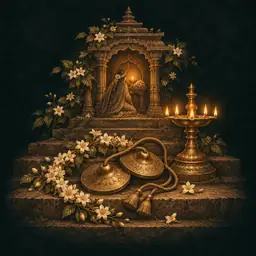

Bhakti, Sanskrit for devotion, is the Hindu path of loving attachment to a personal God, expressed in worship, song and service, and held by its teachers to be open to everyone whatever their birth or learning.
A lineage map for books and systems; it avoids presenting symbolic traditions as literal fact.
Understand the chapter you are in.
Your life’s turning points, measured from your birth.
Walk through Alex’s whole example first


Prefer to explore first?
 The Road of AgesThe turning points of your whole life, from your own chart
Walk my road
What does bhakti mean?
Bhakti comes from a Sanskrit root meaning to share in or belong to. It names love of God taken as a path to liberation in itself, beside the paths of knowledge and of action. The devotee approaches a chosen form of God, Krishna, Rama, Shiva or the Goddess, in a personal relation: as servant, friend, parent or beloved. The tradition holds that God answers such love with grace.
Bhakti’s practices are worship before an image, repetition of the divine name, song, pilgrimage and service to others. Its poetry, composed in the spoken languages and often by women and by people of low caste, is among the best loved literature of India.
On the tree of the hidden arts: The mystics.
What sets Bhakti apart
Bhakti theology is unusually exact about feeling. Teachers list nine forms of devotion, from hearing God's deeds and singing the name to friendship and complete self-surrender, and five relations a devotee may hold toward God, of which the lover's is often ranked the most intense. Longing in absence is prized above presence. The poet-saints came from every station, a cobbler, a weaver, a queen, and their songs attack pride of caste and empty ritual, which is why reformers have claimed them ever since.
- Sanskrit root: bhaj, to share in, belong to, adore
- Classic scriptures: the Bhagavad Gita and the Bhagavata Purana
- Earliest poet-saints: the Tamil Alvars and Nayanars, sixth to ninth centuries
- Nine forms: listed in the Bhagavata Purana, from hearing to self-surrender
- Two styles: saguna, God with form; nirguna, God beyond form
Often mistaken for something else: Jnana, the path of knowledge, seeks freedom by insight into what the self is; bhakti seeks it through love of a personal God and reliance on grace.
The story behind Bhakti
The Bhagavad Gita teaches devotion to Krishna, and the Bhagavata Purana, of about the ninth or tenth century, tells his story for devotees. Tamil poet-saints of the sixth to ninth centuries, the Alvars and the Nayanars, sang in temples across the south. Ramanuja and later teachers built theologies of grace, and from the fifteenth century poets such as Kabir, Mirabai, Surdas and Tulsidas spread it across the north. Guru Nanak, the first Sikh Guru, taught in the same age.
Why Bhakti matters
Most Hindu practice is devotional, so the term is the key to temples, festivals and song that a reader may otherwise see only from outside.
How to read Bhakti
Scholars apply it to a whole family of movements. Devotees mean the feeling itself, and speak of growing in it through the company of other devotees.
Bhakti in practice: an example
A visitor hears a congregation sing one line of a song by Mirabai over and over, each time a little faster, and sees how devotion is carried by music.
Where readings of Bhakti go wrong
Bhakti is the worship of a living faith, described here with respect. Devotion to a human teacher is a separate matter, and the tradition itself says to test a guru.
Sources and editorial method
This entry summarizes the tradition in the Almanac's own words; where no source is listed, it is an editorial summary rather than a primary text, and symbolic readings are named as the tradition's, not as fact.
- Source
- The Great Almanac Dictionary
- Category
- Mystical Systems
- Aliases
- bhakti yoga, bhakti movement, path of devotion, bhakti meaning, devotional hinduism
- Last updated
- 2026-09-26
See Bhakti in your personal almanac
A definition tells you what it is; your own birth chart tells you what it means for you. The Oracle casts your real chart and answers for your love, your work, and your year ahead, in conversation. It opens with the 7-day Oracle trial.
Speak with the OracleRelated terms
More in Mystical Systems
From the reference page to your own chart
Every word here
is in your own chart.
- Your life’s turning points, measured from your birth
- A practical next step to consider
- It opens with 7 days free: the AI Oracle on thirty hidden arts, and your daily horoscope
$0 today, then $19/month after 7 days. Cancel anytime.
Common questions
What does bhakti mean?
It is Sanskrit for devotion. In Hinduism it means loving attachment to a personal God, practised through worship, song, the repetition of the divine name and service.
What was the bhakti movement?
It is the name given to waves of devotional poetry and teaching in India from about the sixth century on, beginning with the Tamil saints. Scholars note that the idea of a single movement was shaped later.
Who were the bhakti poet-saints?
Among the best known are the Tamil Alvars and Nayanars, Basava in Karnataka, Kabir and Mirabai in the north, Tukaram in Maharashtra and Chaitanya in Bengal.


