
The Sufis
Islam’s path of the heart: the orders, the remembrance of God, and the passing away of self.
What do the Sufis teach, and what does Sufism say the path is for?
The mystical paths of the religions: the Sufis, the Christian contemplatives, Zen, Vedanta, the Taoists, the Hasidim and bhakti. The house tells each from its own teachers and books and ranks none above another. A practice that belongs with a teacher is described, not prescribed, and no experience is promised.
What each path teaches, from its own sources
Ask the OracleWhat did the mystics of the great religions teach, and how do their paths differ?
Every large religion has people who sought its God or its truth at first hand and left instructions for others. Islam has the Sufis, Christianity its contemplatives, Buddhism the Zen schools, Hinduism Vedanta and the devotional movements called bhakti, China the Taoists, Judaism the Hasidim. Scholars group them under the word mysticism, a term the paths themselves did not use. Each has its own teachers, books and discipline, and each sits inside a living religion with its law, its worship and its community.
The house tells each path from its own sources and ranks none above another. Whether the mystics of different faiths describe one experience is disputed: William James and Aldous Huxley thought so, and the scholar Steven Katz argued in 1978 that every such experience is shaped by the tradition that prepares it. A practice that belongs with a teacher is described here and not prescribed. What a reader can do from outside is plain: read a named text, sit quietly, visit and listen.
As the inward tradition of each great faith teaches it.
Each of these paths holds that what its faith teaches of God or of the truth can be known, and not only believed, and each has its own word for that knowing. The Sufis speak of ma'rifa, the knowing of God given to the heart. The Christian contemplatives speak of contemplation, in which God is known by love rather than by thought. Zen speaks of kensho, seeing into one's own nature, and Vedanta of the knowledge that the self is brahman, held until it is no longer believed but known. The Hasidim speak of devekut, cleaving to God, and the devotees of bhakti of prema, pure love. The Taoists say least of all, since the Way that can be spoken of is not the constant Way, and ask instead for a life in accord with it.
The words differ, and so do the things they name. The deepest difference is over what becomes of the one who seeks. Advaita Vedanta teaches that the self and the ground of all were never two, so that nothing is joined and nothing is left over. Ramanuja's Vedanta and most schools of bhakti keep the soul distinct, loving and serving God for ever. Al-Junayd teaches a passing away of the self followed by an abiding, in which the servant returns to live by God, and the Orthodox teach a person made divine by grace while God's essence stays beyond all knowing. Zen speaks of neither God nor union, but of a self forgotten and confirmed by the ten thousand things.
Every path names something in the person that hides what it seeks, and aims its practice there. For the Sufis it is the nafs, the self that wants, which starts as the commanding self and is trained until it is the self at peace, while remembrance polishes the heart it has dulled. For the Christian contemplatives it is the passions and self-will, cleansed in the purgative way, and Meister Eckhart asks for a heart detached even from its own spiritual gifts. For Zen it is the self held on to: to study the self, Dogen says, is to forget the self. For Vedanta it is ignorance, the rope taken for a snake.
For the Taoists it is forcing and contrivance, dropped a little every day until nothing is forced. For the Hasidim it is the I, ani in Hebrew, which prayer turns into nothing, ayin, written with the same letters. For the poet-saints of bhakti it is pride, and Chaitanya asks the singer of the name to be humbler than a blade of grass. As each path names the trouble, so it names the work against it: training, cleansing, forgetting, seeing, dropping, emptying and humbling.
Each path also names where its road begins. The Sufis set repentance, tawba, the turning back to God, at the head of the stations. Teresa's castle is entered by the door of prayer, and its first rooms are self-knowledge and humility. Vedanta begins with discrimination, telling the lasting from the passing, and the Bhagavata sets hearing of God's names and deeds first among the nine forms of devotion. The Hasidim ask for joy from the start, because sadness closes the heart to God. Zen begins by sitting down, and the Tao Te Ching asks for a little less each day.
No path is walked alone. The Sufi takes the hand of a shaykh and enters a chain of masters, the silsila. The desert monks went to an abba or an amma for a word, and the Orthodox still go to a spiritual father or mother. Zen holds that awakening passes from teacher to student, mind to mind, and the student meets the teacher alone to show what has been seen. Vedanta and bhakti are learned from a guru standing in a line of teachers, a parampara; the Hasidim gather round a rebbe; the Taoist priest and monk are ordained into a lineage.
The guide is needed because the self is cunning, as the Sufis say, and one who has walked the road can see where it deceives. The pupil's part is named too: courtesy towards the guide and every creature for the Sufis, humble reverence, questioning and service in the Gita, great faith, great doubt and great determination in Zen. And the paths warn that a guide must be tested before being trusted: John of the Cross gives long pages to the harm that blind guides do.
Some practices recur from path to path, each in its own form. A name or a short word is repeated: dhikr in the Sufi circle, the Jesus Prayer on its rope of knotted wool, the single word of The Cloud of Unknowing, the divine name on the devotee's beads. Silence is kept: zazen on the cushion, the Sufi's watchful sitting, the stillness of the hesychasts, the Taoist sitting in forgetfulness.
Texts are read slowly, heard and chewed more than studied: the monks' sacred reading, the Vedantin's hearing of the great sayings from a teacher, the Hasidic tale told at the table. Song and movement carry prayer where words stop, in the Mevlevi turning, the kirtan of the devotees and the wordless melody of the Hasidim. And ordinary work becomes practice: a day without work is a day without food, said a Chan master, and the Hasidim raise holy sparks in every meal and trade. Each of these belongs inside its own path and is described on its page.
Each path maps its road in its own way, and the maps do not line up stage for stage. The Sufis tell stations, won by effort and kept, from states, given by God and passing. The Christian teachers speak of three ways, purgative, illuminative and unitive, and Teresa of Avila of seven dwelling places in the castle of the soul. Zen draws ten pictures of a herdsman and his ox. Vedanta asks for a fourfold readiness and then gives hearing, reflection and contemplation. The Taoists speak of returning to the root, and the devotees of bhakti of five loves, from quiet reverence to the love of a lover.
Each map is drawn for travellers on that road, walking with that guide, and each is taught in full on the page of its own path.
The paths know of lights, sweetness, visions, raptures and powers, and each of them puts such things in their place. The Sufi's states come and go as gifts, and only the stations are kept. Zen calls the visions of deep sitting makyo, and sits on. The Orthodox call the hunger for such experiences prelest, delusion. John of the Cross teaches the soul neither to seek visions nor to rest in them, and Teresa holds that the surest sign of loving God is a real love of one's neighbour.
The test the paths give is much the same: not what was seen, but what a person has become, humbler, kinder and steadier in ordinary life. An experience that frightens or overwhelms is neither failure nor proof. It is a reason to stop, to speak with the guide, and to see a doctor.
In their own words, many of the paths end where they began, in ordinary life, changed. The last of the ox-herding pictures shows the herdsman entering the market with open hands. Al-Junayd teaches that passing away is followed by abiding, the return of one who now lives by God and for God, and his school holds the sober who come back higher than the rapt, because they can serve. Teresa's seventh dwelling joins Martha and Mary, the active life and the contemplative, in one.
The Hasidim find the holy in the meal, the field and the workshop. Vedanta's freed one lives on in the body, bound by nothing, like a burned rope that keeps its shape and can tie nothing. The Taoist sage puts himself last and is found first, and the devotees of the Bhagavata would refuse even liberation if it meant they could no longer serve.
A reader begins with one path and with one of its own books, read slowly and a little at a time, as the paths read their own scriptures. For the Sufis that might be the reed's lament that opens Rumi's Masnavi; for the contemplatives, The Cloud of Unknowing or Teresa's Interior Castle; for Zen, Dogen's instructions for sitting; for Vedanta, the short Mandukya Upanishad or the Bhagavad Gita, beside a commentary; for the Taoists, a chapter of the Tao Te Ching and a story of the Zhuangzi each day; for the Hasidim, the tales of the masters; for bhakti, the songs of Mirabai, Kabir or the Tamil saints.
What belongs inside a path stays inside it: a remembrance given at initiation, a koan, a retreat of forty days, a method of breath. Those are walked with a teacher, within the faith that keeps them, and a reader from outside comes to them as a guest.
Three of the paths below pray to the one God of Abraham, and all three make much of remembrance, of the heart and of the guide: the Sufis, the Christian contemplatives and the Hasidim, whose masters drew on the Kabbalah, which has its own art in the house. Two read the same Upanishads and the same Gita, one as the way of knowledge and the other as the way of love: Vedanta and non-duality, and Bhakti, the way of devotion, with Ramanuja's Vedanta standing between them.
Two grew in China, and both point past words: Zen, the Buddhist school of sitting, the koan and the teacher, and the Taoists, with the Way that cannot be named and the art of acting without forcing. A reader may begin with the path nearest home or with the one that seems farthest away, and each page teaches its path from its own masters.
The Oracle tells each mystical path from its own sources and ranks none above another. These are living religions with teachers of their own; a practice that belongs inside one is described here, not prescribed. If an experience overwhelms you, please see a doctor.
Each one is a question you can ask.
Islam’s path of the heart: the orders, the remembrance of God, and the passing away of self.
What do the Sufis teach, and what does Sufism say the path is for?
From the desert to Carmel: the prayer of the heart, the cloud and the dark night.
What did the Christian mystics teach about the dark night of the soul and the cloud of unknowing?
Sitting, the koan and the teacher: the school that points past words.
What is Zen, and what are zazen and the koan for in the Zen tradition?
Shankara’s teaching that the self and the ground of all things are not two.
What does Advaita Vedanta teach about non-duality, and where does the teaching come from?

The Way that cannot be named, and the art of acting without forcing.
What do the Taoists mean by the Tao and by wu wei?
The teaching of joy, the tzaddik, and cleaving to God in ordinary life that began with the Baal Shem Tov.
What do the Hasidim teach about devekut, cleaving to God?
Love of God as the whole path, from the Bhagavad Gita to the poet-saints.
What is bhakti, the way of devotion, and who were its poet-saints?
Each opens its page in the dictionary.
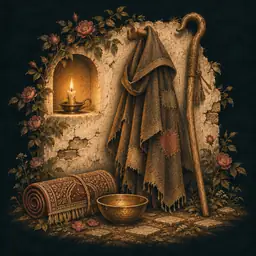 Sufism
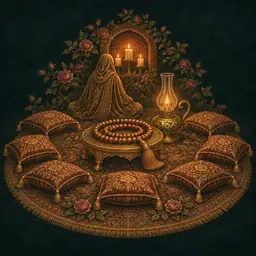 Dhikr
 Fana
 Tariqa
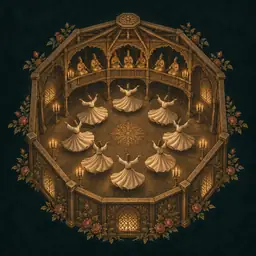 Sema
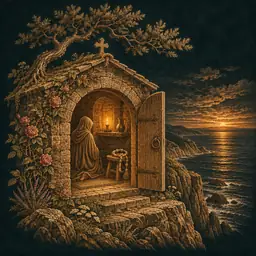 Hesychasm
 Jesus Prayer
 Dark Night of the Soul
 The Cloud of Unknowing
 Apophatic Theology
 Zen
 Zazen
 Koan
 Satori
 Advaita Vedanta
 Taoism
 Wu Wei
 Hasidism
 Devekut
 Tzaddik
 Bhakti
Philosopher born in Egypt, pupil of Ammonius Saccas at Alexandria, who taught in Rome from 244. His pupil Porphyry gathered his essays as the Enneads. He teaches three levels above the world of sense: the One, beyond all naming; Intellect; and Soul, from which each soul comes down and to which, by turning inward and upward, it can return. Later Platonism, and through it Christian, Jewish and Islamic mysticism, rests on him.
The Tao Te Ching, some five thousand Chinese characters in eighty-one short chapters, is the founding text of Taoism: the Way that cannot be named, the strength of what yields, action without forcing. The oldest copies found, on bamboo slips from Guodian, date from about 300 BC.
Indian yogi and astrologer of Bengal, teacher of Paramahansa Yogananda, who made him known in Autobiography of a Yogi (1946). His short book The Holy Science (1894) sets passages of the Bible beside Hindu scripture and gives his own reckoning of the world ages: a cycle of 24,000 years, which he tied to the precession of the equinoxes and to the Sun moving round a companion star.
Philo of AlexandriaAl-GhazaliHildegard of BingenJoachim of FioreSuhrawardiIbn ArabiRumiRamon LlullMeister EckhartIgnatius of LoyolaTeresa of ÁvilaJohn of the CrossJakob BöhmeThe Baal Shem TovLouis-Claude de Saint-MartinWilliam BlakeRalph Waldo EmersonRamakrishnaAnna KingsfordVivekanandaGeorge GurdjieffP. D. OuspenskyRené GuénonHelen SchucmanZhuangziNagarjunaAdi ShankaraPadmasambhavaMilarepaSri AurobindoHazrat Inayat KhanAldous HuxleyMircea EliadeIdries ShahValentinusManiAvicennaEmanuel SwedenborgHenry Steel OlcottJiddu KrishnamurtiErwin SchrödingerDavid BohmBodhidharmaD. T. SuzukiRamana MaharshiParamahansa YoganandaGershom ScholemShunryu SuzukiAlan WattsThich Nhat HanhRam DassThe Monkey KingProclusAbraham AbulafiaIsaac LuriaAnnie BesantWilliam JamesPatanjaliLahiri MahasayaJoseph CampbellThe Holy Grail
MeditationYoga, qigong, tai chiThe spirit realmChakras and the breath
Make today specific
The same sky reaches everyone differently. Your birth details turn a general forecast into one theme, and one thing worth doing about it.
One instrument, one answer. Explore the preview; membership opens every tool.
Read more

