
Lahiri Mahasaya
1828 to 1895
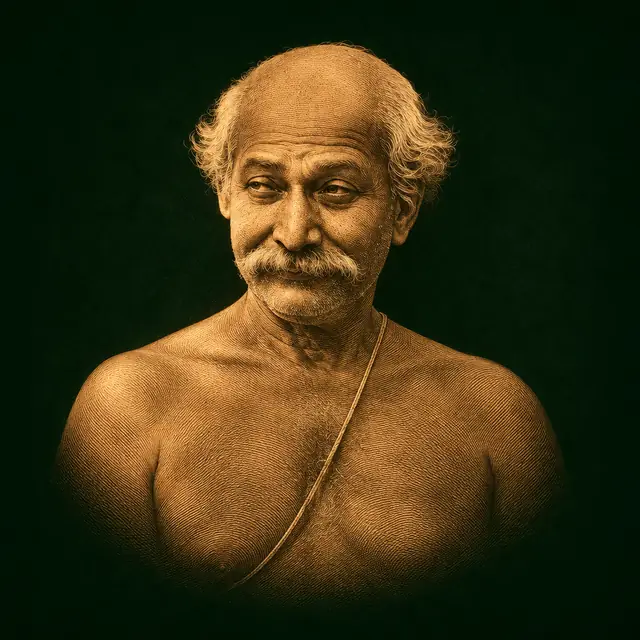
Who was Lahiri Mahasaya, and what is truly known of them?
What is known
Shyama Charan Lahiri, a Bengali householder who worked as an accountant in the Military Engineering Department of British India and lived most of his life at Benares. From the 1860s he taught a discipline of breath and meditation he called Kriya Yoga to people of every caste and faith, while keeping his post, his wife and his children. Commentaries on the Bhagavad Gita and other scriptures were taken down from him by his pupils. Among those pupils were Sri Yukteswar and the parents of Paramahansa Yogananda, whose Autobiography of a Yogi (1946) made him known outside India. Most of what is told of him comes from that book and from his disciples.
The teaching
Taught from his commentaries as his pupils took them down, and the Kriya teaching his line hands on.
Kriya, the yoga of the breath
Lahiri Mahasaya teaches that God is found by stilling the breath and with it the mind, and that the way to that stillness is Kriya Yoga, an inward work of breath and attention along the spine. In his line the practice is given only by a teacher, at an initiation and in stages, and its methods are not written out for strangers; what is taught openly is its aim and its meaning. The breath is the tie between the soul and the body. While it moves restlessly the mind is pulled outward into the senses; as it grows calm the mind turns inward; and when breath and mind are still, the soul knows itself.
Breath offered into breath
He finds the practice in the Bhagavad Gita. In its fourth chapter Krishna speaks of yogis who offer the outgoing breath into the incoming and the incoming into the outgoing, restraining the course of both; in its fifth, of the sage who shuts out outward contacts, fixes the gaze between the brows and makes even the breaths that move within the nostrils, and so becomes free. Lahiri reads these verses as the Kriya itself: the breath drawn upward and sent downward along the spine, each breath offered into the other, until their movement is evened and comes to rest.
The field of the battle
His commentary reads the whole Gita as a map of the inner work. The field of Kurukshetra, where the armies meet, is the body. The blind king Dhritarashtra is the mind blinded by the senses, and his hundred sons are the desires and habits born of them. The five Pandava brothers are the five centres of the spine, from the centre of earth at its base to the centre of ether at the throat, and Arjuna, who must fight, is the yogi's power of self-control. Krishna, his charioteer, is the soul, the inner teacher who guides the battle. The war the Gita commands is the yogi's struggle to bring the senses back under the soul's rule.
The householder's way
The way, he teaches, is open to people as they are. He kept his post, his family and his home all his life, and he told his pupils to do the same: to meet their duties to work and kin in full, and to give their hours of practice to God, morning and evening, without leaving the world. The path asks no change of caste or faith; he gave it to Hindus of every caste, to Muslims and to Christians, and asked of each only steadiness. His counsel for the long road is short: banat, banat, ban jai, doing, doing, one day it is done.
The stillness after the practice
The practice itself is not the goal. The goal is the stillness that follows it, which his line calls the state beyond Kriya: a calm in which the breath is quiet of itself, the attention rests at the point between the brows, and the yogi abides as the witness of all that moves. In his teaching this state is carried back into work and family, so that the householder acts in the world from a centre the world cannot shake.
The cautions of the line
The tradition holds to its cautions, and they belong to the teaching. Kriya is learned from an initiated teacher, in its order, never from a page; the breath is never forced or held to the point of strain, and its stillness comes of itself, slowly, over years; the higher methods are given only when the first ones are steady. Anyone who meets dizziness, breathlessness, pain, fear or a troubled mind in breath practice should stop and seek a teacher's counsel, and a doctor's where the body is concerned. The fruit his line looks for is not a wonder but a quiet mind.
Orders and memberships
No monastic order: he remained a householder all his life. The lines of Kriya Yoga teachers, among them the Self-Realization Fellowship founded by Yogananda, trace their initiation to him.
The legend
That he was initiated in 1861 in the Himalayan foothills near Ranikhet by Mahavatar Babaji, an undying teacher centuries old, who made a golden palace appear for the purpose. The meeting rests on his own telling as his disciples passed it on, and no record of Babaji exists outside the tradition. It is also told that a camera could not take his picture until he allowed it.
Their works
- Autobiography of a YogiAccount, 1946
The book by Paramahansa Yogananda, whose parents were Lahiri’s pupils, that made him known outside India. It tells his meeting with Mahavatar Babaji and many wonders, as his disciples passed them on. Most of what the world knows of him comes from it.
Written by a disciple’s son, and its stories rest on the tradition, not on records.
Ask the Oracle about it - Commentaries on the Bhagavad GitaTeaching, late 19th century
Explanations of the Gita and other scriptures in the light of Kriya Yoga, taken down by his pupils and printed in Bengali by Panchanon Bhattacharya. They read the battle of the Gita as an inward struggle of the yogi.
Taken down and edited by his pupils, so the wording is not certainly his.
Ask the Oracle about it - Purana PurushaBiography, 2000
A life of Lahiri by Ashoke Kumar Chatterjee, and drawn, it says, from his own diaries kept by the family. It gives a fuller picture of the householder yogi than the older books.
The diaries it draws on have not been published in full.
Ask the Oracle about it
How the house tells a life
This life is told from the record, with what is documented, what is legend and what was forged kept apart. A membership in an order is stated only where documents show it. A person’s chart explains none of their deeds.
The arts it feeds
Lives near it in time
Thinkers and teachers
Godfrey HigginsRobert TaylorPhineas QuimbyRalph Waldo EmersonGiuseppe MazziniGerald MasseyRamakrishnaWilliam JamesFrederic MyersFriedrich NietzscheSri YukteswarNikola TeslaThe whole tree

