
Where the chakras come from
The tantric maps of India, and the modern seven colours.
Where do the chakras come from, and how old is the seven-colour system?
The chakras are a map of attention from the yogic and tantric traditions of India; the seven coloured centres most people know are a modern Western retelling. They are not anatomy, and the breath is worked with gently.
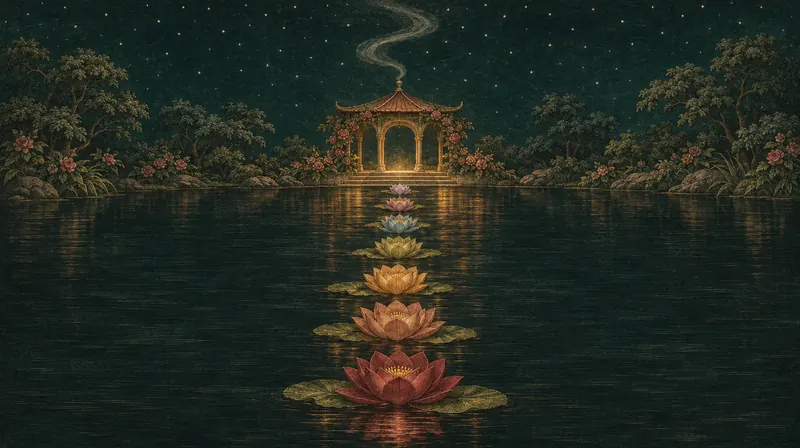
A map of attention, and a safe breath
Ask the OracleWhat are the chakras, and what is a safe way to work with the breath?
The chakras are a map of attention from the tantric traditions of India: points along the spine where a meditator places the mind, each pictured as a lotus with its own sound, element and deity. The texts count them differently, four in one school, six or seven in another. With them come the channels called nadis and the life-breath called prana, and together these make up what the traditions call the subtle body.
The seven rainbow-coloured centres most people know are a Western retelling, assembled between about 1880 and 1980 from one sixteenth-century text, the writings of Theosophists and the psychology of the 1970s. None of it is anatomy, and no instrument has found a chakra. The house reads the map as a way of directing attention, and keeps the breath that goes with it slow, seated and gentle.
As the yoga of the subtle body in the tantric and hatha texts teaches it.
The whole art rests on a link that anyone can feel: the breath and the mind move together. The Hatha Yoga Pradipika says that they are mixed like milk and water and alike in all they do, so that where the breath moves the mind moves, and where the mind moves the breath moves. It also gives the order of rule. The mind is lord of the senses, the breath is lord of the mind, and the breath in its turn is ruled by absorption, the mind's dissolving into stillness.
Fear quickens the breath and makes it rough; a settled mind breathes slowly and quietly without being told to. So the yogi works on the mind by way of the breath, and on the breath by way of a steady body, from the outside in: first a firm seat, then an easy breath, then a place for the gathered mind to rest. The texts draw those places in great detail, as wheels along the spine, so that the attention has something to settle on.
The body that can be touched is the gross body, made of food. Within it the texts describe a subtle body of breath, mind and senses, known from inside by attention rather than seen with the eye, and it is the field of this whole art: the channels, the wheels and the coiled power all belong to it. The tantras teach it as the world in small, with the spine for the mountain at the world's centre. The fuller account, of three bodies and of five sheaths, is given in Where the chakras come from.
Through the subtle body moves prana, the breath of life, which the texts divide into five winds by the work each does. Prana moves in channels, the nadis, which the texts count by the thousand, and three are chief. Ida runs on the left and is cool, the channel of the moon. Pingala runs on the right and is hot, the channel of the sun. Between them, within the spine, runs sushumna, the middle channel.
In ordinary life, the texts say, the breath flows in ida and pingala, now more through one nostril and now through the other, and the mind wanders with it. The yogi's aim is a breath that grows even between the two and at last enters the middle channel, where the mind falls still.
Where channels gather along sushumna the texts set a chakra, a wheel, and picture it as a lotus whose petals are the channels spreading out from it. Each petal bears a letter of the Sanskrit alphabet and each lotus a seed syllable at its heart, so that the subtle body is made of sound as well as breath. At the root, coiled around the self-born linga of Shiva, her mouth closing the door of the middle channel, sleeps the power called kundalini, the coiled one.
The wheels climb the elements from the densest to the finest. Muladhara, the root support at the base of the spine, holds earth, whose sense is smell. Svadhisthana, at the root of the genitals, holds water, whose sense is taste. Manipura, the city of jewels at the navel, holds fire, whose sense is sight. Anahata, the unstruck, at the heart, holds air, whose sense is touch. Vishuddha, the purified, at the throat, holds space, whose sense is hearing. Ajna, the command, between the eyebrows, is beyond the elements and is the seat of the mind. Above them all, at the crown, is the lotus of a thousand petals, sahasrara, not one more station on the road but the place where the road ends.
Every lotus, with its petals, letters, seed syllable and gods, is taught on its own in The seven centres, and the counts that other schools keep are given in Where the chakras come from.
Behind the ladder stands the tantric account of the world. Shiva is pure consciousness, still, and Shakti is his power, moving. In making the world she unfolds from the finest to the densest, in the order the Taittiriya Upanishad gives: from the self came space, from space air, from air fire, from fire water, and from water earth. The body repeats that order from the crown down to the root, and there the power comes to rest at the bottom of her unfolding, in earth, and sleeps, while Shiva stays above.
The highest yoga of these texts runs the unfolding backwards. Woken by long discipline, the power rises through the middle channel, and at each wheel its element is absorbed into the next finer one, earth into water and so on up to mind, until at the crown she is one with Shiva and the mind comes to rest beyond all its movements. That road, the knots along it and the old texts' own warnings are taught in Kundalini; the brow, where the three channels meet, is taught in The third eye.
In practice the wheels do not come first. Patanjali's path runs through eight limbs: restraint and observance in how a person lives, then a steady seat, then the regulation of the breath, then the withdrawal of the senses, and only then concentration on a single place, meditation and absorption. The Hatha Yoga Pradipika keeps the same order in its own terms, the postures first and the breath after, with moderation in food beneath them both.
The wheels belong to concentration, dharana, the binding of the mind to one place, and the commentary on Patanjali names the circle of the navel and the lotus of the heart among those places. So the map is learned early but used only on a steady seat and with a quiet breath, and the breath that goes with it is the plainest kind: slow, even and through the nose, never held. That breath, and why the old texts insist on taming it slowly, is taught in Gentle breath.
A beginner starts with the seat and the natural breath. Sit upright on a chair, both feet on the floor, the back free of the chair, the hands resting on the thighs, the eyes closed or lowered. Let the breath come and go through the nose as it already does, and watch it for a minute or two without changing it. Left alone and watched, it often slows of its own accord.
Then rest the attention lightly at the centre of the chest, where the texts place anahata, for three or four minutes. Notice what is felt there, warmth, pressure, movement or nothing at all, without trying to change it, and when the mind wanders, bring it back to the chest. On later days the map can be walked, a minute at each place from the base of the spine to the crown, with one word noted for what is felt at each, as The seven centres shows.
Nothing is pressed and nothing is opened. The breath is never held or forced: never in water, in the bath or at the wheel, and not at all by anyone who is pregnant or has a heart condition, epilepsy, or a history of panic, psychosis or mania. If pressure or heat builds in the head, bring the attention down to the belly and the feet and end there. Dizziness, tingling, a racing heart or a feeling of unreality means stop and breathe normally; frightening states or sleepless nights mean stop the practice and see a doctor.
The five branches below take the map apart in order. Where the chakras come from gives the subtle body whole, with its sheaths, winds and channels, and the different counts of the schools. The seven centres walks the lotuses one by one, the old description and the modern meaning side by side. Gentle breath is the practice that goes with the map, and the place where a beginner's own work begins.
Kundalini is the end of the road in the texts, the rising of the coiled power, and the reason every teacher urges care; no method for it is given here. The third eye is the brow centre, where the three channels meet and the teacher's command is received, together with the modern teaching that has grown up around it. Read in that order the branches climb from the ground to the summit, while a beginner's practice stays at the ground: a steady seat, an easy breath and a quiet place for the mind.
These are maps of attention from the yogic traditions, not anatomy. Keep to slow, gentle breathing while seated; never breathe forcefully or hold your breath in water or at the wheel, or at all if you are pregnant or have a heart condition, epilepsy, or a history of panic, psychosis or mania. If practice brings frightening states or sleepless nights, stop and see a doctor.
Each one is a question you can ask.
The tantric maps of India, and the modern seven colours.
Where do the chakras come from, and how old is the seven-colour system?
From the root to the crown, one by one.
What are the seven chakras, one by one?
Slow, even, through the nose, seated.
What is a safe, gentle breathing practice to begin with for the chakras?
The coiled energy of the tantric texts, and why teachers urge care.
What is kundalini, and why do teachers urge caution?
The brow centre in the tradition, and the pineal gland in the modern retelling.
What is the third eye in the chakra tradition, and what is said of the pineal gland?
Each opens its page in the dictionary.
Indian yogi and astrologer of Bengal, teacher of Paramahansa Yogananda, who made him known in Autobiography of a Yogi (1946). His short book The Holy Science (1894) sets passages of the Bible beside Hindu scripture and gives his own reckoning of the world ages: a cycle of 24,000 years, which he tied to the precession of the equinoxes and to the Sun moving round a companion star.
Franz Anton MesmerCharles LeadbeaterWilhelm ReichLahiri MahasayaKrishnamacharyaParamahansa Yogananda
Make today specific
The same sky reaches everyone differently. Your birth details turn a general forecast into one theme, and one thing worth doing about it.
One instrument, one answer. Explore the preview; membership opens every tool.
Read more

