
Charles Leadbeater
1854 to 1934
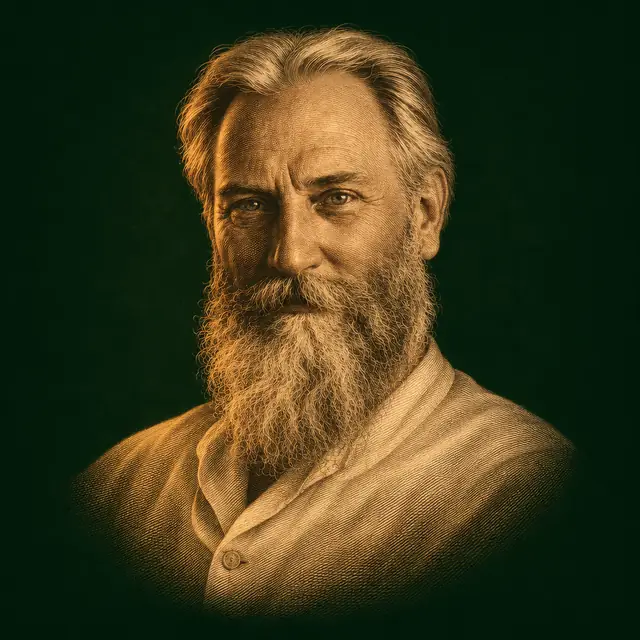
Who was Charles Leadbeater, and what is truly known of them?
What is known
English clergyman and Theosophist, born at Stockport. Ordained in the Church of England in 1879, he joined the Theosophical Society in 1883 and sailed for India with Helena Blavatsky the next year. His books of clairvoyant description, among them Man Visible and Invisible (1902) and The Chakras (1927), gave the West its coloured picture of the aura and the seven centres. In 1906 he resigned from the Society after charges about his conduct with boys in his care, which a committee of the Society heard; Annie Besant had him readmitted in 1908. In 1909 at Adyar he picked out the boy Jiddu Krishnamurti. From 1914 he lived in Sydney, where he became a bishop of the Liberal Catholic Church.
The teaching
Taught from his own books, above all The Chakras (1927), Man Visible and Invisible (1902) and The Hidden Side of Things (1913).
A clairvoyant's map
Leadbeater writes as an observer. His books describe what he says trained clairvoyant sight shows, and he holds that such sight is a faculty latent in everyone, to be opened by purity of life and long practice and never by force. Of its kinds he counts the momentary flash, sight at a distance in space, sight into the past and the future, and the power to magnify the very small, which he says he used to look at atoms. His map of the planes, of the astral world and its people, and of the forms that thoughts take is taught in The planes and the cord; what follows is the rest of his teaching.
The aura
Man Visible and Invisible paints the aura in layers. Nearest the body is the health aura, a bluish white mist whose fine lines stand straight out from the skin in health and droop and tangle in sickness or fatigue. Through it and beyond it is the astral body, its colours changing with every feeling; beyond that the mental body, finer and steadier, coloured by the habits of thought; and around all the causal body, the vehicle of the lasting self, faint in most people and in the developed a great oval of light. The plates show the aura of the undeveloped person, the ordinary person and the developed, of the devotional type and the scientific, and of one person in anger, fear, devotion and love.
The wheels of force
The Chakras teaches that the centres are wheels, chakra being the Sanskrit for wheel: saucer-like vortices on the surface of the etheric double, where the divine life pours into the body. In the undeveloped they glow dully and turn slowly; in the developed they blaze and spin like little suns. He counts seven and gives each its number of spokes, the petals of the Indian books: four at the base of the spine, six at the spleen, ten at the navel, twelve at the heart, sixteen at the throat, ninety-six at the brow in two halves of forty-eight, and at the crown nine hundred and sixty, with twelve more at its heart.
His list differs from the Indian one in one place, and he says why. Where the Indian books set a centre near the organs of generation, he sets the spleen centre instead, holding that to arouse the lower one is fraught with danger. The spleen centre, he teaches, takes in the vitality that comes from the sun in tiny globules, breaks it into rays of seven colours and sends each to its part of the body. The Indian teaching of the centres is told in The seven centres.
The serpent fire, kundalini, sleeps at the base of the spine. Leadbeater warns that it is not to be roused before the character is purified and the right moment has come, and that to force it brings pain, illness and worse. He gives no method for rousing it, and the house gives none.
The hidden side of things
Everything about us acts on us unseen. The Hidden Side of Things teaches that every object takes on the magnetism of those who handle it and of the feelings felt near it, so that a jewel holds something of its wearers, an old house something of its history, a church the devotion of its worshippers and a shop the anxieties of its trade. Music builds forms of colour in the finer matter as it is played, and crowds, sounds and the places where people sleep, work and pray all have their influence.
From this comes a rule of daily life: to surround oneself with what is clean, beautiful and kindly made, to choose company, reading and amusement for what they leave behind, and to keep one's own thought clean, since each person sends out influence as surely as they receive it. The same law makes help possible. A thought of love sent to another, he holds, reaches them, and those who train themselves can serve in sleep as invisible helpers to the dying, the frightened and the newly dead.
The Masters and the path
The Masters and the Path sets out the inner government of the world as he describes it. At its head is the Lord of the World; beneath him stand the Buddha, the World Teacher, whom he names the Lord Maitreya, the Manu and the Mahachohan; and below them the Masters, Morya and Koot Hoomi among them, each working on one of seven rays of life. They are men who have finished human evolution and stay to help it forward.
The way to them runs through three stages of pupilship, as a pupil is first put on probation, then accepted, then made a son of the Master, one with his consciousness, and through five great initiations, of which the arhat's is the fourth and the adept's the fifth. The four qualifications for the path are those he taught with Besant: discrimination, desirelessness, good conduct and love.
The science of the sacraments
As a bishop of the Liberal Catholic Church he taught that the Mass, rightly said, builds a great form in the finer worlds over the altar, a structure raised by the words and acts of the rite and the devotion of the people, through which spiritual force pours out to bless them and the country round. He described each stage of it in The Science of the Sacraments, and held that the rite works by its own form through any validly ordained priest.
Orders and memberships
The Church of England, as a priest from 1879; the Theosophical Society from 1883; the Co-Masonic order from 1915; and the Liberal Catholic Church, which consecrated him bishop in 1916 and made him its presiding bishop in 1923.
The legend
That he was born in 1847, grew up in Brazil and studied at Oxford. He gave these out himself, and his biographer Gregory Tillett found the records against them. His clairvoyant accounts of atoms, of past lives and of the planets are his own reports and have no other witness.
Their works
- The ChakrasBook, 1927
His book on the seven centres in the body, with coloured plates of their wheels as he said he saw them. It gave the West its picture of the chakras, which differs in places from the Indian texts.
Ask the Oracle about it - Man Visible and InvisibleBook, 1902
A book of coloured plates of the aura of people in different states of mind and stages of growth, as he described it from clairvoyance. It fixed the coloured aura in Western esotericism.
Ask the Oracle about it - The Astral PlaneBook, 1895
An early book on the world he said lies next to ours and is reached in sleep and after death. It set the vocabulary of Theosophy for a generation. It rests, like his later books, on his own reports of what he saw.
Ask the Oracle about it - Thought FormsBook, 1901
Written with Annie Besant, coloured pictures of the shapes and colours they said thoughts and feelings take. Its plates are often named among the sources of abstract painting.
Ask the Oracle about it - The Hidden Side of ThingsBook, 1913
Two volumes on the unseen effects he said everyday things have on people, from music to places and jewels. Like his other books it rests on his own reports. It was among his most popular books and stayed in print for many years.
Ask the Oracle about it - The Masters and the PathBook, 1925
His account of the Masters of the Theosophical tradition and of the stages of the path to them. It fixed the later Theosophical picture of the Masters, which has no witness but his own.
Ask the Oracle about it
How the house tells a life
This life is told from the record, with what is documented, what is legend and what was forged kept apart. A membership in an order is stated only where documents show it. A person’s chart explains none of their deeds.
The arts it feeds
Chakras and the breathAstral projectionPast lives and karmaOrders and mystery schools
Lives near it in time
Lives and legends
Henry Steel OlcottDaniel Dunglas HomeThe Fox sistersAnna KingsfordAnnie BesantWilliam Wynn WestcottMacGregor MathersLéo TaxilArthur Edward WaiteJoséphin PéladanFlorence FarrRudolf SteinerThe whole tree

