
MacGregor Mathers
1854 to 1918
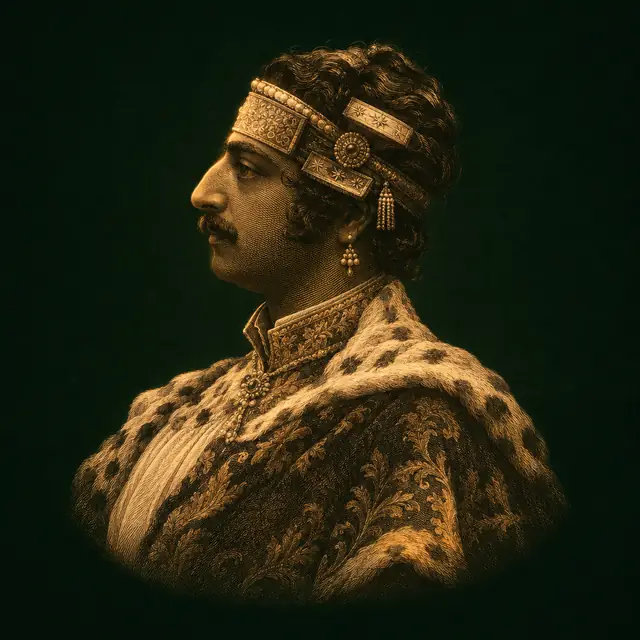
Who was MacGregor Mathers, and what is truly known of them?
What is known
English occultist, born Samuel Liddell Mathers in London and for some years a clerk at Bournemouth. He put into English the books on which modern ceremonial magic rests: The Kabbalah Unveiled (1887), The Key of Solomon the King (1889) and The Book of the Sacred Magic of Abramelin the Mage (1898). In 1888 he co-founded the Hermetic Order of the Golden Dawn and wrote most of its rituals. He married the painter Mina Bergson in 1890 and moved to Paris in 1892. In 1900 the London members expelled him, after he sent the young Aleister Crowley to seize their rooms. In 1910 he went to law to stop Crowley printing the rituals, and lost on appeal. He died in Paris.
The teaching
Taught from The Kabbalah Unveiled (1887), the Abramelin (1898) and the rituals he wrote for the Golden Dawn.
The three veils of negative existence
The introduction to The Kabbalah Unveiled begins above the Tree. Before anything can be said to be, there are three veils of negative existence: Ain, nothing, of which nothing can be thought; Ain Soph, the limitless; and Ain Soph Aur, the limitless light. Out of the limitless light the first point of being concentrates itself, and that point is Kether, the Crown, from which the other nine sephiroth flow one from another down to Malkuth, the Kingdom.
The sephiroth stand in three pillars: mercy on the right, severity on the left, and between them the pillar of mildness that balances the two. The whole system, for Mathers, turns on that balance.
The countenances and the bride
The books of the Zohar he translated speak of God in faces. Kether is Arikh Anpin, the Vast Countenance, the Ancient of Days, seen only in profile and all mercy; the six sephiroth from Chesed to Yesod make Zauir Anpin, the Lesser Countenance, the King; and Malkuth is the Bride and Queen of the Lesser Countenance. The Greater and Lesser Holy Assemblies describe these faces feature by feature, the hair, the brow, the eyes and the beard, each part a mode of the divine life.
He takes from the same books the teaching that the divine is male and female. Elohim, the name of God in the first verse of Genesis, is a feminine word with a masculine plural, and the translators, he says, have hidden the fact that the creative power is both, as the first human beings, made in its image, were made male and female.
The kings of Edom
Before the balanced world, the Zohar tells, there were kings who reigned and died: the kings of Edom, who reigned before any king reigned over Israel. Mathers reads them as worlds of unbalanced force, made and destroyed before creation came into equilibrium. Unbalanced force is the root of evil, and the work of the magician, as of the universe, is to bring every force into balance with its opposite.
The literal Qabalah
The introduction also teaches the three ways of reading letters. In gematria every Hebrew letter is a number, and words of the same sum are held to share a meaning: the promise in Genesis that Shiloh shall come, YBA ShILH, adds to 358, which is also the sum of MShICh, the Messiah. In notariqon a word is read as the initials of a sentence, or a sentence is gathered into its initials, as AGLA is made from Ateh Gibor le-Olahm Adonai, thou art mighty for ever, O Lord. In temurah the letters are exchanged by rule, the first of the alphabet for the last and so on, and by this Sheshach in Jeremiah is read as Babel.
The sacred magic of Abramelin
The Abramelin he translated sets one work before all others: the knowledge and conversation of one's holy guardian angel. In the version he used it takes six months of withdrawal from the world, with prayer growing longer and purity stricter as the months pass, in an oratory kept for nothing else. Only at its end does the angel appear, and only under the angel's guidance may the magician go on to call the spirits of the lower world and bind them to good uses by the squares of letters the book gives. The grimoires, this one among them, are taught in The grimoires.
The book warns that its power turned to harm recoils on the one who uses it, and that the work asks a life few can lead. Its austerities are taught here as the book's demand and not as a practice: no one whose health a fast or a long seclusion could harm should attempt any part of it.
The formula of the Neophyte
For the Golden Dawn Mathers wrote most of the rituals, whose grades and rites are taught in The Golden Dawn. His teaching in them is that one formula runs through every kind of work. The ceremony of the Neophyte, which brings a candidate out of darkness into light, is also the pattern of a consecration, an evocation, a divination or a work of alchemy: the same steps of purifying, consecrating, declaring the work, invoking the powers and closing are followed, and only the matter changes.
The order's papers tie the kinds of work to the letters of the name YHShVH: evocation to Yod, the making of talismans to He, the works of invisibility, transformation and spiritual growth to Shin, divination to Vau, and alchemy to the final He. Over all of it stands the rule Mathers took from the books he translated, that the work is to purify and exalt the magician's own nature, and that magic turned to harm binds the one who works it.
Orders and memberships
Freemasonry, from his initiation at Bournemouth in 1877; the Societas Rosicruciana in Anglia from 1882; and the Golden Dawn, which he co-founded in 1888 and ruled until the split of 1900, leading his own branch afterwards.
The legend
That he was a Highland chief and Count of Glenstrae, by a French title given to a Jacobite forebear, and that he met the order’s “Secret Chiefs” in a Paris park about 1892. The descent has no proof and the meeting only his word. That Crowley killed him by magic is a later tale; he died in the influenza autumn of 1918 and his death certificate names no cause.
Their works
- The Kabbalah UnveiledTranslation, 1887
His English version, by way of the Latin of Knorr von Rosenroth, of three books of the Zohar, with a long introduction. It was for many years the main door to the Kabbalah for English readers of the occult.
Ask the Oracle about it - The Key of Solomon the KingTranslation, 1889
His edition and translation of the Key of Solomon from manuscripts in the British Museum, the best known of the grimoires. Ceremonial magicians have used it ever since.
The Key of Solomon itself is a work of the Renaissance falsely ascribed to Solomon.
Ask the Oracle about it - The Book of the Sacred Magic of Abramelin the MageTranslation, 1898
His translation of a French manuscript in the Arsenal library at Paris, telling of a long retreat to meet one’s guardian angel. It shaped Aleister Crowley and much modern magic.
The book claims to be by a Jew of the fifteenth century, and the French text he used is a late and partial version.
Ask the Oracle about it - The Tarot: Its Occult SignificationBook, 1888
A short guide to the tarot and its use in divination, sold with a pack of cards. It was among the first English books on the tarot. It gives the meanings of the cards and simple ways of laying them out, and it was soon followed by the Golden Dawn’s own fuller teaching.
Ask the Oracle about it - The rituals of the Golden DawnRitual, from 1888
The ceremonies of the order and of its inner Rose and Cross grade, most of which he wrote. Israel Regardie printed them between 1937 and 1940, and they shape most ceremonial magic today.
Ask the Oracle about it - The GoetiaTranslation, 1904
The first book of the Lesser Key of Solomon, a catalogue of seventy-two spirits, translated by Mathers and printed by Aleister Crowley after their quarrel. It is among the most used of the grimoires.
Printed by Crowley without Mathers’s consent, and the grimoire itself is ascribed to Solomon.
Ask the Oracle about it
How the house tells a life
This life is told from the record, with what is documented, what is legend and what was forged kept apart. A membership in an order is stated only where documents show it. A person’s chart explains none of their deeds.
The arts it feeds
Magic and protectionThe Tree of LifeOrders and mystery schoolsTarot, runes, I Ching
Lives near it in time
Lives and legends
Daniel Dunglas HomeThe Fox sistersAnna KingsfordAnnie BesantWilliam Wynn WestcottCharles LeadbeaterLéo TaxilArthur Edward WaiteJoséphin PéladanFlorence FarrRudolf SteinerStanislas de GuaitaThe whole tree

