
Rudolf Steiner
1861 to 1925
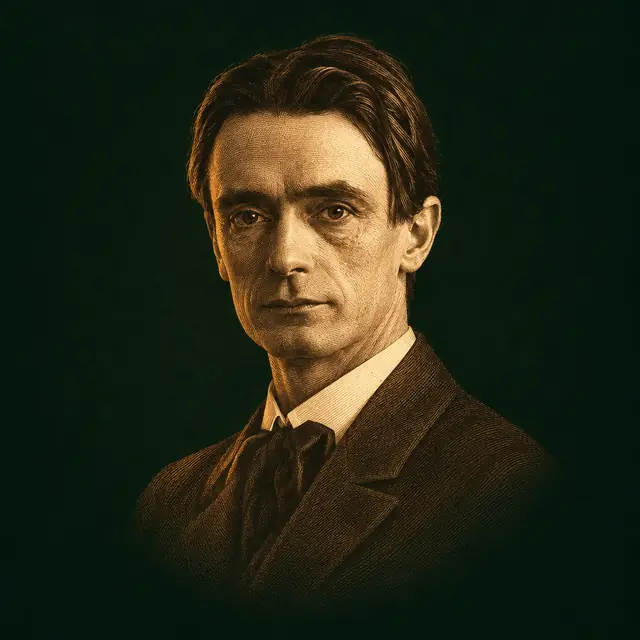
Who was Rudolf Steiner, and what is truly known of them?
What is known
Austrian philosopher who led the German section of the Theosophical Society from 1902, broke with it, and founded the Anthroposophical Society in 1912 and 1913. Waldorf schools (1919) and biodynamic farming (1924) come from him. Some of his statements about race are rejected today, including by anthroposophists.
The teaching
Taught from his own books and lectures, from The Philosophy of Freedom (1894) to the Agriculture Course (1924).
Thinking and freedom
The Philosophy of Freedom begins with thinking. The world comes to us first as percepts, what the senses and the inner life present; thinking brings to them the concepts that belong to them, and knowledge is the joining of the two. Thinking is therefore not a copy made inside the head of a world outside it, but the place where a person stands within the world's own order. In thinking, which a person can observe as their own activity, they meet something that rests on nothing but itself.
From this comes his ethics. An act is free when it springs from a person's own insight into what the moment asks, a moral intuition grasped in thinking, and is done out of love for the deed itself, not from command, custom or fear. Steiner calls the one who acts so a free spirit, and gives the rule of a society of such people: to live in love toward one's own actions, and to let others live in understanding of their will.
Body, soul and spirit
Theosophy describes the human being as threefold, body, soul and spirit, and then in finer detail. There is the physical body, which a person shares with the minerals; the life body or etheric body, the body of formative forces, shared with the plants; and the soul body or astral body, the bearer of feeling and desire, shared with the animals. In the soul the I lives and works, first as the sentient soul, then as the intellectual or mind soul and then as the consciousness soul, and the I is to transform the bodies into spirit, as spirit self, life spirit and spirit man.
The I is the centre, the one name each person can give to themselves alone. It returns to earth in life after life, each life shaped by the deeds of earlier ones, the law he calls karma. Between death and a new birth the soul passes through the soul world, where it is freed of its longing for the physical, and on into the land of spirit, where it gathers the fruit of the life just lived and prepares the next.
The path of knowledge
How to Know Higher Worlds teaches that the powers of higher knowledge sleep in every person and can be woken by patient inner work. Its first condition is reverence: a mood of devotion toward truth and knowledge, cultivated in place of criticism and judgement, since the soul that venerates grows and the soul that only criticises dries up. Its golden rule is that for every step taken toward higher knowledge, three are to be taken toward the perfecting of one's character for the good.
The practice begins with moments of inner quiet set aside each day, in which the student looks at their own experiences and deeds as a stranger would, calmly and without excuse. Then come exercises of feeling: to look at a seed and picture the plant that will grow from it, to look at a plant in full bloom and then at one withering, and to give oneself wholly to the feelings of growing and of fading that rise in the soul. In the evening the day is reviewed backward, from evening to morning.
Beside these stand six exercises of the soul, each practised for a month and then carried on with the next: control of thought, holding the mind for a few minutes on one simple object; control of action, doing one small chosen act each day at a fixed time; equanimity in joy and sorrow; seeing the good in everything; openness to what is new; and the harmony of all five together. Steiner warns against any practice that dims clear waking consciousness or weakens a person's duties in ordinary life. The training is meant to make a person more awake and more capable in daily life, and the house adds that anyone whom inner exercises unsettle should stop and seek help.
The evolution of the world
Occult Science traces the world and humankind through a series of earlier states before the present earth, which Steiner names Old Saturn, Old Sun and Old Moon, as he says he read them. On Saturn the first seed of the physical body was laid down, on the Sun the life body was added, on the Moon the soul body, and on the earth the I, so that the human being is in his teaching the oldest of the earth's creatures and not the youngest. Three states are still to come, which he names Jupiter, Venus and Vulcan, in which the I is to transform the bodies into spirit.
Lucifer, Ahriman and the Christ
Two powers work against the human being's balance. Lucifer draws upward and inward, into pride, fantasy and a spirituality that flees the earth; Ahriman draws downward, into coldness, materialism and a mind that knows only what can be measured. Neither is simply to be fled, since each holds something a person needs, and the task is to stand between them in balance. That balance, for Steiner, is the work of the Christ.
The deed at Golgotha is the centre of the whole evolution. A being from the spiritual sun, in his teaching, entered the man Jesus at the baptism in the Jordan, and through the death and the rising united himself with the earth, which has carried his life ever since. It is a deed done for all humankind and not for one faith alone, and the free I of the present age can find the Christ within its own thinking and willing.
The child's three ages
His education rests on a picture of growth in periods of seven years. From birth to the change of teeth the child learns by imitation, while the life body is still at work building the physical body, so what matters is a good example and a world worth imitating. From the change of teeth to puberty the child learns through pictures, rhythm and feeling, under a teacher loved as an authority, since the life body is now set free for learning. After puberty, with the soul body born, judgement awakens and the young person is ready to think things through for themselves. The Waldorf schools take their plan from this.
The farm as an organism
The Agriculture Course teaches that a farm is to be an individual organism, as closed in itself as it can be, raising its own feed and making its own manure, with soil, plants, animals and people in one living whole. The soil is alive, and the farmer is to tend its life rather than feed the plant with salts. The plant stands between two kinds of influence: the near, earthly forces, which he ties to lime and to the planets nearer than the sun, and the far, cosmic forces of light and warmth, which he ties to silica and to the outer planets.
For this he prescribed preparations. Cow manure is packed into a cow's horn and buried through the winter, then stirred into water for an hour, the vortex reversed again and again, and sprayed on the soil; ground quartz is packed into a horn and buried through the summer, then stirred and sprayed finely on the plants. Six more, made from yarrow, camomile, nettle, oak bark, dandelion and valerian, are put into the compost heap. The house teaches them as his doctrine.
Orders and memberships
Theosophical Society, then his own Anthroposophical Society. For some years he also led an irregular Masonic rite he had been chartered to work.
The legend
His accounts of Atlantis and earlier ages are his own clairvoyant claims and no part of the historical record.
Their works
- TheosophyBook, 1904
A short book on the nature of the human being, the life of the soul after death and repeated earth lives, written while he led the German Theosophists. It sets out the picture of body, soul and spirit that runs through all his later work. It remains one of the basic books of Anthroposophy.
Ask the Oracle about it - How to Know Higher WorldsBook, 1904 to 1905
Printed first as articles and then as a book, it describes the exercises of attention, feeling and meditation he taught for spiritual development. It is the most widely read of his books and the main guide used in anthroposophical practice. What it says of higher worlds rests on his own claims of insight.
Ask the Oracle about it - The Philosophy of FreedomBook, 1894
His philosophical work, written before his Theosophical years, arguing that thinking can be free and that moral action can rise from a person’s own insight. He held to the end that it was the ground of all his later teaching. It belongs to German philosophy after Kant and Goethe more than to the occult.
Ask the Oracle about it - Occult Science, an OutlineBook, 1910
His account of the evolution of the world and of humanity through a series of earlier states before the present earth, and of the path of knowledge he taught. It contains the cosmology that later anthroposophical writing draws on. Its accounts of past ages are his own clairvoyant claims and no part of the historical record.
Ask the Oracle about it - The Four Mystery DramasPlay, 1910 to 1913
Four plays he wrote and staged at Munich, following a group of people through their inner development and their earlier lives. They were meant to show his teaching as lived experience. They are still performed at the Goetheanum.
Ask the Oracle about it - The GoetheanumBuilding, begun 1913
The centre of the Anthroposophical Society at Dornach in Switzerland, which he designed. The first building, of carved wood with two domes, burned on New Year’s Eve 1922, and he designed its successor in poured concrete, finished in 1928 after his death. It is a landmark of expressive architecture.
Ask the Oracle about it - Agriculture CourseLectures, 1924
Eight lectures given to farmers at Koberwitz in Silesia, from which biodynamic farming comes. They join practical advice on soil and compost to his views on cosmic forces and the preparations he prescribed. The movement that grew from them is still active, though the claims about cosmic forces are not supported by agricultural science.
Ask the Oracle about it
How the house tells a life
This life is told from the record, with what is documented, what is legend and what was forged kept apart. A membership in an order is stated only where documents show it. A person’s chart explains none of their deeds.
The arts it feeds
Lives near it in time
Lives and legends
Charles LeadbeaterMacGregor MathersLéo TaxilArthur Edward WaiteJoséphin PéladanFlorence FarrStanislas de GuaitaPapusMax HeindelGrigori RasputinHarry HoudiniCarl JungThe whole tree

