
Papus
1865 to 1916
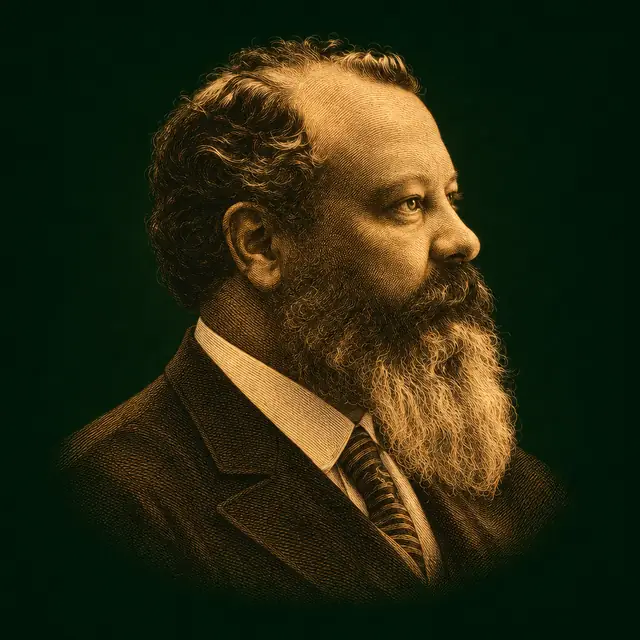
Who was Papus, and what is truly known of them?
What is known
Pen name of Gérard Encausse, a French physician born at La Coruña in Spain to a French father and a Spanish mother and raised in Paris. While still a medical student he wrote an Elementary Treatise of Occult Science (1888) and The Tarot of the Bohemians (1889), and founded the review L’Initiation. He joined the Theosophical Society and soon left it, helped de Guaita and Péladan found their Rose-Croix in 1888, and in 1891 organised the Martinist Order, which spread to many countries. He took his doctorate in medicine in 1894. Between 1901 and 1906 he travelled three times to Russia and was received by Nicholas II. He served as an army doctor in the war and died in Paris.
The teaching
Taught from his own books, above all the Elementary Treatise of Occult Science (1888) and The Tarot of the Bohemians (1889).
The method of analogy
Occult science, as Papus teaches it, differs from the science of the schools by its method. Science studies facts one by one and climbs from them to laws; the occultist uses analogy, reasoning from the known to the unknown by correspondence, since what is above is like what is below and every level of the world repeats the others in its own matter. A law found in the body is sought in the soul and in the universe, and a law found in one is a key to the others.
Everything falls into three: the world of nature, the world of humankind and the world of God; and in a person, the body, the astral body and the spirit. Papus pictures them as a carriage. The body is the coach, the astral body is the horse that draws it, and the spirit is the coachman who holds the reins. The astral body, the plastic mediator of the old writers, carries the life of the body and does its unconscious work, and the spirit governs both, or should.
The law of the divine name
The key of the whole system is the four letters of the divine name, Yod, He, Vau, He, which Papus reads as the law of every process. Yod is the active, the beginning, the masculine; the first He is the passive, the receptive, the feminine; Vau is the neutral, the link that joins the two and is born of them; and the second He is the passage to a new cycle, in which the whole becomes the first term of a new series on the next level. Every creation, from a thought to a world, runs through these four.
To numbers he applies two operations. Theosophic reduction adds the figures of a number until one is left, so that 10 and 19 both come back to 1; theosophic addition adds all the numbers up to a given one, so that 4 gives 1 and 2 and 3 and 4, which is 10. By them he shows that every number returns into the first four, the four of the divine name.
The tarot as an absolute key
The Tarot of the Bohemians builds the whole pack on that law. Each suit runs through the four letters, the king for Yod, the queen for He, the knight for Vau and the knave for the second He, and the four suits themselves answer to the letters, wands to Yod, cups to He, swords to Vau and pentacles to the second He. The twenty-two trumps, set on the Hebrew letters after Lévi, fall into three sets of seven, the divine, the human and the natural, with the Fool between the last two cards. The pack, for Papus, is the absolute key of occult science, a whole philosophy in figures.
Reintegration
His Martinist Order teaches the doctrine of Martinez de Pasqually and of Louis-Claude de Saint-Martin, the Unknown Philosopher: the reintegration of the human being. Humanity was emanated as a spiritual being, glorious and free, and fell by its own error into matter, into the body and into a world of division; its task is to return, to be reintegrated into the state it lost and into God. The way the order follows is Saint-Martin's inward way of the heart, prayer, the purifying of desire and the work of the spirit within, rather than the ceremonial theurgy of his teacher.
Its initiation passes from one initiate to another, and its chief symbols are the mask, which teaches the initiate to work unknown and without vanity, and the cloak, which teaches withdrawal into the inner life and the discretion that guards it. Its highest grade is the Unknown Superior.
Orders and memberships
The Martinist Order, which he founded in 1891 and headed; the Kabbalistic Order of the Rose-Croix from 1888; briefly the Theosophical Society; and the Paris temple of the Golden Dawn from 1895. The main French Masonic bodies did not admit him; he held degrees only in irregular rites.
The legend
That at the Russian court in 1905 he called up the spirit of Alexander III, who foretold the revolution, and that he promised the Tsar safety for as long as he himself lived. He died in October 1916, months before the fall. The story comes from the memoirs of the French ambassador, who had it at second hand.
Their works
- Le Tarot des BohémiensBook, 1889
The Tarot of the Bohemians, which reads the tarot through the Kabbalah and the Hebrew letters, after the ideas of Éliphas Lévi. It also repeats the old tale that the cards came to Europe with the Roma, a story with no historical support. In English translation it became one of the standard books on the tarot for decades.
Ask the Oracle about it - Traité élémentaire de science occulteBook, 1888
His Elementary Treatise of Occult Science, written while still a medical student. It gives a clear outline of the ideas of the French occultists, analogy, the Kabbalah and the astral plane. It made his name and was reprinted many times.
Ask the Oracle about it - L’InitiationMagazine, from 1888
The monthly review he founded and edited, which became the voice of the Paris occultists of the 1890s. It carried articles by de Guaita, Péladan and many others. It is one of the best sources for that circle and its quarrels.
Ask the Oracle about it - Traité méthodique de science occulteBook, 1891
A large and fuller treatise, setting out his whole system of occult study in one volume. It was meant as a handbook for the students of his Martinist Order and his other groups. It shows how widely he read and how much he tried to join medicine and the occult.
Ask the Oracle about it - La KabbaleBook, 1892
His study of the Kabbalah, with translations of texts and a long bibliography. It presents the Kabbalah as the French occultists understood it, joined to the tarot and to Christian mysticism. Scholars of Jewish mysticism do not follow its readings.
Ask the Oracle about it - Le Tarot divinatoireDeck, 1909
A book with a pack of cards drawn by Gabriel Goulinat, meant for reading the tarot as divination. The cards join astrological and Hebrew signs to traditional scenes. It was the last of his works on the tarot.
Ask the Oracle about it
How the house tells a life
This life is told from the record, with what is documented, what is legend and what was forged kept apart. A membership in an order is stated only where documents show it. A person’s chart explains none of their deeds.
The arts it feeds
Orders and mystery schoolsTarot, runes, I ChingThe Tree of Life
Lives near it in time
Lives and legends
Léo TaxilArthur Edward WaiteJoséphin PéladanFlorence FarrRudolf SteinerStanislas de GuaitaMax HeindelGrigori RasputinHarry HoudiniCarl JungAleister CrowleyEdgar CayceThe whole tree

