
Aleister Crowley
1875 to 1947
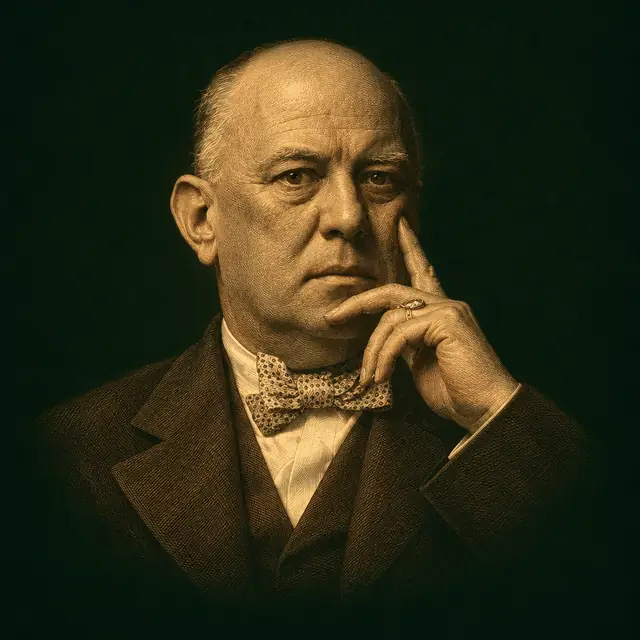
Who was Aleister Crowley, and what is truly known of them?
What is known
English occultist, poet and mountaineer. He wrote The Book of the Law in Cairo in 1904 and founded on it the religion of Thelema, whose law is “Do what thou wilt”. He ran the Abbey of Thelema in Sicily from 1920 until Italy expelled him in 1923. He struggled with heroin for much of his later life and died in Hastings.
The teaching
Taught from his own books, above all The Book of the Law (1904), Magick in Theory and Practice (1929) and The Book of Thoth (1944).
The law of Thelema
The Book of the Law gives its religion one law: “Do what thou wilt shall be the whole of the Law.” Thelema is Greek for will, and the will meant is not passing desire but the true will, the course that belongs to each person by their nature as an orbit belongs to a star. “Every man and every woman is a star,” the book says, each with its own path; stars collide only when one leaves its course. To do one's will is the whole duty of a person, and the book names the one wrong: “The word of Sin is Restriction.”
The companion law follows: “Love is the law, love under will.” Love is the union of opposites, and it is to be ruled by the will, not set against it. Thelemites greet one another with the first law and answer with the second. The book adds that pure will, delivered from the lust of result, is every way perfect: the will that acts for its own sake, without craving an outcome, cannot be thwarted.
Nuit, Hadit and Ra-Hoor-Khuit
The book speaks in three voices, one to a chapter. Nuit is the star-filled sky, infinite space and every possibility. Hadit is the point at the core of every star, the self that goes and knows, who says that he is “everywhere the centre, as she, the circumference, is nowhere found.” Nuit is “divided for love's sake, for the chance of union”: the universe is the play of the two, the endless meeting of the point with all it can experience. Ra-Hoor-Khuit, the crowned and conquering child, a form of Horus, speaks the third chapter, the voice of the new age in its force.
The aeons
History, in his teaching, moves in aeons, each ruled by a formula. The aeon of Isis was the age of the mother, of nature and its fruit. The aeon of Osiris was the age of the father and the dying god, who must be slain to rise: the age of sacrifice, with death as the gate to life. With the Book of the Law began the aeon of Horus, the child, in which life is growth rather than sacrifice, death is a phase of a continuing course, and each person's task is the free unfolding of their own will.
Magick
He spells the word with a k to set it apart from the conjuring of the stage, and defines it: “Magick is the Science and Art of causing Change to occur in conformity with Will.” By that measure every act done on purpose is magick, and a ritual is only its most concentrated form, every colour, scent, sound, gesture and word bent on one aim so that the whole person moves in one direction.
The chief aim is the Knowledge and Conversation of the Holy Guardian Angel, the meeting with one's own higher genius, which he took from the old book of Abramelin, and through it the discovery of the true will. Banishing comes first, to clear away every influence foreign to the work; the method of invocation he sums up in four words, enflame thyself in praying.
The training of the mind
Before ritual comes the yoga of attention, set out plainly in Book Four. The student takes a posture and holds it until the body is forgotten, steadies the breath, and then practises concentration: holding the mind on one simple object, a coloured shape or a point, and noting each time it wanders. The breaks are counted and written down, and the count falls slowly over months. Beyond concentration lies dhyana, in which the one who sees and the thing seen become one, and beyond that samadhi.
His drill for the control of speech and action sets a penalty for each lapse, a cut on the arm with a razor. The house leaves that out, for a tally in the notebook does the same work without harm; it never forces or holds the breath, and long sitting is built up slowly in short sessions.
The record
Every exercise and operation is entered in a diary: the date and hour, the conditions, the state of body and mind, what was done and what followed, written plainly and without flattery. His journal, The Equinox, bore the motto the method of science, the aim of religion, and the diary is how the method is kept: a working is judged by what the record shows, not by what the magician hoped.
The adorations of the sun
The daily rite he gave every student is simple. Four times a day, at sunrise, noon, sunset and midnight, the student faces the place of the sun and salutes it under the god of that hour: Ra in his rising, Ahathoor in his triumphing, Tum in his setting and Khephra in his hiding. The practice binds the day to the sun's course and recalls, at each of its four points, that the student is a star in an orbit of their own.
The grades and the Abyss
His order, the A∴A∴, follows the ladder of the Tree of Life that the Golden Dawn laid out, which the protection art's branch Ceremonial and chaos magic teaches grade by grade. What is his is its form and its goal. The student works alone, knowing only the one who teaches them and the one they teach, and rises from Probationer through the elemental grades to Adeptus Minor, whose single task is the Knowledge and Conversation of the Angel.
Beyond the adepts lies the Abyss that parts the human from the divine side of the Tree, and its crossing is the great ordeal of his system. The adept must give up all that he is, every attachment and opinion, poured out to the last drop into the cup of Babalon. Choronzon, the demon of the Abyss, is dispersion itself, the mind that will not let go. The one who crosses becomes a Master of the Temple, in whom no self remains to claim the attainment.
The tarot of Thoth
His tarot keeps the Golden Dawn's order and changes it where the Book of the Law commands. The book says “Tzaddi is not the Star,” so the Emperor and the Star exchange their letters. Strength becomes Lust, Temperance becomes Art, Justice becomes Adjustment, the World becomes the Universe, and Judgement becomes the Aeon, the old card of the dead rising replaced by the coming of the new age. The court cards are Knight, Queen, Prince and Princess, Pentacles become Disks, and every small card carries a title that gives its meaning at a glance: the Two of Cups is Love, the Three of Swords Sorrow, the Ten of Swords Ruin.
Behind the cards stand the tables of 777, in which the paths of the Tree, the signs and planets, the gods of many peoples, the colours, stones and scents are set side by side by number, so that a student who knows one column can find its kin in all the others.
What the house leaves aside
His higher degrees in the Ordo Templi Orientis taught a magic of sex, which he held to be the order's chief secret, and he used drugs in his experiments for many years. The house teaches neither. The first belongs, if anywhere, to consenting adults and their own conscience. The second cost him dearly, and his novel of the drug fiends gives the finding of the true will as their cure, which is the novel's teaching and no medicine: an addiction needs a doctor.
Orders and memberships
Initiated into the Hermetic Order of the Golden Dawn in 1898; from 1912 head of the British branch of the Ordo Templi Orientis, whose leadership he later claimed; and founder of his own order, the A∴A∴. All documented.
The legend
The press named him “the wickedest man in the world”. Tales of human sacrifice rest on his own provocations in print and on no evidence.
Their works
- The Book of the LawScripture, 1904
Three short chapters he wrote in Cairo over three days in April 1904, which he said were dictated by a voice he named Aiwass. It is the founding text of Thelema, whose law is Do what thou wilt. It was first printed in 1909.
He said it was dictated by a being he called Aiwass; that is his own account.
Ask the Oracle about it - Magick in Theory and PracticeBook, 1929
The third part of his larger Book Four, setting out his view of ritual magic, its methods and its aims. It gave the spelling magick he used to set his work apart from stage magic. It remains the most read of his technical books.
Ask the Oracle about it - The Book of ThothBook, 1944
His study of the tarot, written to go with the pack painted by Frieda Harris. It sets out his own reading of each card, joined to astrology, the Kabbalah and Thelema. It was printed in a small edition at the end of the war.
Ask the Oracle about it - The Thoth tarotDeck, 1938 to 1943
The pack painted by Lady Frieda Harris to his direction over five years, with its bold geometry and colour. It was shown in London in 1942 but not printed as a pack until 1969. It is one of the most widely used tarot packs today.
Ask the Oracle about it - The EquinoxMagazine, 1909 to 1913
The journal of his order, the A∴A∴, issued twice a year, which printed rituals of the Golden Dawn, his own writings and much else. It broke his oaths to the Golden Dawn and led to a court case. It is the main record of his teaching in those years.
Ask the Oracle about it - 777Book, 1909
A book of tables setting out the correspondences of the Kabbalah, the tarot, astrology, gods, colours and much else, largely drawn from the papers of the Golden Dawn. It became a standard reference for ritual magicians. Much of its matter came from the order’s papers, and Allan Bennett is held to have gathered part of it.
Ask the Oracle about it - Diary of a Drug FiendNovel, 1922
A novel of a young couple who fall into cocaine and heroin and are rescued by a Thelemic teacher. It draws on his own struggles with drugs. The newspapers attacked it, and it added to his public notoriety.
Ask the Oracle about it - MoonchildNovel, 1929
A novel of rival magicians in Paris and Italy fighting over an attempt to bring a spirit into an unborn child. It mocks many real figures of the occult world under false names. It was written in 1917 and printed twelve years later.
Ask the Oracle about it
How the house tells a life
This life is told from the record, with what is documented, what is legend and what was forged kept apart. A membership in an order is stated only where documents show it. A person’s chart explains none of their deeds.
The arts it feeds
Lives near it in time
Lives and legends
Stanislas de GuaitaPapusMax HeindelGrigori RasputinHarry HoudiniCarl JungEdgar CaycePamela Colman SmithAlice BaileyH. Spencer LewisGerald GardnerAustin Osman SpareThe whole tree

