
Pamela Colman Smith
1878 to 1951
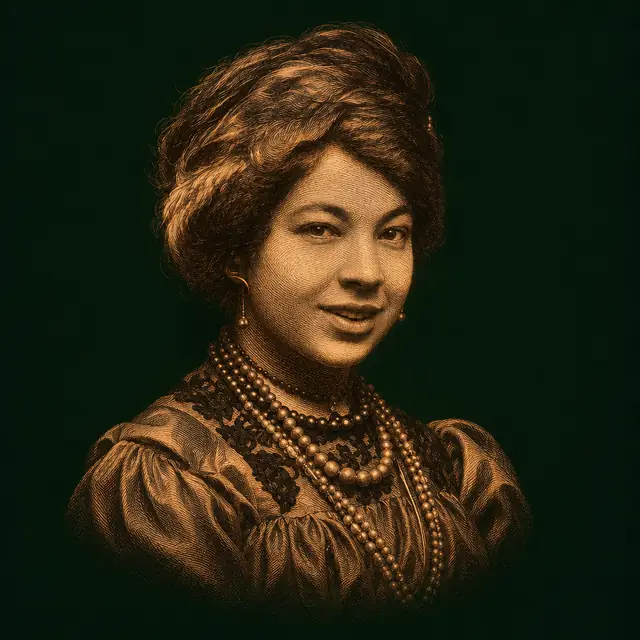
Who was Pamela Colman Smith, and what is truly known of them?
What is known
Artist and illustrator, born in London to American parents and raised partly in Jamaica, who trained at the Pratt Institute in Brooklyn. She toured with the Lyceum Theatre company of Henry Irving and Ellen Terry, illustrated books for Bram Stoker and the Yeats family, told Jamaican folk tales on stage, and in 1907 had a show at Alfred Stieglitz’s gallery in New York. In 1909 she drew all seventy-eight cards of the tarot that A. E. Waite commissioned, for a flat fee and, as she wrote to Stieglitz, very little money. She became a Catholic in 1911, moved to Cornwall, and died at Bude in debt.
The teaching
Taught from her pictures and her own words on her art, above all her essay Should the Art Student Think? (1908).
A scene on every card
Her best known work teaches by pictures. Of the seventy-eight cards she drew for Waite's pack, the twenty-two trumps follow the old subjects in the order Waite set, and the forty numbered cards, which most older packs showed only as a count of cups or swords, she gave whole scenes: people at work, in grief, at feast, in a landscape, so that a reader who forgets the book can read the card from its picture. A man bent under ten staves trudges toward a town; a woman stands bound and blindfolded among eight swords; five youths fight with staves. The meanings card by card are taught on the divination art's branch The tarot; what is hers is that the meaning is drawn as a moment of human life.
The stage as a school
She learned to draw such moments in the theatre, and told students to learn there too. Go and see all the plays you can, she wrote, for the stage is a great school to the illustrator: watch first the simple forms of joy, fear and sorrow, the position of the whole body before the face, and then the clothes, the way a cloak swings as its wearer walks, the way the hands are used. The stage, she said, had taught her almost all she knew of clothes, of action and of the gestures that tell in a picture.
Her exercise is plain. Draw a composition of fear, or sadness, or great sorrow, in a few lines and with no detail; show it to a friend and ask what it portrays; when they can tell, put in the face and the dress. A picture must first tell its tale.
The idea in the corner of the mind
Her first counsel to a beginner is to decide early what end they are working for, and to keep that idea in a corner of the mind, calling it up now and then to review the work in front of it. A student who means to paint portraits studies the faces of everyone they see and asks how to show more of a person's character than appears on the surface. A student who looks at an old portrait notes the dress, the face and the pose, fixes its period in memory, and sketches what they cannot place in order to look it up, so that the knowledge is there when a book has to be drawn.
Feel everything
“Learn from everything, see everything, and above all feel everything!” she wrote, and the rest follows from it: make whoever looks at the drawing feel it too. Hear all the music you can, she told students, for sound and form are more closely joined than we know. Think good thoughts of beautiful things, colours, sounds and places; in a crowd of dirty and weary people, look past the dirt to the great spirit in them all and the power they stand for. Through ugliness, she held, beauty is sometimes found.
She ends with a quest. Banish fear, set the ideal high, and use more than the eyes of the body: “Find eyes within, look for the door into the unknown country.” What is sought there is beauty, of thought first, then of feeling, form, colour and sound, and with it the power of showing it to others.
Pictures from music
Her own way through that door was music. She drew while it played, quickly and without a plan, and held that what came were not illustrations of the piece but visions the sound called up, figures and landscapes moving in a light of their own, and she named each picture after the music that brought it. The practice is the essay's teaching made into a method: the ear opens the inner eye, and the hand records what it sees before the mind can correct it.
Anansi
Her first book set down the Jamaican tales of Anansi, which she also told aloud on stage in the speech of their tellers. Anansi is the spider, small and weak among the beasts, who gets the better of Tiger and the rest by wit and talk; yet the trickster is often caught by his own greed, and the tales laugh at him as much as with him. They teach as folk tales do, by letting the listener watch cunning, appetite and pride at work in a creature small enough to laugh at.
Orders and memberships
Initiated into the Isis-Urania Temple of the Golden Dawn in 1901; after the split of 1903 she followed Waite into his branch of the order. Documented. No other order is recorded.
The legend
How the work on the cards was shared. For decades the pack carried Waite’s name and the publisher’s and not hers. It is usually held that the scenes on the forty numbered cards are her own invention, and several resemble a fifteenth-century Italian pack she could have seen in photographs at the British Museum, but no working notes by either of them survive.
Their works
- The Rider Waite Smith tarotDeck, 1909
All 78 cards of the tarot that A. E. Waite commissioned from her, drawn in a few months for a flat fee. She gave every numbered card a full scene, which few packs had done before, and nearly all later packs follow her. For decades the pack carried Waite’s name and the publisher’s and not hers.
How the work was shared with Waite is not recorded; no working notes by either survive.
Ask the Oracle about it - Annancy StoriesBook, 1899
Jamaican folk tales of the spider Anansi, which she wrote down and illustrated, and which she also told on stage. It was her first book. It shows the Jamaican side of her life and art.
Ask the Oracle about it - The Green SheafMagazine, 1903 to 1904
A small hand coloured magazine of poems, drawings and tales she edited and published in London, with work by Yeats and others. It ran for thirteen numbers. It shows her as an artist and publisher in her own right.
Ask the Oracle about it - Drawings at the Stieglitz galleryPainting, 1907
Her show of drawings made while listening to music, held at Alfred Stieglitz’s gallery in New York. It was the first show of work other than photographs at the gallery, and it sold well. She saw these drawings as visions called up by sound.
Ask the Oracle about it - The Lair of the White WormBook, 1911
Bram Stoker’s last novel, which she illustrated with full page colour pictures. It came from her long friendship with Stoker through the Lyceum Theatre. It is the best known of her book illustrations.
Ask the Oracle about it
How the house tells a life
This life is told from the record, with what is documented, what is legend and what was forged kept apart. A membership in an order is stated only where documents show it. A person’s chart explains none of their deeds.
The arts it feeds
Lives near it in time
Lives and legends
Max HeindelGrigori RasputinHarry HoudiniCarl JungAleister CrowleyEdgar CayceAlice BaileyH. Spencer LewisGerald GardnerAustin Osman SpareAdolf HitlerDion FortuneThe whole tree

