
Gerald Gardner
1884 to 1964
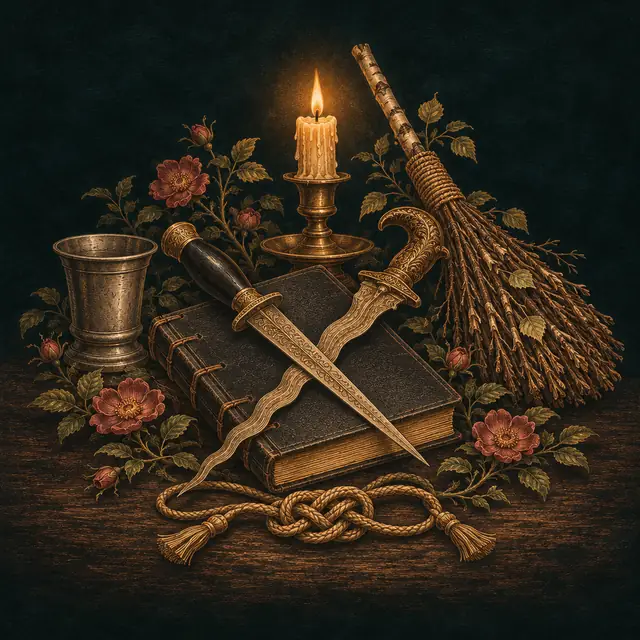
Who was Gerald Gardner, and what is truly known of them?
What is known
English civil servant, born near Liverpool, who spent his working life in Ceylon, Borneo and Malaya as a planter and customs officer and wrote a study of the Malay kris. He retired in 1936 and settled on the edge of the New Forest in 1938. In the novel High Magic’s Aid (1949) and, after the Witchcraft Act was repealed in 1951, in Witchcraft Today (1954) he announced that a witch religion had survived and that he was one of its members. He ran a museum of witchcraft at Castletown on the Isle of Man and initiated the people who carried what is now called Wicca through Britain and to America. He died at sea off Tunis.
The teaching
Taught from his own books, Witchcraft Today (1954) and The Meaning of Witchcraft (1959), with the rites of his covens.
The religion of the Wica
Gardner teaches that witchcraft is not the worship of the devil but the remnant of an old religion of Europe, older than Christianity, kept in secret by a few families through the centuries of persecution. Its people call themselves the Wica, the wise, and they worship a god and a goddess. He traced them in part to a small, dark people of the Stone Age, whom later legend remembered as the fairies, and held that the witch trials had all but destroyed them. That is his claim, and the plain fact stands beside it: no trace of such an unbroken religion has been found, and the rites he gave are of his own century.
The god and the goddess
The god of the witches, in his account, is the horned one, lord of the hunt, of death and of what lies beyond it, who keeps the gate through which the dead pass and opens it again for their return. The goddess is the great mother, the giver of fertility, love and rebirth. The god rules the dark half of the year and the goddess the bright. In the circle the high priestess stands for the goddess, so that a woman is first in the coven and the priest works at her side.
The power from the body
The witches' magic rests on a power that comes from the human body. The circle is cast to hold it in, as a vessel holds water, and they work in it naked, he says, because clothes hinder its flow. They raise it by dancing round, by chanting and by the other ways of their craft, until it can be sent out to its work as a cone. He told that in the summer of 1940 the witches of the New Forest raised their power to put into Hitler's mind the thought that he could not cross the sea, as their forebears had done against the Armada and against Napoleon. That is his story, and nothing can show it.
The eight ways and the five essentials
His book of rites names eight ways of making magic: meditation or concentration; trance and the projection of the astral body; rites, chants, spells, runes and charms; incense, drugs and wine, whatever is used to release the spirit; the dance; control of the blood with the cords, and control of the breath; the scourge; and the Great Rite, the union of priest and priestess. They are not all to be combined in one rite, it says, for some work against others, as meditation and dancing do.
Before any of them stand five essentials. The first is intention: the witch must know that they can and shall succeed. Then come preparation, a circle properly cast and purified, the purification of all who work in it, and tools properly consecrated.
The house teaches the ways as the book gives them and leaves several aside. The book itself warns that drugs are very dangerous and must be strictly limited; the house uses none. Binding with cords to slow the blood, holding the breath and the scourge all work by strain on the body, and the house leaves them out. The Great Rite belongs to consenting adults, and many covens work it only in token, with the cup and the blade.
The law of the threefold return
In his rites the scourge carries a law. In the rite of the second degree the one who has received the strokes gives back three times as many, and learns that in witchcraft whatever is received must ever be returned threefold. From that rule of the circle grew the teaching, now widespread among witches, that what a person sends out comes back to them three times over, for good or for ill.
The laws of the craft
In 1957 he gave his covens a set of laws, which he said were old. They bind the witch to keep secret the names and meeting places of the others; forbid the use of the art for money, for boasting or for harm; tell each witch to copy the book of rites in their own hand and to have it destroyed at their death; and set the high priestess at the head of the coven, with the counsel that she should retire gracefully in favour of a younger woman when the time comes. The circle, its tools, the festivals and the degrees as his covens worked them are taught on the protection art's branch Wicca and the modern craft.
Born again among one's own
The witches, he says, believe in rebirth, and their hope is not to escape the world but to be born again among the people they loved, to meet them, know them and love them again. The rites are meant to help them toward it, and the goddess grants it. That hope is, in his telling, the heart of the old religion: life is good, and the craft asks for more of it.
Orders and memberships
Made a Freemason in Sphinx Lodge No. 107 at Colombo in 1910. About 1938 he joined the Rosicrucian Order Crotona Fellowship at Christchurch, and in 1947 Aleister Crowley gave him a charter in the Ordo Templi Orientis. All documented. His own covens date from the late 1940s.
The legend
That in September 1939 he was initiated into a coven of the New Forest that kept an unbroken old religion, at the house of “Old Dorothy”. Dorothy Clutterbuck was a real woman, but historians, Ronald Hutton chief among them, have found no trace of an old religion behind it, though whether a small group met there in the 1930s is still argued, and his ritual book borrows from Crowley, the Key of Solomon, Leland and Kipling.
Their works
- Witchcraft TodayBook, 1954
His book announcing that a witch religion had survived in England and that he belonged to it, published after the Witchcraft Act was repealed. It carried an introduction by Margaret Murray. Historians have found no trace of an old religion behind it, and the rites he described borrow from much later sources.
Ask the Oracle about it - High Magic’s AidNovel, 1949
A novel set in the Middle Ages, signed with his witch name Scire, in which a witch and two magicians work rites together. It put some of the rites of his covens into print before he could publish them openly. It was his first public statement of his witchcraft.
Ask the Oracle about it - The Meaning of WitchcraftBook, 1959
His second book on witchcraft, a history of the craft as he saw it and a reply to its critics. It repeats his claim of an unbroken old religion. Historians do not accept that claim.
Ask the Oracle about it - The Book of ShadowsScripture, from about 1949
The ritual book of his covens, copied by hand by each new initiate. It joins material from Crowley, the Key of Solomon, Charles Leland and Kipling with work of his own and of Doreen Valiente, who rewrote much of it. It is the founding text of Gardnerian Wicca.
It grew over years through several hands, and he gave it as older than it is.
Ask the Oracle about it - Keris and Other Malay WeaponsBook, 1936
His study of the kris and other Malay weapons, written from his long years in Malaya. It was well received and is still cited by collectors. It is the work of his life as a civil servant and amateur scholar.
Ask the Oracle about it - Gerald Gardner, WitchBiography, 1960
A biography signed by his follower Jack Bracelin, published in his lifetime. It tells his life as he wished it told, including the initiation in the New Forest. It is generally held to have been written by Idries Shah.
Signed by Jack Bracelin and generally held to have been written by Idries Shah.
Ask the Oracle about it
How the house tells a life
This life is told from the record, with what is documented, what is legend and what was forged kept apart. A membership in an order is stated only where documents show it. A person’s chart explains none of their deeds.
The arts it feeds
Lives near it in time
Lives and legends
Carl JungAleister CrowleyEdgar CaycePamela Colman SmithAlice BaileyH. Spencer LewisAustin Osman SpareAdolf HitlerDion FortuneManly P. HallIsrael RegardieFranz BardonThe whole tree

