

Mystical systems
Fairy
Direct answer
Fairy: A fairy, in the folk belief of Ireland and Britain, is one of a hidden people who live beside humans, in mounds, hills or lakes, and must be treated with respect.
$0 today, then $19/month after 7 days. Cancel anytime.
At a glance
- Also called
- fairies, faerie, the fair folk, the good neighbours
- Found in
- Mystical Systems
- Related
- Changeling, Elementals, Nymph, Gnome
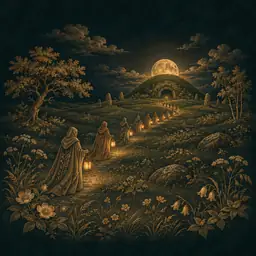
A fairy, in the folk belief of Ireland and Britain, is one of a hidden people who live beside humans, in mounds, hills or lakes, and must be treated with respect.
A lineage map for books and systems; it avoids presenting symbolic traditions as literal fact.
Understand the chapter you are in.
Your life’s turning points, measured from your birth.
Walk through Alex’s whole example first


Prefer to explore first?
 The Road of AgesThe turning points of your whole life, from your own chart
Walk my road
What is a fairy in folklore?
The word fairy comes through French from the Latin fata, the Fates, and at first meant enchantment or the land of enchantment. In the folk belief of Ireland, Scotland, Wales and England it names a hidden people. They are of human size or a little smaller, live in mounds, old forts and under lakes, hold markets and funerals, and take offence easily. People spoke of them by kind names, the good neighbours or the gentry.
The belief was a set of rules more than a set of stories: do not cut a lone thorn, do not block a fairy path, leave the last of the milk. Explanations varied. Some said the fairies were fallen angels too good for hell, some the old gods, some the dead.
On the tree of the hidden arts: The spirit realm.
What sets Fairy apart
The fairies of folk belief are defined by rules of dealing more than by looks. They keep to their own places and times, above all the old mounds, the lone thorns, and the turning points of May Eve and November Eve. They repay respect and punish a slight. Time runs differently with them, so that a night in the mound is years outside, and food taken there binds the eater. None of this needs wings or smallness, which came from the stage and the nursery centuries later.
- Word: Old French faerie, from the Latin fata, the Fates
- Irish name: aos sí, the people of the mounds
- Kind names: the good neighbours, the gentry, the fair folk
- Early account: Robert Kirk, The Secret Commonwealth, 1691
- Their nights: May Eve and November Eve
- Faked photographs: Cottingley, 1917 and 1920; admitted in 1983
Often mistaken for something else: The elementals are four neat kinds set out by one author; the fairies are a tangle of local beliefs with no founder and no single list.
The story behind Fairy
Irish tradition ties the fairies to the Tuatha Dé Danann, who in the medieval tales withdrew into the mounds. Chaucer's Wife of Bath, about 1390, already says the fairies have gone. Robert Kirk described Highland belief in 1691. Shakespeare shrank them for A Midsummer Night's Dream, and painters from the 1790s onward added insect wings. The Cottingley photographs of 1917 and 1920 were made with paper figures, as the two who took them admitted in 1983.
Why Fairy matters
Fairy records how rural communities explained luck, illness and loss, and the gap between that belief and the nursery fairy is one of the widest in folklore.
How to read Fairy
Readers meet fairies in place names, in ballads and in collections of folklore, and reading the old accounts corrects the picture-book image.
Fairy in practice: an example
A road in the west of Ireland that bends round a single hawthorn in a field is following the old rule that a fairy thorn is not to be cut.
Where readings of Fairy go wrong
The house claims no hidden people in any place. Tales of fairy substitution were at times used to excuse cruelty, and are read here as history.
Sources and editorial method
This entry summarizes the tradition in the Almanac's own words; where no source is listed, it is an editorial summary rather than a primary text, and symbolic readings are named as the tradition's, not as fact.
- Source
- The Great Almanac Dictionary
- Category
- Mystical Systems
- Aliases
- fairies, faerie, the fair folk, the good neighbours, aos si, fairy folklore
- Last updated
- 2026-09-26
See Fairy in your personal almanac
A definition tells you what it is; your own birth chart tells you what it means for you. The Oracle casts your real chart and answers for your love, your work, and your year ahead, in conversation. It opens with the 7-day Oracle trial.
Speak with the OracleRelated terms
More in Mystical Systems
From the reference page to your own chart
Every word here
is in your own chart.
- Your life’s turning points, measured from your birth
- A practical next step to consider
- It opens with 7 days free: the AI Oracle on thirty hidden arts, and your daily horoscope
$0 today, then $19/month after 7 days. Cancel anytime.
Common questions
What is a fairy in folklore?
One of a hidden people who live alongside humans in mounds, hills or water. In Irish and British belief they are powerful, touchy neighbours, not small winged sprites.
Where does the word fairy come from?
From Old French faerie, enchantment, which goes back to the Latin fata, the Fates. It first meant the state or land of enchantment and later its inhabitants.
Why do fairies have wings in pictures?
The wings are an addition of painters and the theatre in the eighteenth and nineteenth centuries. The fairies of older folk belief walk or ride and have none.


