

Mystical systems
Nymph
Direct answer
Nymph: A nymph, in Greek myth and religion, is a female spirit of a particular place in nature, such as a spring, a tree, a mountain or the sea.
$0 today, then $19/month after 7 days. Cancel anytime.
At a glance
- Also called
- naiad, dryad, nereid
- Found in
- Mystical Systems
- Related
- Undine, Elementals, Daimon, Fairy
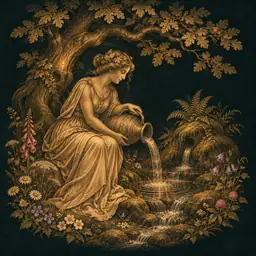

A nymph, in Greek myth and religion, is a female spirit of a particular place in nature, such as a spring, a tree, a mountain or the sea.
A lineage map for books and systems; it avoids presenting symbolic traditions as literal fact.
Understand the chapter you are in.
Your life’s turning points, measured from your birth.
Walk through Alex’s whole example first


Prefer to explore first?
 The Road of AgesThe turning points of your whole life, from your own chart
Walk my road
What is a nymph in Greek mythology?
A nymph is a minor female divinity tied to a place. The Greeks sorted nymphs by where they lived: naiads in springs and rivers, dryads and hamadryads in trees, oreads in mountains, nereids in the sea. They are pictured as young women, long-lived but not always immortal, and a hamadryad was said to die with her tree. Nymphs nurse young gods, attend Artemis, and in many stories are pursued by gods or carry off mortals.
They were also worshipped. Springs and caves across Greece held shrines of the nymphs, where people left small offerings and asked for water, health and children. A person thought to be seized by them was called nympholeptos. Paracelsus later took the word for the water people of his four elements.
On the tree of the hidden arts: The spirit realm.
What sets Nymph apart
What marks a nymph is that she belongs to one spot. A naiad is the nymph of this spring and no other, and when the spring dries she is gone; a hamadryad shares the life of a single tree. This made nymphs the divinities ordinary people actually visited, at caves and springs outside the towns, with small gifts of cakes, milk and clay figures. The Greeks also had a word for someone carried away by them, nympholeptos, which could mean inspired as well as taken.
- Word: Greek nymphe, a young woman or bride
- Fresh water: naiads, of springs, rivers and fountains
- Trees: dryads, and hamadryads who die with their tree
- Mountains: oreads, of hills and mountains
- Sea: nereids, the fifty daughters of Nereus
- A shrine: the cave of the nymphs at Vari in Attica
Often mistaken for something else: A goddess such as Artemis is worshipped across the Greek world; a nymph is honoured at the one spring, cave or grove where she lives.
The story behind Nymph
Homer already speaks of nymphs as daughters of Zeus who live in springs, groves and meadows, and Hesiod gives the nereids by name. Cave shrines of the nymphs are known from the sixth century BCE onward, among them the cave at Vari in Attica. Latin poets, above all Ovid, passed the stories to Europe. In the sixteenth century Paracelsus used nymph as another name for his undines, and painters made the figure a commonplace of art.
Why Nymph matters
Nymphs show that the Greeks thought of the landscape as inhabited, place by place, and they are the older figure behind the undine.
How to read Nymph
Readers meet nymphs in myth, in poetry and in painting, and in the names of springs and plants; knowing the kinds makes the stories easier to follow.
Nymph in practice: an example
A traveller who finds an ancient spring with niches cut in the rock beside it is probably looking at a shrine where the nymphs of that water were honoured.
Where readings of Nymph go wrong
Nymphs belong to Greek religion and myth. The house claims no being in any spring or tree, and nothing here calls on one.
Sources and editorial method
This entry summarizes the tradition in the Almanac's own words; where no source is listed, it is an editorial summary rather than a primary text, and symbolic readings are named as the tradition's, not as fact.
- Source
- The Great Almanac Dictionary
- Category
- Mystical Systems
- Aliases
- nymphs, naiad, dryad, nereid, water nymph, nymph meaning
- Last updated
- 2026-09-26
See Nymph in your personal almanac
A definition tells you what it is; your own birth chart tells you what it means for you. The Oracle casts your real chart and answers for your love, your work, and your year ahead, in conversation. It opens with the 7-day Oracle trial.
Speak with the OracleRelated terms
More in Mystical Systems
- Rider-Waite-Smith Tarot
- Sufism
- Tzimtzum
- Anatta
- Brahman
- Elixir of Life
- Hermetic Order of the Golden Dawn
- Logarithmic Spiral
From the reference page to your own chart
Every word here
is in your own chart.
- Your life’s turning points, measured from your birth
- A practical next step to consider
- It opens with 7 days free: the AI Oracle on thirty hidden arts, and your daily horoscope
$0 today, then $19/month after 7 days. Cancel anytime.
Common questions
What is a nymph in Greek mythology?
A nymph is a female nature spirit bound to a place, such as a spring, a wood, a mountain or the sea. Nymphs rank below the gods and above mortals.
What are the kinds of nymph?
The best known are naiads of fresh water, dryads of trees, oreads of mountains and nereids of the sea. A hamadryad lives and dies with a single tree.
Is a nymph the same as an undine?
Not quite. Nymph is the ancient Greek word for a nature spirit of many kinds. Undine is the name Paracelsus coined in the sixteenth century for his water people, whom he also called nymphs.


