

Mystical systems
Elementals
Direct answer
Elementals are the beings said to inhabit the four elements, as described by Paracelsus: gnomes in earth, undines in water, sylphs in air and salamanders in fire.
$0 today, then $19/month after 7 days. Cancel anytime.
At a glance
- Also called
- elemental spirits, elemental beings, gnomes undines sylphs salamanders, spirits of the four elements
- Found in
- Mystical Systems
- Related
- Daimon, Jinn, Elemental Magic
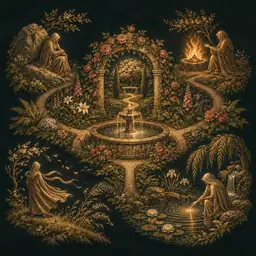

Elementals are the beings said to inhabit the four elements, as described by Paracelsus: gnomes in earth, undines in water, sylphs in air and salamanders in fire.
A lineage map for books and systems; it avoids presenting symbolic traditions as literal fact.
Understand the chapter you are in.
Your life’s turning points, measured from your birth.
Walk through Alex’s whole example first


Prefer to explore first?
 The Road of AgesThe turning points of your whole life, from your own chart
Walk my road
What are the four elementals?
Elementals are spirits of the four classical elements. The scheme comes from Paracelsus, who taught that each element is a world with its own inhabitants, just as air is the world of humans. Gnomes, also called pygmies, live in earth; undines or nymphs in water; sylphs in air; salamanders in fire. He describes them as human in form, mortal, clever, and lacking an immortal soul.
Later writers changed the picture. The seventeenth-century Comte de Gabalis made them courtly and witty, Romantic authors made the undine a tragic lover, and Theosophists of the nineteenth century reworked them as nature spirits in a larger ladder of beings.
On the tree of the hidden arts: The spirit realm.
What sets Elementals apart
Paracelsus's striking claim is that each element is to its people what air is to us: gnomes walk through rock unhindered, and undines breathe water. He calls the element their chaos, meaning their medium. The beings are neither angels nor demons nor the dead, but a separate branch of creation without Adam's soul. That last point drives the stories: an elemental can gain a soul only through marriage with a human, and a water wife insulted on the water goes back to it.
- Source: Paracelsus, A Book on Nymphs, Sylphs, Pygmies and Salamanders, printed 1566
- Earth: gnomes or pygmies; the word gnome is first found in Paracelsus
- Water: undines or nymphs, from Latin unda, a wave
- Air: sylphs, also called sylvestres, people of the woods
- Fire: salamanders, also called vulcani
- Made popular by: the Abbé de Villars, Le Comte de Gabalis, 1670
Often mistaken for something else: Fairies come from many strands of folklore with no fixed system; the elementals are one author's tidy scheme of four kinds, one for each element.
The story behind Elementals
Paracelsus wrote his treatise on the four kinds before his death in 1541, and it was printed in 1566. He took the salamander from an old belief about a lizard that lives in fire, and the water women from tales such as that of Melusine. The Abbé de Villars made the names popular in 1670, and Pope, Fouqué and Hans Christian Andersen's Little Mermaid carried the theme into literature.
Why Elementals matters
The four names lie behind much of European fairy lore and fantasy, and knowing that they have one author, and a date, clears up where they come from.
How to read Elementals
Readers take the four as figures for the elements themselves, and for the four temperaments they were long matched with.
Elementals in practice: an example
A garden writer who calls a damp, mossy corner the work of undines is using the word as the heirs of Paracelsus do, for the felt character of an element.
Where readings of Elementals go wrong
They are figures of folklore and of one author's natural philosophy. Nothing here calls on them, and no being is said to attend any place or person.
Sources and editorial method
This entry summarizes the tradition in the Almanac's own words; where no source is listed, it is an editorial summary rather than a primary text, and symbolic readings are named as the tradition's, not as fact.
- Source
- The Great Almanac Dictionary
- Category
- Mystical Systems
- Aliases
- elemental spirits, elemental beings, gnomes undines sylphs salamanders, spirits of the four elements, paracelsus elementals
- Last updated
- 2026-09-26
See Elementals in your personal almanac
A definition tells you what it is; your own birth chart tells you what it means for you. The Oracle casts your real chart and answers for your love, your work, and your year ahead, in conversation. It opens with the 7-day Oracle trial.
Speak with the OracleRelated terms
More in Mystical Systems
From the reference page to your own chart
Every word here
is in your own chart.
- Your life’s turning points, measured from your birth
- A practical next step to consider
- It opens with 7 days free: the AI Oracle on thirty hidden arts, and your daily horoscope
$0 today, then $19/month after 7 days. Cancel anytime.
Common questions
What are the four elementals?
Gnomes of earth, undines of water, sylphs of air and salamanders of fire. The list comes from the sixteenth-century physician Paracelsus.
Who invented the elementals?
Paracelsus set out the scheme in a treatise printed in 1566. He drew on older folklore of mine spirits and water women, and the word gnome is first found in his writing.
Do elementals have souls?
Paracelsus said they do not, though they are otherwise like humans. He added that a water woman could gain a soul by marrying a man, the idea behind the story of Undine.


