

Mystical systems
Ley Lines
Direct answer
Ley Lines: Ley lines are straight lines drawn through ancient sites on a map, proposed in 1921 as prehistoric trackways and recast in the 1960s as channels of an unseen earth energy.
$0 today, then $19/month after 7 days. Cancel anytime.
At a glance
- Also called
- leys, earth energy lines, old straight track
- Found in
- Mystical Systems
- Related
- Dowsing, Stonehenge, Megalith, Feng Shui
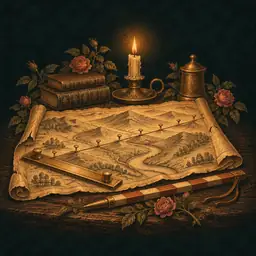

Ley lines are straight lines drawn through ancient sites on a map, proposed in 1921 as prehistoric trackways and recast in the 1960s as channels of an unseen earth energy.
A lineage map for books and systems; it avoids presenting symbolic traditions as literal fact.
Understand the chapter you are in.
Your life’s turning points, measured from your birth.
Walk through Alex’s whole example first


Prefer to explore first?
 The Road of AgesThe turning points of your whole life, from your own chart
Walk my road
Are ley lines real?
The idea began with Alfred Watkins, a businessman and photographer of Hereford in England. Looking at a map in 1921 he saw that standing stones, burial mounds, old churches, fords and hill forts seemed to fall in straight rows. He concluded that prehistoric traders had walked sighted lines from hill to hill, and called the lines leys.
Forty years later the lines were given a new meaning. Writers joined them to flying saucers, to dowsing and to the dragon paths of Chinese tradition, and described them as currents of energy in the land. That is the sense most people now have in mind. Watkins proposed nothing of the kind.
On the tree of the hidden arts: Sacred places.
What sets Ley Lines apart
The term is unusual in having an inventor, a date and two unrelated meanings. Watkins was a practical man who thought he had found lost roads, and he looked for mark stones and notches cut in ridges as proof. His followers of the 1960s kept the map lines and discarded the roads. The idea also has a weakness that can be counted: the more old sites a map shows, the more straight rows of three and four appear among them by accident.
- Proposed by: Alfred Watkins of Hereford, in 1921
- His book: The Old Straight Track, 1925
- Original meaning: prehistoric trackways sighted from hill to hill
- Energy meaning: from the 1960s; John Michell, The View Over Atlantis, 1969
- Tests: statistical study in the 1980s found the alignments no more than chance
Often mistaken for something else: A Roman road is a straight track proved by its paving and ditches; a ley is a line drawn on a map, with nothing on the ground to show it.
The story behind Ley Lines
Watkins set out his idea in The Old Straight Track in 1925, and a club of followers hunted leys until the 1940s. Archaeologists rejected the tracks from the start. The energy version dates from the 1960s and was fixed by John Michell's The View Over Atlantis in 1969. In the 1980s a statistical study showed that the alignments were what chance would give among so many old sites, and a long project to detect energies at a stone circle in Oxfordshire reported nothing conclusive.
Why Ley Lines matters
Ley Lines is a clear case of a modest idea turned into a different and far larger claim while keeping the same name.
How to read Ley Lines
People speak of a house or a stone circle standing on a ley line; it is worth asking which of the two meanings is meant.
Ley Lines in practice: an example
A reader with a map and a ruler finds four old churches in a row, then finds as many rows among dots placed at random.
Where readings of Ley Lines go wrong
A line on a map gives no right of way: keep to public paths, and treat a paid survey of energy lines as belief, not measurement.
Sources and editorial method
This entry summarizes the tradition in the Almanac's own words; where no source is listed, it is an editorial summary rather than a primary text, and symbolic readings are named as the tradition's, not as fact.
No instrument has found the “energy” of ley lines or vortices.
- Source
- The Great Almanac Dictionary
- Category
- Mystical Systems
- Aliases
- ley line, leys, ley lines meaning, earth energy lines, old straight track
- Last updated
- 2026-09-26
See Ley Lines in your personal almanac
A definition tells you what it is; your own birth chart tells you what it means for you. The Oracle casts your real chart and answers for your love, your work, and your year ahead, in conversation. It opens with the 7-day Oracle trial.
Speak with the OracleRelated terms
More in Mystical Systems
From the reference page to your own chart
Every word here
is in your own chart.
- Your life’s turning points, measured from your birth
- A practical next step to consider
- It opens with 7 days free: the AI Oracle on thirty hidden arts, and your daily horoscope
$0 today, then $19/month after 7 days. Cancel anytime.
Common questions
Are ley lines real?
Old sites do sometimes fall in line, but no more often than chance predicts when a map holds many sites. No instrument has detected an energy running along them.
Who discovered ley lines?
Alfred Watkins of Hereford proposed them in 1921 and described them in The Old Straight Track in 1925. He thought they were ancient trade routes, not lines of energy.
Is Stonehenge on a ley line?
Lines have been drawn through it, as they can be drawn through any well known site. Archaeologists do not accept them, and Stonehenge is explained by its own alignment to the solstices.


