

Mystical systems
Megalith
Direct answer
Megalith: A megalith is a large stone that prehistoric people set up, alone or as part of a tomb, a row or a circle; the word is Greek for great stone.
$0 today, then $19/month after 7 days. Cancel anytime.
At a glance
- Also called
- standing stone, menhir and dolmen
- Found in
- Mystical Systems
- Related
- Stonehenge, Henge, Newgrange, Göbekli Tepe
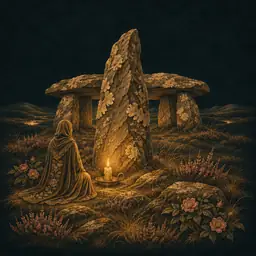

A megalith is a large stone that prehistoric people set up, alone or as part of a tomb, a row or a circle; the word is Greek for great stone.
A lineage map for books and systems; it avoids presenting symbolic traditions as literal fact.
Understand the chapter you are in.
Your life’s turning points, measured from your birth.
Walk through Alex’s whole example first


Prefer to explore first?
 The Road of AgesThe turning points of your whole life, from your own chart
Walk my road
What is the difference between a menhir and a dolmen?
A megalith is a big stone moved and set in place by people who had no metal tools and no writing. Archaeologists sort megaliths by what was built of them. A menhir is a single standing stone. A dolmen is a chamber of uprights roofed with a capstone, once the heart of a burial mound. Stone rows, stone circles and passage tombs are larger works of the same kind.
Western Europe has tens of thousands, from Portugal to Scandinavia, and the habit of building them arose more than once: Korea alone has some thirty-five thousand dolmens. Most were tombs or gathering places of farming communities, and their size shows how many hands a village could call on.
On the tree of the hidden arts: Sacred places.
What sets Megalith apart
What marks a megalith is the effort set against the means. The builders had rope, timber, antler and stone, and moved blocks that modern cranes handle with care. The work was done by communities of a few hundred, which is why archaeologists read a great stone as a measure of how many people could be gathered and fed. Because stone cannot be dated directly, the ages come from charcoal, bone and antler found in the sockets and under the mounds.
- Word: Greek megas, great, and lithos, stone; megalithic in English from 1849
- Main kinds: menhir, dolmen, stone row, stone circle, passage tomb
- Oldest in western Europe: tombs in Brittany, about 4500 BCE
- Largest raised stone: the Grand Menhir at Locmariaquer, about 20 metres, now fallen
- Most dolmens: Korea, with some thirty-five thousand
Often mistaken for something else: A megalith is any great stone set up in prehistory; a henge is an earthwork of bank and ditch, which may or may not have stones inside it.
The story behind Megalith
The oldest megalithic tombs of western Europe stand in Brittany and date from about 4500 BCE; a study of some 2,400 radiocarbon dates published in 2019 argued that the custom spread from there along the coasts by sea. The largest stone ever raised in Europe, the Grand Menhir at Locmariaquer, was some twenty metres long and now lies broken. The word megalithic was coined in English in 1849. Before that the stones were put down to giants, fairies or Druids.
Why Megalith matters
The word puts a village stone and Stonehenge in one family, so each can be dated and compared instead of wondered at alone.
How to read Megalith
Guides and maps mark a site as megalithic to say that it was built of great undressed stones in prehistory, whatever its later legend.
Megalith in practice: an example
A walker who meets a lone stone in a field can ask what it stood beside: a tomb, a row or a circle now ploughed away.
Where readings of Megalith go wrong
Many stand on private farmland and all are fragile: ask before crossing a fence, and do not climb, chalk or dig.
Sources and editorial method
This entry summarizes the tradition in the Almanac's own words; where no source is listed, it is an editorial summary rather than a primary text, and symbolic readings are named as the tradition's, not as fact.
- Source
- The Great Almanac Dictionary
- Category
- Mystical Systems
- Aliases
- megaliths, megalithic monument, standing stone, menhir and dolmen, megalith meaning
- Last updated
- 2026-09-26
See Megalith in your personal almanac
A definition tells you what it is; your own birth chart tells you what it means for you. The Oracle casts your real chart and answers for your love, your work, and your year ahead, in conversation. It opens with the 7-day Oracle trial.
Speak with the OracleRelated terms
More in Mystical Systems
- Perennial Philosophy
- Satori
- Tartarus
- Vortex Mathematics
- Ashtanga Yoga
- Christian Kabbalah
- Field of Reeds
- Ida and Pingala
From the reference page to your own chart
Every word here
is in your own chart.
- Your life’s turning points, measured from your birth
- A practical next step to consider
- It opens with 7 days free: the AI Oracle on thirty hidden arts, and your daily horoscope
$0 today, then $19/month after 7 days. Cancel anytime.
Common questions
What is the difference between a menhir and a dolmen?
A menhir is one standing stone. A dolmen is a small chamber made of several upright stones with a flat capstone on top, usually the remains of a tomb that was once covered by a mound.
Who built the megaliths?
The farming peoples of each region, over about three thousand years. Their quarries, tools, burials and houses have been excavated, and nothing found calls for any builder but them.
How were such heavy stones moved?
With ropes, timber sledges, levers and many people. Experiments have moved stones of several tonnes with a few dozen pullers, and far larger ones with a few hundred.


