

Mystical systems
Stonehenge
Direct answer
Stonehenge is a ring of great dressed stones on Salisbury Plain in southern England, built in stages between about 3000 and 2000 BCE and aligned on the solstice Sun.
$0 today, then $19/month after 7 days. Cancel anytime.
At a glance
- Also called
- stone henge
- Found in
- Mystical Systems
- Related
- Henge, Megalith, Solstice, Newgrange
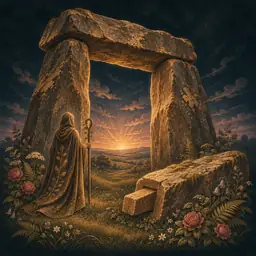

Stonehenge is a ring of great dressed stones on Salisbury Plain in southern England, built in stages between about 3000 and 2000 BCE and aligned on the solstice Sun.
A lineage map for books and systems; it avoids presenting symbolic traditions as literal fact.
Understand the chapter you are in.
Your life’s turning points, measured from your birth.
Walk through Alex’s whole example first


Prefer to explore first?
 The Road of AgesThe turning points of your whole life, from your own chart
Walk my road
Who built Stonehenge?
Stonehenge is the best known prehistoric monument in Europe. Its outer ring was thirty upright sarsens, hard sandstone blocks standing about four metres above the ground and joined by a continuous run of lintels. Inside stood five taller pairs of uprights, each with its own lintel, and among them some eighty smaller bluestones. The lintels are held by joints borrowed from carpentry, which is found at no other stone circle.
The monument faces the midsummer sunrise in one direction and the midwinter sunset in the other. It was also a burial ground: the cremated remains of scores of people were laid in its first ditch and pits.
On the tree of the hidden arts: Sacred places.
What sets Stonehenge apart
Three things set Stonehenge apart from every other stone circle. Its stones were dressed, hammered smooth and shaped, where others are left rough. Its lintels are locked on with joints copied from woodwork, pegs and sockets on the uprights and tongues and grooves between the lintels, and the ring of lintels was made level on sloping ground. And its stones were brought from far away, some from hundreds of kilometres, when good stone lay nearer.
- First earthwork: about 3000 BCE
- Sarsen ring raised: about 2500 BCE
- Sarsen source: West Woods near Marlborough, 25 kilometres north (study of 2020)
- Bluestone source: Preseli Hills, west Wales, about 240 kilometres
- Altar Stone source: north-east Scotland, more than 700 kilometres (study of 2024)
- Axis: midsummer sunrise and midwinter sunset
Often mistaken for something else: Avebury is a far larger ring of rough stones inside a true henge; Stonehenge is small beside it, and unique in its shaped and jointed stones.
The story behind Stonehenge
A ditch and bank were dug about 3000 BCE. The sarsens were raised about 2500 BCE; most came from West Woods, 25 kilometres away, as a study showed in 2020. The bluestones came from the Preseli Hills of Wales, and a study of 2024 traced the flat Altar Stone to the north-east of Scotland. In the twelfth century Geoffrey of Monmouth wrote that Merlin had brought the stones from Ireland. John Aubrey and William Stukeley, in the seventeenth and eighteenth centuries, gave them to the Druids, who lived two thousand years too late.
Why Stonehenge matters
Stonehenge is the place where most people first ask who the builders of the Stone Age were, and where digging has answered much of it.
How to read Stonehenge
Writers point to it as the clearest case of a monument set to the turning points of the year by people who left no writing.
Stonehenge in practice: an example
A visitor at midwinter stands in the Avenue at sunset and looks to where the Sun once went down between the uprights of the tallest doorway, one of which has fallen.
Where readings of Stonehenge go wrong
The stones are roped off on ordinary days to protect them; touching, climbing and leaving offerings are against the rules of the site.
Sources and editorial method
This entry summarizes the tradition in the Almanac's own words; where no source is listed, it is an editorial summary rather than a primary text, and symbolic readings are named as the tradition's, not as fact.
- Source
- The Great Almanac Dictionary
- Category
- Mystical Systems
- Aliases
- stone henge, stonehenge meaning, who built stonehenge, stonehenge solstice, stonehenge history
- Last updated
- 2026-09-26
See Stonehenge in your personal almanac
A definition tells you what it is; your own birth chart tells you what it means for you. The Oracle casts your real chart and answers for your love, your work, and your year ahead, in conversation. It opens with the 7-day Oracle trial.
Speak with the OracleRelated terms
More in Mystical Systems
From the reference page to your own chart
Every word here
is in your own chart.
- Your life’s turning points, measured from your birth
- A practical next step to consider
- It opens with 7 days free: the AI Oracle on thirty hidden arts, and your daily horoscope
$0 today, then $19/month after 7 days. Cancel anytime.
Common questions
Who built Stonehenge?
Farming communities of Stone Age Britain, over many generations. A large settlement of the builders has been excavated at Durrington Walls nearby, with the remains of their houses and midwinter feasts.
Did the Druids build Stonehenge?
No. The Druids were priests of the Iron Age, first written of more than two thousand years after the great stones were raised. The link was made by antiquarians of the 1600s and 1700s.
How were the stones brought there?
Dragged on timber sledges with ropes, as far as is known. The sarsens weigh about twenty-five tonnes each and came 25 kilometres; the smaller bluestones came some 240 kilometres from Wales.


