
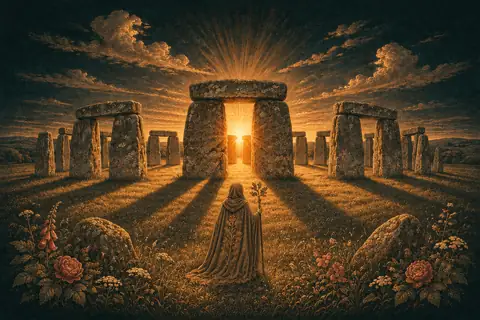
Stonehenge and the stone circles
Raised in stages from about 3000 BCE and set to the midsummer sunrise: what is known of it.
Who built Stonehenge and the stone circles, and what were they for?
The places people have held sacred, each told by who built it and when, what has been measured there, and what is only claimed. The builders are given their due, a holy place of a living faith is spoken of with respect, and no instrument has found the energy some say runs between them.
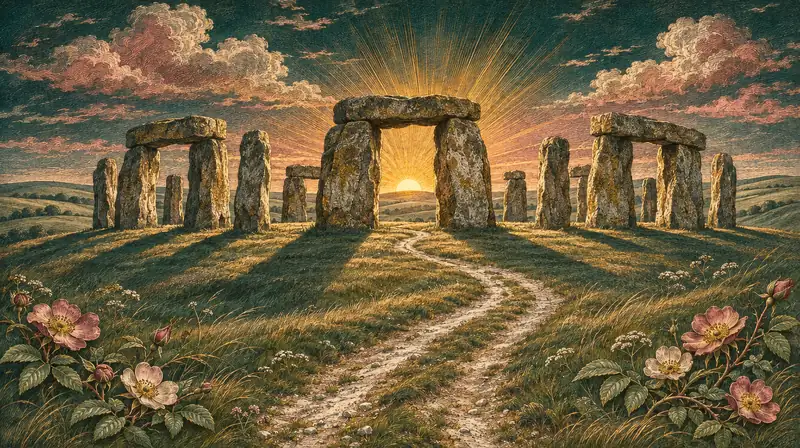
What stands there, who built it, and what is claimed
Ask the OracleWhat is truly known of the sacred places, and what is only told of them?
People have always marked certain ground as set apart: a hilltop, a spring, a ring of stones, a tomb, a road walked for the sake of its end. This shelf tells of such places by what can be known of them. Who raised Stonehenge and the Great Pyramid, and when, is no longer a riddle: the quarries, the tools, the workers' houses and even a boatman's logbook have been dug up. The builders were the peoples of their own lands, and their skill needs no lost race to explain it.
What a place was for is harder to say, and the house says so where the record is thin: a megalith keeps its date better than its meaning. Around the facts stand the claims, such as ley lines of energy, vortices, or a fortune changed by moving a bed. Each is given here with whose claim it is and what has been measured. A holy place of a living faith is told with respect, and its rules for visitors are its own: at Uluru the Anangu ask that no one climb, and since 2019 no one may. A pilgrimage, at least, anyone with sound feet can try: it is a long walk with a purpose.
As the lore of holy ground kept by its builders, keepers and pilgrims teaches it.
The teaching of sacred places begins at a boundary. When Moses turns aside to see the bush that burns and is not consumed, the voice from it says: “put off thy shoes from off thy feet, for the place whereon thou standest is holy ground.” The Greeks called a sanctuary a temenos, a piece of land cut off, and in Hebrew the holy is what is separated, kept apart from common use. A sacred place is first of all a line drawn on the earth: on one side the ordinary world, on the other ground where other rules hold.
A place becomes holy, in the traditions' own telling, in a few ways. Something is shown or done there: Jacob sleeps on the road with a stone for his pillow, dreams of a ladder set up on the earth whose top reaches heaven, and wakes saying, “Surely the LORD is in this place; and I knew it not”; then he sets the stone up as a pillar, pours oil on it and names the place Bethel, the house of God. The land itself has a form that draws worship: a mountain, a spring, a cave, the meeting of rivers. The dead are laid there, a king in his pyramid, an apostle in his tomb. Or people build the place to a pattern and consecrate it.
The boundary is marked, and crossing it is a rite. A bank and ditch ring the henge; a wall rings the temple court and the cathedral close; at the stations on the roads to Mecca the pilgrim enters ihram, the state of consecration, and keeps its rules until the rites are done. At the threshold the body changes its ways: shoes are left at the door of a temple, a mosque or a gurdwara, the head is covered in a gurdwara, and voices drop.
Washing before the holy is common to many of these traditions. Inquirers at Delphi washed at the Castalian spring before they climbed the Sacred Way; Muslims make the ablution before prayer; pilgrims on Shikoku rinse hands and mouth at every temple. The washing says with the body what the boundary says in earth and stone: that whoever enters leaves something of the ordinary world outside.
Within the boundary the traditions look for the centre. At Delphi the omphalos, the navel stone, marked the middle of the earth, where the two eagles of Zeus met. The Kaaba is the house toward which every Muslim turns in prayer, wherever in the world they stand. In the Indian faiths Mount Meru stands at the centre of the world, and temple towers are raised as images of it; in the plan of vastu the middle square is Brahma's, kept open to the sky. Many holy buildings draw whoever enters toward their centre, through courts and gates, along a nave, or round a labyrinth's winding path.
The centre is also where heaven and earth are held to meet. Jacob's stone stands at what he called the gate of heaven; the pyramid is the horizon where the king passes from this world to the next; the tops of holy mountains are where gods are met. To read a holy place is to find its centre and ask what is held to meet there.
Holy buildings are laid out against the sky. Stonehenge stands on the line of the midsummer sunrise and the midwinter sunset; the passage of Newgrange takes in the sunrise of the shortest day; the sides of the Great Pyramid face the four quarters almost exactly, and Egyptian temple scenes show the rite by which holy buildings were set out, the stretching of a cord sighted on the stars of the north. Churches were long built with the altar to the east, toward the rising sun, which Christians read as a figure of Christ. A mosque marks the direction of the Kaaba with its niche, the mihrab, and a synagogue sets its ark on the wall that faces Jerusalem.
The arts of placing a house carry the same rule into ordinary dwellings. Vastu lays the plot on the four quarters, each with its guardian god, the door best toward the east or the north; feng shui seats a house with high ground behind it and open ground before, water curving past its front and its bright hall facing the sun. So the first question of any holy place, and of any house built by these arts, is which way it faces, and toward what.
A holy place is approached, and the approach belongs to it. The pilgrim's road has the same shape in many faiths: a leaving of home with a blessing, a set road with its stages, hardship borne willingly, an arrival and a return. The Camino has its shell, its staff and its stamped card; the circuit of Shikoku has its eighty-eight temples, the pilgrim walking, as the words on the hat say, two together with the Daishi; the hajj has its days, each with its rite.
At the place itself the pilgrim goes round. Muslims walk seven times round the Kaaba, keeping it on the left hand. Hindus, Buddhists and Jains walk round a shrine, a stupa or a holy mountain clockwise, keeping it on the right, and Tibetan pilgrims walk the long circuit of Mount Kailash that way, while followers of Bon walk it the other way round. The labyrinth folds the whole road into a floor: one path with no choices, winding in to a centre and out again by the same way.
Nearly every holy place has a story of its founding, told by its own people, and the story is part of what the place is. Apollo shoots the she-dragon at Pytho and takes the oracle for his own; the body of James comes by boat to Galicia, and his forgotten tomb is found by lights seen over a wood; drops of the nectar of immortality fall at four river towns of India; Ibrahim and Ismail raise the walls of the Kaaba. A visitor who knows the story sees what the place's own people see when they look at it.
The story is learned as the story and the builders' work as their work, and a visitor holds both without letting either take the other's place.
A place where a faith still worships is first its worshippers' place, and the visitor learns its customs before arriving. Some are closed to outsiders, as Mecca is to all who are not Muslims; some open at set hours, or open their inner parts only on certain days; many ask for covered shoulders and knees, covered heads, bare feet or silence, and some forbid photographs. The guest finds out beforehand and keeps the customs without being asked.
Ruins and stones in fields have keepers too, a trust, a ministry or a farmer, and a line on a map gives no right to cross a fence. The old manners of the visit are simple: take nothing, move nothing and leave nothing behind. A remote place is visited with a companion, with water, and with someone at home who knows the route.
The art begins near home. The student chooses one old holy place within reach, a parish church, a temple, a shrine, a stone circle on a public path, and learns it before going: who built it and when, what its own people say happened there, and what its keepers ask of a visitor. Then the student goes, and walks round the outside first, to find the boundary and the way in.
At the threshold the student notes what changes, then finds the centre and stands there, or as near as the place allows. A compass or the sun shows which way the place faces; the student notes where the light enters at that hour and what lies on the horizon along its line, then sits a while and simply attends. The visit is written up afterwards in a notebook, the plan sketched and the facts and the stories each in their own column, so that the next place can be laid beside the first.
The branches each teach one place or one practice on this ground. Stonehenge and the stone circles are taught as monuments set to the turning of the year, with Newgrange and its light of midwinter. The pyramids of Giza are taught as royal tombs laid true to the four quarters, their passages read as roads for the soul. Delphi is taught by its navel stone, its spring, its Sacred Way and its day of consultation, and the labyrinth of Chartres as the road folded into a floor.
The pilgrim roads are taught through the Camino, the hajj, the Kumbh Mela and the circuit of Shikoku, each with its own story and customs. Ley lines are taught as two claims about straight lines drawn on a map, that they were tracks and that they carry a power, beside what the old traditions themselves said of straight lines. Feng shui and vastu are taught as the two arts of placing a house and its rooms. A reader new to the art does well to begin with one place that can be visited, then the pilgrim roads, and to come to the claims about lines once the places themselves are familiar.
The Oracle tells what is known of a sacred place, who built it and when, and names what is only claimed of it. No instrument has found the “energy” of ley lines or vortices. A holy place of a living faith has rules of its own for visitors. Do not trespass, and do not go to a remote place alone.
Each one is a question you can ask.
Raised in stages from about 3000 BCE and set to the midsummer sunrise: what is known of it.
Who built Stonehenge and the stone circles, and what were they for?
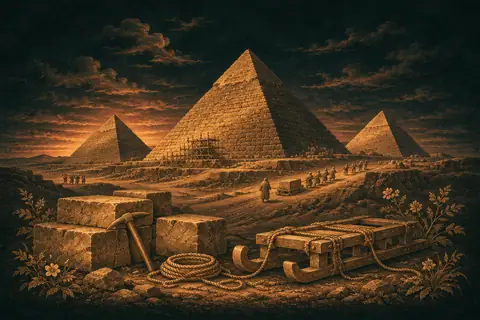
Royal tombs of about 2500 BCE, built by Egyptian crews whose town and logbook have been found.
Who built the pyramids of Giza, how, and what is only claimed of them?
The sanctuary of Apollo, the Pythia on her tripod, and the stone called the navel of the world.
What happened at Delphi, and what is truly known of its oracle?
One winding path laid in a cathedral floor about 1200, and how it is walked today.
What is the labyrinth of Chartres, and how do people walk a labyrinth today?
The Camino, the Kumbh Mela, the Shikoku circuit and the hajj: the roads and their customs.
What are the great pilgrim roads, and what does a pilgrimage ask of the one who walks it?
Old straight tracks proposed in 1921, and made into lines of energy only in the 1960s.
What are ley lines, who proposed them, and has anything ever been measured?
Two old arts of placing a house and its rooms, told as their own traditions tell them.
What are feng shui and vastu, and what do they say about arranging a house?
Each opens its page in the dictionary.
 Megalith
 Henge
 Stonehenge
 Newgrange
 Göbekli Tepe
 Great Pyramid of Giza
 Omphalos
 Pythia
 Labyrinth
 Pilgrimage
 Camino de Santiago
 Kumbh Mela
 Ley Lines
 Feng Shui
 Vastu Shastra
 Bagua
The wizard of the Arthurian stories. Geoffrey of Monmouth made him about 1136, joining a Welsh prophet-bard, Myrddin, to the tale of a wonder-child without a father. He foretells the kings of Britain, brings about Arthur’s birth, and in the French romances is at last shut away by the woman he taught, Nimue or Viviane.
A legendary sage, the Greek Hermes joined to the Egyptian Thoth, under whose name the Hermetica were written in Roman Egypt. The Renaissance believed him older than Moses: in 1463 Marsilio Ficino set Plato aside to translate the Corpus Hermeticum first. In 1614 the scholar Isaac Casaubon showed from their language that the texts belong to the early Christian centuries.
Theseus and the MinotaurThe Holy GrailThe SibylMorgan le FayFulcanelliRamana Maharshi
Make today specific
The same sky reaches everyone differently. Your birth details turn a general forecast into one theme, and one thing worth doing about it.
One instrument, one answer. Explore the preview; membership opens every tool.
Read more

