
Theseus and the Minotaur
Greek myth; known to Homer, sung by Bacchylides in the fifth century BC, told whole by Plutarch
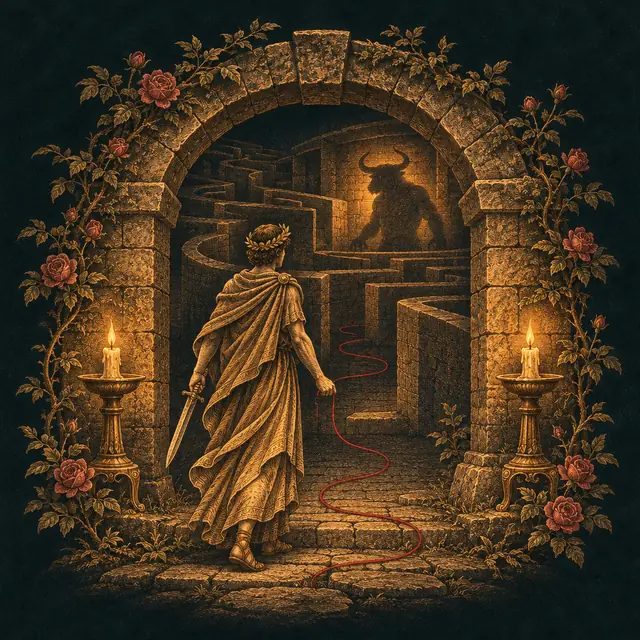
What is the story of Theseus and the Minotaur, and what has it been taken to mean?
The story and its sources
Athens owes King Minos of Crete a tribute of seven youths and seven girls, sent to be devoured by the Minotaur, half man and half bull, kept in the Labyrinth. Theseus, the king’s son, goes as one of them. Ariadne, daughter of Minos, gives him a ball of thread to fasten at the door and follow back; he kills the creature, sails away with her and leaves her on Naxos. Coming home he forgets to change his black sail for a white one, and his father, seeing it, believes him dead and does not live to greet him. Plutarch’s Life of Theseus, about AD 100, gathers the versions.
The teaching
Taught from Plutarch's Life of Theseus, with Bacchylides, Catullus and Ovid.
The sword under the rock
Aegeus, king of Athens, has no son, and the oracle at Delphi tells him not to loose the wineskin's foot until he is home. At Troezen he lies with Aethra, the king's daughter, and before he leaves he hides his sword and sandals under a great rock, telling her that if she bears a son who can lift it, she is to send him to Athens with them in secret, for Aegeus fears the fifty sons of his brother Pallas. The boy is Theseus, and some said his true father was Poseidon. When he is grown he lifts the rock with ease, takes the tokens and chooses to go by land, along the road over the Isthmus that robbers have made deadly, because he burns to equal the deeds of his kinsman Heracles.
The road to Athens
On the road he deals with each robber as the robber dealt with others. He kills the club man Periphetes at Epidaurus and keeps his club; Sinis, who tore travellers apart between two bent pines, he kills the same way; he kills the wild sow of Crommyon, and throws Sciron, who made travellers wash his feet and kicked them over the cliff into the sea, down his own cliff; he wrestles Cercyon to death at Eleusis; and he fits Procrustes to his own bed, the bed to which that host stretched or cut his guests until they fitted. At Athens his father's wife Medea knows who he is before Aegeus does, and persuades the old king to give the stranger a cup of poison at a feast. But Theseus draws his sword as if to carve the meat, his father knows it, dashes the cup away and owns his son.
The tribute
Then the ship comes for the tribute. Androgeos, son of King Minos of Crete, was killed in Attica, and Minos made war on Athens until the gods, sending plague and famine, bade the city give him what he asked: every ninth year seven young men and seven girls, sent to Crete to be shut in the Labyrinth and devoured by the Minotaur, or to wander there until they died. Theseus offers himself, or, as some tell it, is chosen by lot. His father gives the steersman a white sail and bids him raise it on the way home if Theseus lives; the ship goes out under a black one, as on a voyage to death.
The dive
Bacchylides sings the voyage. On the ship Minos lays his hand on the cheek of one of the Athenian girls, Eriboea, and Theseus rebukes him: he too has a god for his father. Minos prays to Zeus, who answers with lightning, then throws his gold ring into the sea and dares Theseus to fetch it from his father's house. Theseus leaps, and dolphins carry him down to the hall of Poseidon, where the daughters of Nereus dance in a light like fire, and the queen Amphitrite clothes him in a purple robe and sets on his hair a wreath dark with roses, her own wedding gift from Aphrodite. He rises beside the ship unwetted, with the gifts of the sea, to the dismay of Minos, and the young Athenians raise a song of joy.
The thread
In Crete, Ariadne, daughter of Minos, falls in love with him, and by the counsel of Daedalus gives him a ball of thread. He fastens it at the door of the Labyrinth and unwinds it as he goes in, through the windings Daedalus built, which Ovid likens to the river Maeander turning back on itself, so that Daedalus himself could scarcely find the way out. At the heart of it he kills the Minotaur, with his sword or, as some say, with his fists, follows the thread back to the door, and sails away with Ariadne and the young Athenians. On Delos, Plutarch says, he and the young people danced a dance that imitates the turns and returns of the Labyrinth, still danced there in his day and called the Crane.
Ariadne on the shore
On the island of Naxos, or Dia, he leaves her, and here the tellings part. Catullus pictures her waking on the empty shore to see his sails far out, her robe slipping from her as she stands, and lets her curse him: may he bring on himself and his house, with the same forgetful mind, the grief he has brought on her; and Jupiter nods assent. Catullus and Ovid both bring Bacchus to her with his rout, burning with love, and Ovid has him set her crown among the stars, where it shines still between the Kneeler and the Serpent Holder. Plutarch gathers the darker versions and the plainer: that she hanged herself when she was left; that she stayed on Naxos and married a priest of Dionysus; that Theseus left her for love of another woman; or that a storm drove his ship from Cyprus while she lay ill ashore, and she died there in childbirth. Monteverdi set her lament to music in 1608, and its first cry, Lasciatemi morire, let me die, is sung still.
The black sail
Coming home, in his joy, or his grief for Ariadne, or under her curse, Theseus forgets to change the sail. Old Aegeus, watching from the heights, sees it black, believes his son dead and throws himself down from the rock; later tellers say into the sea, which bears his name. Plutarch tells the rites Athens kept for that day: at the feast of the return the herald carries his wreath on his staff and not on his head, and the people's cries mix joy with grief. The ship of thirty oars the Athenians kept for centuries, putting in new timber as the old planks rotted, until the philosophers used it to argue whether a thing renewed in all its parts remains the same thing.
What the tellers read in it
Plutarch set out to make the fable submit to reason and take on the look of history, and his Theseus is the king who gathered the scattered villages of Attica into one city and gave it a common festival, the founder whose bones Athens brought home from Scyros and honoured. Medieval Christians made the slayer in the Labyrinth a figure of Christ, who goes down into the house of death, overcomes the beast at its centre and leads the captives out, and they laid the winding path in the floors of their churches; that reading and the walking of the path are taught under Sacred places, in The labyrinth of Chartres. Catullus draws the old tale's own hard lesson from the sail: the same forgetfulness that left Ariadne alone on the shore left Aegeus to die.
Who took it up
No order was his; Athens made him its founding hero. The winding path was laid into the floors of medieval cathedrals, Chartres about 1200 among them, where later custom walked it as a pilgrimage in small, and Jung’s school reads the thread as the way back from the depths.
What later tellings added or changed
That the palace of Knossos was the Labyrinth. Arthur Evans, who dug it from 1900, said so, and the name stuck; no building there fits the story. A labyrinth as the Middle Ages drew it has one path and no wrong turnings, so nobody could be lost in it.
The texts that tell it
- Life of TheseusBiography, about AD 100
Plutarch set Theseus beside Romulus in his paired lives and gathered every version he could find: the labours on the road to Athens, the Minotaur and the Labyrinth, Ariadne on Naxos, the black sail and the death of Aegeus. He notes where his sources disagree and tries to treat a myth as history, and it remains the fullest ancient account.
Ask the Oracle about it - Odes Seventeen and EighteenPoem, 5th century BC
Two songs of Bacchylides, known only from a papyrus published in 1897. In the first Theseus, on the ship to Crete, dives into the sea to prove himself the son of Poseidon and returns with a gift from the sea goddess. The second hails his coming to Athens as a young stranger.
Ask the Oracle about it - Poem Sixty FourPoem, 1st century BC
The longest poem of Catullus, on the wedding of Peleus and Thetis, holds within it the picture of Ariadne waking on Naxos to see Theseus’ ship sailing away. Her lament and curse, which brings about the forgotten sail, is among the great passages of Latin poetry and shaped later tellings of her.
Ask the Oracle about it - Metamorphoses, Book EightPoem, about AD 8
Ovid tells of the Labyrinth built by Daedalus, the thread, the killing of the Minotaur and Ariadne left on Naxos, whom Bacchus takes and whose crown he sets among the stars. In the Heroides he gives her a letter of her own to the man who left her.
Ask the Oracle about it - L’AriannaOpera, 1608
Claudio Monteverdi’s second opera, on Ariadne’s abandonment by Theseus, was staged at Mantua for a ducal wedding. The music is lost but for the Lament of Ariadne, which was famous at once, was printed in several forms and is still often sung.
Only the lament survives of its music.
Ask the Oracle about it
How the house tells a life
This is a story, told with its sources and with what later tellings added or changed. What it means for you is yours to judge.
The arts it feeds
Lives near it in time
Stories of forbidden knowledge
CirceTiresiasPrometheusPandoraPersephoneThe SibylCassandraThe PhoenixDionysusOrpheusEnochKing MidasThe whole tree

