
Pandora
Greek myth; Hesiod, about 700 BC
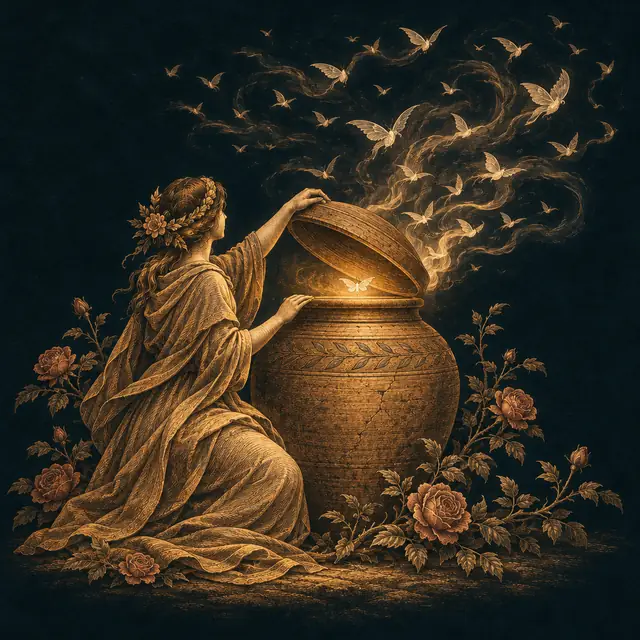
What is the story of Pandora, and what does it warn of?
The story and its sources
The first woman of Greek myth, made by the gods at Zeus’s order as the price of the stolen fire. In Hesiod she opens a great storage jar and lets out every ill; only Hope stays under its lid.
The teaching
Taught from Hesiod's Works and Days and Theogony, with the later tellings from Babrius to Rossetti.
The beautiful evil
Hesiod tells her making twice. In the Theogony, at the order of Zeus, Hephaestus moulds from earth the likeness of a modest maiden, Athena dresses and crowns her, and she is led before gods and men, a beautiful evil, the price of the stolen fire and the first of the race of women. In the Works and Days she has a name, and every god gives her a gift; Epimetheus takes her in against his brother's warning, she lifts the lid of the great jar, the ills fly out over the earth, and Hope alone stays under its rim. Both tellings are taught in full under Forbidden knowledge, in Prometheus; here is what belongs to her alone.
The name
Hesiod reads her name as all gift, the one to whom all the gods gave. But the word can also mean the giver of all, and that was a title of the Earth, who sends every gift up from below. On a cup painted at Athens in the fifth century BC the newly made woman, with Athena and Hephaestus adorning her, is named Anesidora, she who sends up gifts, another name of the Earth. Pheidias carved her birth on the base of his great Athena in the Parthenon, with twenty gods present, as Pliny counts them, so that the first woman, the work of the city's own gods of craft, stood at the feet of its goddess.
The jar
What Hesiod gives her is a pithos, a great storage jar of the kind that stood half sunk in a farmhouse floor holding grain or oil or wine, too big to carry; a Latin retelling of 1508 made it a little box. He never says where the jar came from or why the ills were in it. Until she lifted the lid, mortals had lived free of hard toil and the sicknesses that bring death; now the ills wander over land and sea, and diseases come to people by day and by night of their own accord, in silence, for Zeus took away their voices. Hope alone stays within, in her unbreakable house under the rim, because Pandora put the lid back first, by the will of Zeus. So, Hesiod ends, there is no way to escape the mind of Zeus.
The jar of good things
Another telling turns the jar inside out. In the fables of Babrius, Zeus gathers all good things into a jar, closes it and leaves it with a man; the man, unable to bear not knowing what is inside, pushes off the lid, and the good things fly away to the houses of the gods. Only Hope is left, caught as the lid came down, and so Hope alone stays with mankind, promising each of us the good things that have fled. The poet Theognis says much the same: Hope is the one good god still left among men, for Trust and Restraint have gone, and the Graces have left the earth for Olympus.
What Hope means
So the old question is never settled: is Hope kept in the jar a good saved for mankind, or the last of the ills, held back? The Greek word, elpis, is expectation, of bad things as well as good, and Hesiod himself warns elsewhere that hope is a poor companion for the needy man who sits idle. Nietzsche read it darkly: Zeus wanted men, however the other ills tormented them, not to throw their lives away, and so he left them hope, in truth the worst of the ills, because it draws the torment out. Others have read it as the one gift that makes the rest bearable, and the tale leaves both readings open.
The first woman and her answerers
Hesiod's hard verdict, that from her comes the race of women, a sorrow to men, was taken up by all who wished to lay the world's troubles at a woman's door, and Christian writers set her beside Eve; Origen, answering a pagan who mocked the story of Eve, replied that the Greeks' own Pandora was stranger still. The poets and painters answered the verdict in their own way. Rossetti painted her grave and tall, holding a casket from which the smoke of the ills curls up, and in the sonnet he wrote for the picture he asks her whether the deed was truly hers, and ends by telling her that she cannot know whether the Hope still shut in the casket is alive or dead.
Who took it up
No order took her as an emblem; she belongs to the poets and the painters.
What later tellings added or changed
The “box”. Hesiod says a jar; the box comes from a mistranslation by Erasmus in the sixteenth century. Whether Hope kept in the jar is a comfort or the last of the ills has been argued since antiquity.
The texts that tell it
- Works and DaysPoem, about 700 BC
Hesiod names her Pandora, the gift of all the gods, who each give her something at Zeus’s command. She lifts the lid of a great jar and scatters sorrows and diseases among men; only Hope stays inside under the rim. It is the version all later tellings follow.
Ask the Oracle about it - TheogonyPoem, about 700 BC
In Hesiod’s other poem the first woman is made by Hephaestus and dressed by Athena as the price of the stolen fire, but she is not named and there is no jar. From her, the poem says, comes the race of women, a hard judgement that later readers have answered.
Ask the Oracle about it - AdagesCollection, 1508
Erasmus of Rotterdam gathered thousands of Greek and Latin proverbs with his comments on them. Writing of the saying that a fool learns only from what he suffers, he retold the story and gave Pandora a small box, a pyxis, in place of Hesiod’s great jar. The box has stayed with her ever since.
The change is laid to Erasmus, who may have confused the jar with the box of Psyche.
Ask the Oracle about it - PandoraPainting, 1871
Dante Gabriel Rossetti painted her several times with the face of Jane Morris, holding a jewelled casket from which smoke and spirits rise. The 1871 version, in red, is the best known. He also wrote a sonnet on the picture, one of the many Victorian works that took her up.
Ask the Oracle about it
How the house tells a life
This is a story, told with its sources and with what later tellings added or changed. What it means for you is yours to judge.
The arts it feeds
Lives near it in time
Stories of forbidden knowledge
ThothGilgameshSisyphusCirceTiresiasPrometheusPersephoneThe SibylTheseus and the MinotaurCassandraThe PhoenixDionysusThe whole tree

