
Circe
Greek myth; in Homer’s Odyssey, about 700 BC
What is the story of Circe, and what has it been taken to mean?
The story and its sources
A goddess, daughter of the Sun, who lives with her handmaids on the island of Aeaea. In the Odyssey, about 700 BC, she gives the crew of Odysseus a drugged drink and turns them into pigs with a touch of her wand. Hermes gives Odysseus a herb called moly, which protects him; she swears to do no harm, restores the men, and the ship stays a year. It is Circe who tells him how to reach the land of the dead and how to pass the Sirens. Homer calls her a goddess of many drugs and never a witch.
The teaching
Taught from Homer's Odyssey, Books Ten and Twelve, with Apollonius of Rhodes, Ovid and the ancient allegorists.
The island of Aeaea
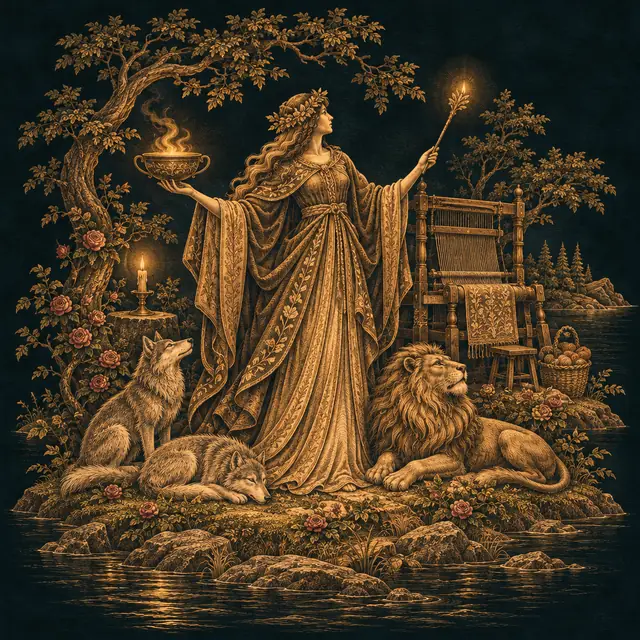
Circe is a dread goddess who speaks with a human voice, daughter of the Sun and of Perse, a daughter of Ocean, and sister of Aeetes, king of Colchis, whose daughter is Medea. She lives on the island of Aeaea in a house of polished stone in a clearing of the woods, and round it prowl mountain wolves and lions that do not attack but fawn on strangers as dogs fawn on their master, for they are men she has drugged. Inside she sings at her great loom, weaving the fine, bright work of goddesses.
The cup and the wand
The crew of Odysseus draws lots, and Eurylochus leads twenty-two men to the house. Circe throws open her shining doors and calls them in, and all go in but Eurylochus, who suspects a snare and waits outside. She seats them and mixes them a drink, the kykeon, of cheese, barley meal and pale honey in Pramnian wine, and stirs into it baneful drugs, so that they forget their native land. When they have drunk, she strikes them with her wand and pens them in her sties. They have the heads and voices, the bristles and the bodies of swine, but their minds are as they were before, and they weep as she throws them acorns and cornel berries to eat.
Moly
Eurylochus runs back with the news, and Odysseus goes alone. On the path Hermes meets him in the likeness of a young man and gives him a herb against her drugs: black at the root, with a flower as white as milk, called moly by the gods, hard for mortal men to dig, but the gods can do all things. Hermes tells him what to do. When she strikes him with her wand he is to draw his sword and rush at her as if to kill her; she will shrink back and ask him to her bed, and he is not to refuse, but first he must make her swear the great oath of the gods to plot no more harm against him, so that she cannot unman him when he lies unarmed.
So it happens. Her drink does him no harm, and when he rushes at her with his sword she runs in under it, clasps his knees and cries that he must be Odysseus, the man of many turns, whose coming Hermes always foretold.
The men restored
She swears the oath, and her four handmaids, daughters of springs, of groves and of the sacred rivers, bathe him and set out a feast, but Odysseus will not eat while his men are beasts. Circe goes to the sties, drives them out and rubs each one with another drug, and the bristles fall away: they are men again, younger than before, taller and far handsomer, and they weep for joy until the house rings and the goddess herself is moved. She bids him bring the rest of the crew from the ship, and for a whole year they stay, feasting on meat and sweet wine, until his men remind him of home.
The way to the dead
When Odysseus clasps her knees and asks to go, she does not hold him, but tells him that first he must go to the house of Hades and dread Persephone, to consult the soul of the blind seer Tiresias, to whom alone among the dead Persephone has left his mind. She gives him the way: let the north wind carry him over the stream of Ocean to the shore of Persephone's groves of poplar and willow, where the rivers of fire and of wailing flow into Acheron. There he is to dig a pit a cubit square, pour for all the dead milk and honey, then sweet wine, then water, sprinkle white barley, sacrifice a ram and a black ewe, and keep the shades from the blood with his sword until Tiresias has drunk and spoken. As they leave, Elpenor, the youngest of the crew, asleep on her roof heavy with wine, wakes in the noise, falls and breaks his neck.
The Sirens and the strait
When they come back from the dead she greets them as men twice dying, who have gone down to Hades while others die only once, and that night she tells Odysseus the dangers ahead. The Sirens sit in their meadow among heaps of bones, singing to every sailor who passes: let him stop his crew's ears with wax, and if he wishes to hear, have himself bound to the mast, and the bonds drawn tighter when he begs to be loosed. Beyond lie two ways. One passes the Wandering Rocks, which only the ship Argo ever ran. The other runs between Scylla, with her six heads, in her cave high on the cliff, and Charybdis, who sucks down the black water three times a day: let him keep close to Scylla and lose six men rather than all. And on the island of the Sun he must not touch the god's cattle.
Other tellings
Hesiod gives her two sons by Odysseus, Agrius and Latinus, and a lost epic of the Trojan cycle another, Telegonus, who grows up to seek his father, kills him without knowing him, and brings the body to Aeaea, where Circe makes Penelope and Telemachus immortal. In Apollonius of Rhodes, Jason and Medea come to her hearth as silent suppliants after killing Medea's brother. She purifies them of the blood, holding a suckling pig above their heads, cutting its throat and wetting their hands with the blood, and calling on Zeus the cleanser; but when she learns what they have done she sends her niece away. Ovid gives her spells of jealousy: refused by the sea god Glaucus, she poisons the pool where his beloved Scylla bathes and makes a monster of her, and when the king Picus will not love her she turns him into a woodpecker.
What the tellers read in her
Homer calls her a goddess of many drugs, dangerous and then generous: the one who makes beasts of men also sends Odysseus safely to the dead and home past the Sirens. The ancient allegorists read her cup as pleasure, which makes swine of the greedy, and the moly that Hermes gives as reason, or as education, hard to win and keeping the mind its own. Horace tells a young friend that had Odysseus drunk her cup with his foolish and greedy crew, he would have lived senseless under a mistress's rule, an unclean dog or a sow that loves the mud. Plutarch turns the tale round in a dialogue: Odysseus asks that the Greeks among her beasts be made men again, and one of the swine, Gryllus, refuses, arguing that beasts are braver and more temperate than men. Porphyry read her as the circling of the soul through birth after birth, from which reason alone delivers it, and Plotinus told the soul to flee to its own country as Odysseus fled the enchantress.
Moly has never been named for certain; garlic and the snowdrop are among the plants offered for it, and nothing in the tale is a recipe for any drug.
Who took it up
No cult of note was hers. For later ages she became the pattern of the enchantress: Ovid adds her jealous spells, and painters and poets down to the nineteenth century took her up. Madeline Miller’s novel of 2018 retold the tale from her side.
What later tellings added or changed
That she is a figure of evil. In Homer she is dangerous first and then a generous host and guide. The herb moly has never been identified, though many plants have been proposed.
The texts that tell it
- The Odyssey, Book TenEpic, about 700 BC
Odysseus comes to Aeaea, where Circe turns half his men into swine with a drink and a wand. Hermes gives him the herb moly; she cannot charm him, swears an oath, restores the men and keeps them a year as her guests. When they leave she sends him to the land of the dead and, on his return, tells him how to pass the Sirens.
Ask the Oracle about it - Argonautica, Book FourEpic, 3rd century BC
Apollonius of Rhodes brings Jason and Medea, her niece, to Circe after they have killed Medea’s brother. She cleanses them of the blood with the sacrifice of a piglet, then learns what they have done and sends them away. Here she is a figure of old and grave rites more than of charms.
Ask the Oracle about it - Metamorphoses, Book FourteenPoem, about AD 8
Ovid gives Circe new tales of jealous spells: she poisons the bay where the nymph Scylla bathes and turns her into a monster, and changes the king Picus into a woodpecker when he will not love her. Through Ovid the Middle Ages and the Renaissance knew her as the pattern of the dangerous enchantress.
Ask the Oracle about it - Circe Offering the Cup to UlyssesPainting, 1891
John William Waterhouse painted her enthroned, holding out the cup and wand, with Odysseus seen only in the mirror behind her and a swine at her feet. Now in Oldham, it is the best known of the many Victorian pictures of her and shaped how she is still imagined.
Ask the Oracle about it
How the house tells a life
This is a story, told with its sources and with what later tellings added or changed. What it means for you is yours to judge.
The arts it feeds
Lives near it in time
Stories of forbidden knowledge
Isis and OsirisThothGilgameshSisyphusTiresiasPrometheusPandoraPersephoneThe SibylTheseus and the MinotaurCassandraThe PhoenixThe whole tree

