
Isis and Osiris
Egyptian myth; in the Pyramid Texts about 2400 BC, told whole by Plutarch about AD 120
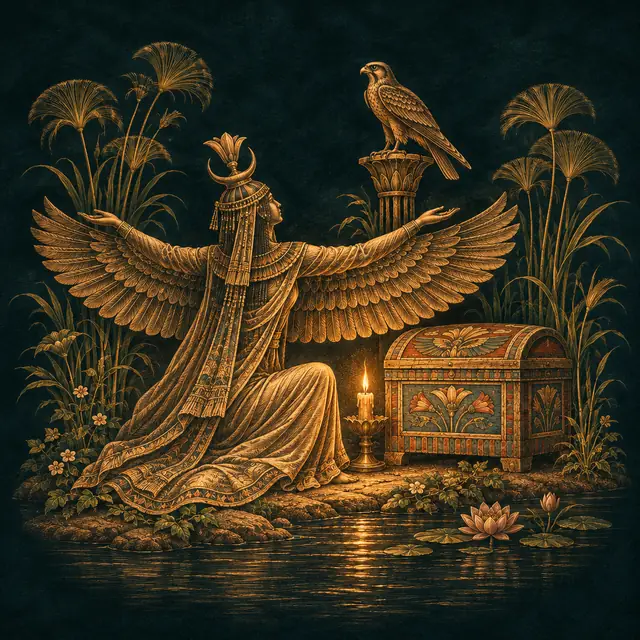
What is the story of Isis and Osiris, and what has it been taken to mean?
The story and its sources
The central myth of ancient Egypt. Osiris, a good king, is killed by his brother Set; his wife Isis gathers his body, restores him long enough to conceive their son Horus, and Osiris becomes lord of the dead while Horus wins back the throne. Egyptian texts from the Pyramid Texts onward allude to it in pieces and never tell it straight through. The fullest connected telling is in Greek, by Plutarch, early in the second century AD, with the chest set adrift on the Nile and the body cut into fourteen parts. Every dead Egyptian hoped to become “an Osiris”.
The teaching
Taught from Plutarch's On Isis and Osiris, with the Great Hymn to Osiris, the Contendings of Horus and Set and Diodorus.
The five days
Nut, the sky, whom Plutarch calls Rhea, has lain in secret with Geb, the earth, and the Sun lays a curse on her: she shall give birth in no month and in no year. But Thoth loves her too. He plays at draughts with the Moon, wins from her the seventieth part of each of her days of light, and makes of them five new days, set after the three hundred and sixty of the year. On these Nut bears her children: Osiris first, at whose birth a voice cries that the lord of all is coming into the light; then the elder Horus; then Set, out of season, bursting through his mother's side; then Isis and Nephthys. Isis and Osiris love each other already in the darkness of the womb.
The good king
Osiris reigns in Egypt and lifts its people out of a poor and beastlike life, showing them the fruits of the earth, giving them laws and teaching them to honour the gods. Then he travels the world, winning its peoples less by arms than by persuasion, song and music, which is why the Greeks took him for their Dionysus. In Diodorus it is Isis who finds wheat and barley growing wild, and Osiris who teaches people to sow them and to stop eating one another.
The chest
When Osiris comes home, Set plots with seventy-two companions and a queen of Ethiopia named Aso. He secretly takes his brother's measure, has a chest made to fit him, richly worked, and at a banquet promises in jest to give it to whoever fills it exactly. One by one the guests lie down in it and none fits, until Osiris does. The plotters slam the lid, seal it with nails and molten lead, and throw it into the Nile, which carries it out to the sea.
The Egyptian texts never mention a chest. In the Pyramid Texts Set strikes his brother down at Nedyt and leaves him lying on his side, and other texts say that he drowned; they touch the death only in passing and dwell on what follows it.
The search
Isis cuts off a lock of her hair, puts on mourning and wanders everywhere asking for the chest. Children who saw it tell her by which mouth of the river it went out, and for this, Plutarch says, the Egyptians take omens from what children cry out at play in the temples. On the way she learns that Osiris once lay with Nephthys, taking her for Isis, and that Nephthys, afraid of Set, left the child to die; led by dogs, Isis finds him and raises him, and he is Anubis, her guardian. The Great Hymn to Osiris sings her as Egypt saw her: strong in speech, driving off his enemies with her words, roaming the land lamenting, never resting until she finds him.
At Byblos
The sea lays the chest in a clump of heather at Byblos, and the heather shoots up into a tall trunk that closes round it. The king admires the tree, cuts it down and makes it a pillar under his roof. Isis comes to Byblos and sits by a spring in tears, speaking only to the queen's maids, whose hair she braids and whose skin she fills with a fragrance from her own body, until the queen sends for her and makes her nurse to her baby. Isis feeds the child from her finger, and at night lays him in the fire to burn away his mortality while she flies round the pillar as a swallow, lamenting. The queen sees her son in the flames and screams, and his immortality is lost.
Then the goddess shows herself, draws out the pillar, cuts the chest free, and gives the wood, wrapped in linen and anointed, to the king and queen, who keep it in her temple. She sails away with the chest, and in a lonely place she opens it, lays her face against the dead face and weeps.
The fourteen parts
She hides the chest and goes to her son Horus at Buto, but Set, hunting by moonlight, finds it, knows the body and tears it into fourteen parts, which he scatters. Isis seeks them through the marshes in a boat of papyrus, and wherever she finds one she holds a funeral, which is why Egypt has many tombs of Osiris; or, others say, she gave city after city a likeness of him, so that he would be honoured everywhere and Set would never find the true grave. His member alone she never finds, for the fish of the river have eaten it, and she makes a likeness of it and hallows it. Diodorus counts twenty-six parts, one for each plotter, and has Isis model each into a man's figure of wax and spices and give one to each order of priests, telling each that it alone holds the body.
The kite and the child
The Egyptian texts tell what Plutarch passes over. Isis and Nephthys mourn over the body as two kites, and Anubis wraps it, the first of all mummies. Then Isis hovers over her husband: in the Great Hymn she makes shade with her feathers and breath with her wings, raises the weariness of the still heart, takes his seed and bears his heir. She hides the child in the marshes of Chemmis, where no one knows his dwelling, and when his arm is strong she brings him into the hall of Geb, where the gods rejoice and give him his father's throne.
Horus and Set
In Plutarch, Osiris comes back from the dead to train his son and asks him what is noblest. To avenge father and mother, Horus says; and the most useful animal in war is the horse, for a lion helps one who needs help, but a horse overtakes a fleeing enemy. Horus wins the war, but when Set is given to Isis in chains she lets him go, and Horus in anger tears the crown from her head; Thoth gives her a helmet like a cow's head instead.
The Contendings of Horus and Set makes it a lawsuit of eighty years before the gods, where the Sun favours Set as the elder. Isis, disguised as a young widow, tells Set that a stranger has taken her dead husband's cattle and is driving out his son, and Set cries that the cattle must not go to a stranger while the son lives, and so judges himself. Then come the trials: the two fight as hippopotamuses in the river, Set tears out Horus' eyes and Hathor heals them with a gazelle's milk, and in a race of stone boats Horus sails pine painted to look like stone while Set's real stone sinks. At last the gods write to Osiris among the dead. He asks why his son is cheated, when it was he who made the grain that feeds the gods, and reminds them that all who live come to him in the end. Horus is crowned, and Set goes up to thunder in the sky beside the Sun.
Lord of the West
Osiris does not return to the living. He reigns in the West as king and judge of the dead, and every Egyptian rightly buried hopes to follow him, to be raised and justified as he was and called by his name. In the month of Khoiak the temples moulded his figure from earth and grain and watered it until the grain sprouted from it, and at the end of the feast they raised the djed pillar, his backbone, upright. The road the dead take after him, to the hall where the heart is weighed, is taught under Death and what follows, in The weighing of the heart; the initiations of Isis that Apuleius tells, under Orders and mystery schools, in The ancient mysteries.
What Plutarch reads in it
Plutarch tells Clea that the tale is neither a record of deeds nor an idle fiction: as the rainbow is the sun seen in a cloud, it reflects a truth that turns the mind beyond it. Some read Osiris as the Nile and Set as drought, or Osiris as the Moon and his fourteen parts as the days of its waning. His own reading goes deeper. Osiris is reason and order, all that is good and measured in the world; Set is the violent, disorderly and destroying part of the world's soul; Isis is nature, the female that receives every form, who by her own being loves the good and longs to be filled by it; and Horus their son is this visible world, the image of the world of mind.
The rites of Isis, he says, aim at the knowledge of the truth about the gods, and her true servant is not the one in linen with a shaven head but the one who searches out by reason what the rites show. On her statue at Sais he reads that she is all that has been and is and shall be, and that no mortal has ever lifted her robe.
Who took it up
The mysteries of Isis spread across the Roman empire, with initiations that Apuleius describes about AD 160. Freemasons of the eighteenth century, and Mozart’s Magic Flute of 1791, borrowed the names; nothing joins those lodges to the Egyptian temples.
What later tellings added or changed
That Horus was born of a virgin on 25 December, was crucified and rose after three days. None of that is in any Egyptian text; it comes from writers of the nineteenth and twentieth centuries. In the myth Osiris does not return to the living: he rules the dead.
The texts that tell it
- On Isis and OsirisTreatise, about AD 120
Plutarch, a priest at Delphi, wrote it for Clea, a priestess at Delphi who had been dedicated to the rites of Osiris. It is the only connected telling of the myth from antiquity: the chest set adrift on the Nile, the body found at Byblos, the fourteen parts gathered by Isis. He then reads the story through Greek philosophy, and most later accounts of Isis and Osiris begin from his.
Ask the Oracle about it - The Pyramid TextsFunerary texts, about 2400 BC
Spells carved on the walls of royal burial chambers at Saqqara, the oldest religious writing of Egypt. They speak of the dead king as Osiris, of Isis and her sister Nephthys mourning him, and of Horus avenging his father, but only in allusions. The whole story is taken for granted and never told.
Ask the Oracle about it - The Great Hymn to OsirisHymn, about 1400 BC
A hymn cut on the stela of an official named Amenmose, now in the Louvre. It is the fullest Egyptian telling of the myth: Isis searching without rest for her husband, sheltering him with her wings and making breath with them, conceiving their son and raising him in secret until he can claim his father’s throne.
Ask the Oracle about it - The Contendings of Horus and SetMyth, about 1150 BC
A long tale on a papyrus of the reign of Ramesses V, now in the Chester Beatty collection in Dublin. The gods sit in court for eighty years over whether Horus or his uncle Set shall have the throne of Osiris. It is bawdy and quarrelsome, with Isis using every trick she knows, and it ends with a letter from Osiris among the dead that settles the case.
Ask the Oracle about it - The Library of History, Book OneHistory, 1st century BC
Diodorus of Sicily, writing in Greek, gives Egypt the first book of his universal history and tells of Osiris as a king who taught people to grow grain and travelled the world, of his murder by Typhon, as he calls Set, and of Isis gathering his body. He draws on Greek writers in Egypt and shows how the myth was told to visitors in his day.
Ask the Oracle about it
How the house tells a life
This is a story, told with its sources and with what later tellings added or changed. What it means for you is yours to judge.
The arts it feeds
Death and what followsOrders and mystery schoolsThe sky in the scriptures
Lives near it in time
Stories of forbidden knowledge
ThothGilgameshSisyphusCirceTiresiasPrometheusPandoraPersephoneThe SibylTheseus and the MinotaurCassandraThe PhoenixThe whole tree

