
Prometheus
Greek myth; first told by Hesiod, about 700 BC
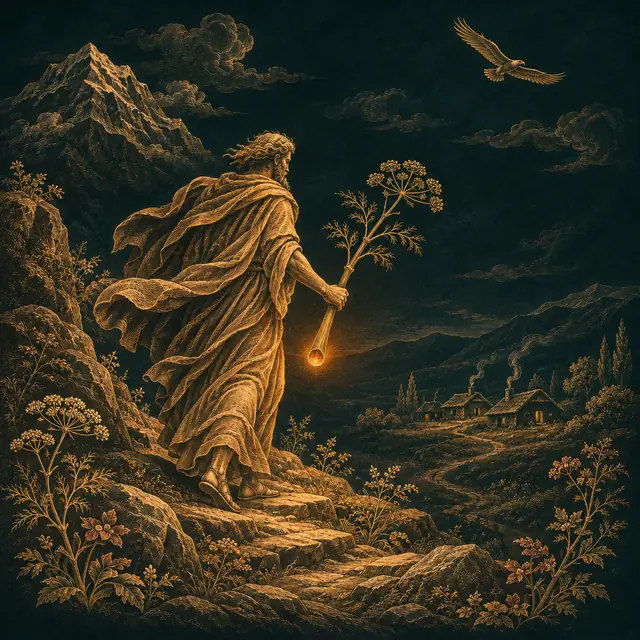
What is the story of Prometheus, and what does it warn of?
The story and its sources
A Titan of Greek myth. In Hesiod he tricks Zeus over the sacrifice and steals fire for humankind, hidden in a fennel stalk; Zeus chains him to a pillar where an eagle eats his liver each day, and sends Pandora to men in return. In the tragedy Prometheus Bound, handed down under the name of Aeschylus, he has given humans every craft and suffers for loving them. Heracles frees him at last.
The teaching
Taught from Hesiod and Prometheus Bound, the fragments of its lost sequel, and the Romantics from Goethe to Shelley.
The story the old poems tell
At Mekone, where gods and men settle what each shall have of a sacrifice, Prometheus hides the meat of an ox under its stomach and wraps the bones in shining fat, and Zeus takes the bones. Zeus withholds fire in return, and Prometheus steals it back in a fennel stalk. Zeus sends the first woman to men as its price, and chains the thief to a pillar where an eagle eats his liver by day and it grows again by night. In Prometheus Bound he is nailed to a crag at the edge of the world and tells how, besides fire, he gave mortals number, letters, medicine, the reading of signs and every craft. All of this, with Plato's telling in the Protagoras, is taught under Forbidden knowledge, in Prometheus; what follows here is the rest of his story and its later life.
The secret of Thetis
Prometheus Bound turns on a secret. The Titan, taught by his mother, knows that Zeus is moving towards a marriage that will give him a son stronger than his father, and that Zeus will fall unless he is warned, and he will not tell until he is freed. The sequel the play looks towards, Prometheus Unbound, is lost but for fragments and reports: the Titans, released from the pit, come as its chorus to see their brother, and Heracles shoots the eagle. Later tellers name the bride. She is the sea goddess Thetis; when Prometheus tells, Zeus gives her instead to the mortal Peleus, and her son is Achilles, who is indeed greater than his father.
The ring and the crown
Heracles frees him with the consent of Zeus, and the centaur Chiron, wounded past healing by one of Heracles' poisoned arrows, gives up his immortality so that he may die, and Prometheus takes his place among the deathless. Later writers add that Zeus, bound by his oath that the Titan would never be loosed, had him wear for ever a ring made from the iron of his chain with a chip of the rock set in it, and that this is why men wear rings with stones, and crowns in their festivals, in memory of his bonds.
The torch race
Athens honoured him beside Hephaestus, the other god of fire and craft. His altar stood in the grove of the Academy, and from it, at his festival, runners raced to the city with burning torches; the winner was the one who reached the end with his flame still alight, and if the leader's torch went out, the race passed to the next. The Greeks and Romans took the race for an image of life handed on: Plato speaks of passing on life like a torch from one generation to the next, and Lucretius of the generations as runners who hand on the lamp of life.
Goethe's rebel
The young Goethe gave the Titan a voice of his own, defying Zeus from his workshop. Let Zeus cover his sky with clouds and practise his thunder on oaks and mountain tops like a boy beheading thistles; he must leave this earth standing, and the hut he did not build, and the hearth whose glow he envies. Nothing under the sun is poorer than the gods, who feed their majesty on offerings and prayers and would starve if children and beggars were not hopeful fools. Who helped me against the Titans, he asks, who saved me from death and slavery, if not my own glowing heart? Time and Fate, his masters and Zeus's too, made him a man. Here he sits, forming men in his own image, a race to suffer and to weep, to enjoy and be glad, and to pay no heed to Zeus, as he does not.
Byron and Shelley
Byron's poem of 1816 makes him the pattern of a human greatness that suffers and endures: his godlike crime was to be kind, and to lessen by his teaching the sum of human wretchedness, and his only answer to the thunder was a silent suffering that would not let the sky hear it.
Percy Shelley went further. Unwilling, as his preface says, to reconcile the champion of mankind with its oppressor, he wrote the sequel anew. His Prometheus, chained for three thousand years, asks to hear again the curse he once laid on Jupiter, and when he hears it he takes it back: he wishes no living thing to suffer pain. The Furies torment him with visions of every good turned to evil, and he does not yield. His beloved Asia goes down to the cave of Demogorgon, the dark power in the depths, and the hour comes: Jupiter is dragged into the abyss, Heracles unbinds the Titan, and the world is made new, with man left free, without sceptre or master, king over himself. The last speech gives the lesson: to suffer, to forgive, to defy power, to love and endure, and “to hope till Hope creates from its own wreck the thing it contemplates”.
What the story warns of
Each teller finds a different warning in it. Hesiod warns that no one outwits the mind of Zeus, and that every gift that lifts mortals above the beasts is paid for in labour and grief. Aeschylus warns of power new to its throne that rules without counsel, and shows a benefactor who will suffer rather than yield; his lost sequel, as far as its fragments show, ended in reconciliation. Plato warns that skill without justice and shame destroys the cities it builds. The Romantics read it as a warning to tyrants, and Shelley as a warning to rebels too: a curse kept is a chain, and only the one who forgives is free. Mary Shelley's Frankenstein, The Modern Prometheus, gives the warning of the maker who will not answer for what he has made; it is taught under Forbidden knowledge, in Frankenstein.
Who took it up
No cult of secrets was his; Athens honoured him with a torch race. The Romantics made him their emblem of the rebel who serves humanity: Goethe, Byron, Shelley’s Prometheus Unbound. Mary Shelley subtitled Frankenstein “The Modern Prometheus”.
What later tellings added or changed
That he is a figure of evil. In the Greek tellings he is humanity’s benefactor, and the question the story asks is what a gift costs, not whether knowing is wicked.
The texts that tell it
- TheogonyPoem, about 700 BC
Hesiod’s poem of the birth of the gods tells the oldest version: Prometheus tricks Zeus into choosing the bones and fat of the sacrifice, Zeus withholds fire, and Prometheus steals it back in a fennel stalk. He is bound and his liver eaten each day by an eagle until Heracles frees him, and Zeus sends the first woman to men in return.
Ask the Oracle about it - Works and DaysPoem, about 700 BC
Hesiod tells the theft of fire again, this time as the reason why men must labour for their living, and names the woman sent in return Pandora, with her jar. The poem is a farmer’s advice to his brother, and the story stands in it as an explanation of why life is hard.
Ask the Oracle about it - Prometheus BoundPlay, 5th century BC
A Greek tragedy in which the Titan is nailed to a rock at the edge of the world and defies Zeus. He tells the chorus that he gave humans not only fire but numbers, letters, medicine and every craft, and he will not tell Zeus the secret of his downfall. It made Prometheus the great sufferer for mankind.
It has come down under the name of Aeschylus, but many scholars doubt that he wrote it.
Ask the Oracle about it - PrometheusPoem, written about 1774
Goethe’s ode gives Prometheus the voice of a man who scorns the gods and makes humans in his own image, to suffer and rejoice without them. Printed without his consent in 1785, it became a banner of the German Sturm und Drang and was later set to music by Schubert and Wolf.
Ask the Oracle about it - Frankenstein; or, The Modern PrometheusNovel, 1818
Mary Shelley’s novel of a student who makes a living man and then abandons him. The subtitle sets Victor Frankenstein beside the Titan who formed humans and stole fire for them, and asks what is owed to a creature one has made. It has been retold ever since.
Ask the Oracle about it - Prometheus UnboundPlay, 1820
Percy Bysshe Shelley’s lyrical drama in four acts, written in Italy, takes up the lost sequel to Prometheus Bound and changes its ending. His Prometheus does not make peace with Jupiter; he withdraws his curse, and the tyrant falls, freeing the world. It is the Romantic Prometheus in full.
Ask the Oracle about it
How the house tells a life
This is a story, told with its sources and with what later tellings added or changed. What it means for you is yours to judge.
The arts it feeds
Lives near it in time
Stories of forbidden knowledge
Isis and OsirisThothGilgameshSisyphusCirceTiresiasPandoraPersephoneThe SibylTheseus and the MinotaurCassandraThe PhoenixThe whole tree

