
Prometheus
Fire stolen for humankind, and its price.
What does the story of Prometheus say about forbidden knowledge?
The old stories of the one who reaches past the limit, from Prometheus to Frankenstein. They are told here as the history of a story, each with its source, and none of them is about you.
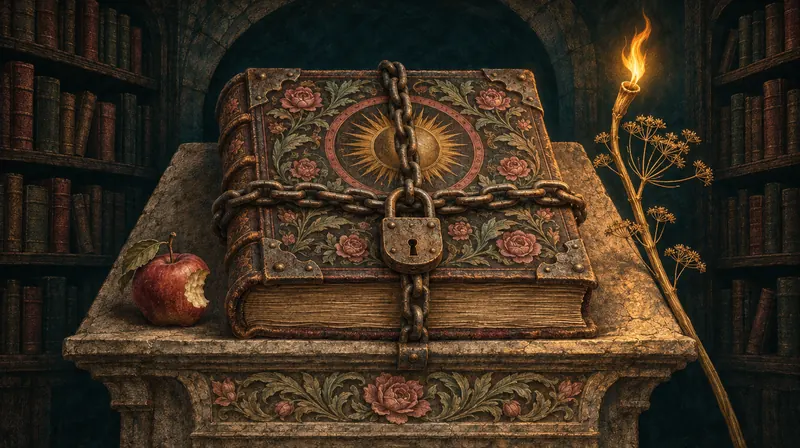
From Prometheus to Frankenstein
Ask the OracleWhat do the old stories of forbidden knowledge warn of, and what do they ask of me?
Every age has told a story of someone who reaches past the limit. The Greeks told of Prometheus, who stole fire for humankind. Genesis tells of a tree whose fruit was not to be eaten. The sixteenth century told of Faust, the scholar who trades his soul in order to know, and in 1818 Mary Shelley gave the story its modern form in Frankenstein, the maker who abandons what he has made. The house tells them as the history of a story, each with its source.
They are worth reading together because the warning changes as it travels. It begins as a ban on taking, and ends as a duty to answer for what was taken. None of these stories is a law about what may be learned, and none of them is about the reader: the pact, the stolen fire and the bitten fruit are devices of the telling. What they leave behind is a question worth asking of any new power, who pays for it and who answers for it.
As the lore of the limit and the reach from Hesiod and Genesis to Mary Shelley teaches it.
Every story in this art has the same bones. There is a limit, set by a power above the one who meets it: Zeus, God, the order of nature. Behind the limit lies a knowledge or a power: fire and the crafts it makes possible, the knowing of good and evil, mastery over spirits, the making of life. Someone reaches for it, often helped by a go-between who stands on both sides of the line. The reach succeeds. And a price follows, which falls on the one who reached and very often on others.
To study the art is to learn to see those bones under very different flesh, and to notice what each telling does with them. The page of what they share sets the pattern out with all its tellings; each of the other branches teaches one story whole.
The stories forbid different things, and a student begins by telling them apart. In the Greek telling what is kept back is fire, and with fire every art: in the play Prometheus Bound the Titan counts them over, numbers and letters, the risings of the stars, the taming of beasts, ships, medicine and the working of metals. In Genesis it is the knowledge of good and evil, which the text never defines. In the Faust book it is everything the schools could not teach, bought from a spirit. In Frankenstein it is the cause of life itself.
Scripture draws two more lines of its own. Deuteronomy gives the hidden things to God and the revealed things to us and to our children, a line between what is given to be known and what is not. And the Qur'an tells of a sorcery taught at Babylon by two angels, Harut and Marut, who warned everyone they taught that they were only a trial, and from whom people learned what harmed them and did not profit them. That is forbidden knowledge in its plainest sense: knowledge that does harm.
The tellings differ most on why the limit is set, and that question is the heart of the art. In Hesiod the gods keep hidden from mortals the means of life, and Zeus withholds fire in anger after Prometheus has tricked him over the sacrifice: the limit belongs to a god guarding his own order, and the poet takes the god's side. In Genesis the command comes with a warning, that on the day of eating they shall die, and it is the serpent who says that God forbids out of envy, knowing that their eyes would be opened and they would be as gods. The Greek story lets the gods guard what is theirs; the Hebrew story puts the charge of jealousy in the serpent's mouth.
Later teachers moved the limit from the thing known to the one who knows it. The rabbis kept the teaching of creation and of the divine chariot for the few who were ready, as a care for the learner more than a ban. Paul warned that knowledge puffs up and love builds up. Victor Frankenstein, telling his tale, bids Walton learn from his example how dangerous the getting of knowledge is, and at the last, dying, cannot quite forbid another to succeed where he failed.
The knowledge seldom crosses by itself. Prometheus is a god who loves mortals; the serpent a beast that speaks; the Watchers of the Book of Enoch angels who come down and teach metalwork, charms and the reading of the stars; Mephistopheles a spirit who serves for a term of years. The cost seldom stays with the one who reached. Pandora's jar falls on all humankind, the ground is cursed for Adam's sake, the Watchers' teaching fills the earth with violence, and Victor's creature kills those he loves. The Greeks called the overreaching hubris and the retribution that answers it nemesis, and the stories ask, every time, who pays.
And what is learned is never taken back. Humankind keeps the fire, and Zeus answers with a gift of his own, not with a recall. The eyes opened in Eden stay open, and the way to the tree of life is guarded instead. Victor cannot undo what he has made. Because the knowledge stays, the question these stories leave is best asked before the reach, where that is possible.
The art would teach falsely if it heard only the warning, for the same books praise knowledge as highly as they fear its misuse. Aristotle opens his Metaphysics by saying that every human being by nature desires to know. The Book of Proverbs calls wisdom the principal thing and bids the reader get understanding with all their getting. The Qur'an teaches the Prophet to pray to be increased in knowledge, and Solomon, offered any gift he asked, asked for an understanding heart and was praised for it.
So the warning is never against knowing as such. It falls on the grasping, the pride, the secrecy and the harm that can go with a knowledge taken without wisdom, and the wisdom books draw the limit inward, to the fear of the Lord and the turning from evil. Francis Bacon read Eden the same way, as a fall by the proud knowledge of good and evil and not by the knowledge of nature, and the Enlightenment's motto, dare to know, carries the same freedom further. The page of what they share follows these voices through.
Across the tellings the fault moves. In the oldest it lies in the taking itself. The Faust book damns its scholar less for the pact than for despair, the belief that he could not be forgiven, which kept him from asking. Goethe's Faust is saved at the last by his striving and by love. Mary Shelley places the wrong less in Victor's making than in his leaving: he gives life and will not answer for it. The modern form of the warning is not do not know, but answer for what you know.
The same teaching keeps the line from being a trap. In the stories themselves it can be crossed back: in the Qur'an Adam receives words from his Lord and is forgiven; Jewish teaching holds the way of return open to every person; the Faust book's own moral is that its scholar was lost because he would not ask. None of these stories is about the reader, and no one makes a pact or forfeits anything by reading, wishing or speaking carelessly.
The art's practice is a way of reading. Take the oldest telling first, whole and slowly, in a translation with notes: Hesiod's two short accounts of Prometheus, the two chapters of Genesis, the Faust book before Marlowe and Goethe. Mark the limit, who sets it and the reason given; the reach and the go-between; the price, who pays it and what remains. Then set a later telling beside it and note where the tellers disagree, for the disagreement is where each age speaks. A story that is scripture is read next with its own tradition's commentary, since it is theirs first.
Last, put three questions to your own reach: what am I reaching for, and who says I may not; if I get it, who else pays; and what would it mean to answer for it afterwards? They suit a new skill, a new tool or a piece of news that cannot be unlearned, and they are the whole of what the art asks a reader to practise.
Prometheus and the tree in Eden are the two roots, the Greek and the Hebrew, and are read first. Faust carries the story into the age of universities and print, with the pact at its centre. Frankenstein gives it its modern form, the maker who will not answer for what he made. What they share sets all four beside the Watchers, Icarus, Babel and the rabbis' orchard, and draws the common lesson.
These are stories, told with their sources. The Oracle will never tell you that you have made a pact, lost your soul or crossed a line that cannot be uncrossed. If that fear stays with you, speak with someone you trust in your own tradition.
Each one is a question you can ask.
Fire stolen for humankind, and its price.
What does the story of Prometheus say about forbidden knowledge?
The telling most readers know first.
What does the story of the tree of knowledge in Eden say about forbidden knowledge?
The scholar who signs away his soul to know.
What is the story of Faust and his pact with the devil, and where does it come from?
Mary Shelley’s maker who will not answer for what he made.
What does Frankenstein say about forbidden knowledge and responsibility?
Not “do not know”, but “answer for what you know”.
What do all the stories of forbidden knowledge have in common?
Each opens its page in the dictionary.
A Titan of Greek myth. In Hesiod he tricks Zeus over the sacrifice and steals fire for humankind, hidden in a fennel stalk; Zeus chains him to a pillar where an eagle eats his liver each day, and sends Pandora to men in return. In the tragedy Prometheus Bound, handed down under the name of Aeschylus, he has given humans every craft and suffers for loving them. Heracles frees him at last.
The first woman of Greek myth, made by the gods at Zeus’s order as the price of the stolen fire. In Hesiod she opens a great storage jar and lets out every ill; only Hope stays under its lid.
Son of the craftsman Daedalus, who built the Labyrinth of Crete. To escape the island Daedalus makes wings of feathers and wax, and warns his son to fly neither too low, where the sea will wet them, nor too high, where the sun will melt them. Icarus climbs, the wax softens, and he falls into the sea that takes his name. Ovid tells it in the Metamorphoses.
A real man stands behind the legend: Johann Georg Faust, a wandering German astrologer, alchemist and fortune-teller of the early sixteenth century, named with scorn in a handful of letters and town records. Within fifty years the chapbook Historia von D. Johann Fausten (1587) had him sign away his soul for twenty-four years of knowledge and pleasure. Christopher Marlowe put it on the English stage about 1592, and Goethe made it his life’s work (Part One 1808, Part Two 1832), in which Faust is saved.
Frankenstein; or, The Modern Prometheus is a novel by Mary Shelley, begun in 1816 by Lake Geneva when she was eighteen and published in 1818. Victor Frankenstein is a student, not a doctor: he reads Agrippa, Paracelsus and Albertus Magnus as a boy, turns to modern chemistry, and gives life to a creature he then abandons in horror. The creature, who has no name, learns to speak and read, asks for a companion, is refused, and destroys those Victor loves. The experiments of Galvani and Aldini with electricity and dead tissue stood behind it.
In Jewish tradition a golem is a figure of clay brought to life by the letters of a holy name; the word is in the Psalms, and the Talmud tells of sages who made such a creature. The famous story sets it in Prague, where Rabbi Judah Loew, the Maharal (died 1609), makes a golem to protect the Jewish quarter and must unmake it when it grows beyond control.
Joseph CampbellEnochNarcissusCupid and PsycheLokiThe Monkey KingJekyll and HydeDorian GrayGiordano BrunoTommaso CampanellaJohann Wolfgang von GoetheRobert TaylorEdward Bulwer-LyttonAldous HuxleyGilgameshSisyphusThe Sorcerer’s ApprenticeSimon MagusRoger BaconThe SibylKing Midas
Make today specific
The same sky reaches everyone differently. Your birth details turn a general forecast into one theme, and one thing worth doing about it.
One instrument, one answer. Explore the preview; membership opens every tool.
Read more

