
What they share
Not “do not know”, but “answer for what you know”.
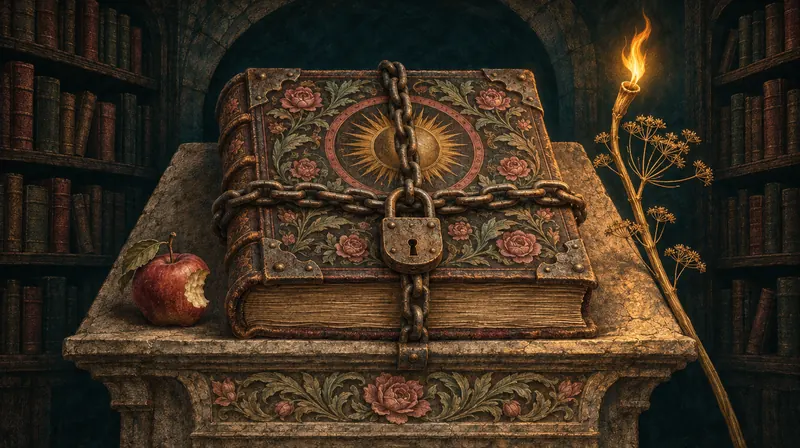
What do all the stories of forbidden knowledge have in common?
What it is
Set side by side, the stories share a shape. Someone reaches for a knowledge or a power that an authority has kept back; the reach succeeds; and a cost follows that falls partly on others. The Greeks had a word for the overreaching, hubris. What changes across the centuries is where the fault is placed. In the oldest tellings it is the taking itself. By the time of Frankenstein it has become the refusal to answer for what was taken. The modern form of the warning is less a ban on knowing than a demand to stand by what one knows and makes.
The teaching
As the shared shape of the stories from Enoch to Kant teaches it.
The go-between
In nearly every telling the knowledge crosses the limit by way of a go-between, a figure who stands between two worlds: Prometheus, a god who loves mortals; the serpent, a beast that speaks; the Watchers, angels who desire human wives; Mephistopheles, a spirit who serves in order to own. The go-between is never simply wicked or simply kind. Prometheus suffers for his gift, and Mephistopheles mocks the one who takes his. The serpent tells the truth about the opened eyes and is silent about the cost. The Watchers teach real crafts without the wisdom to use them. And the cost never falls on the reacher alone: it falls on Pandora's children, on all the sons of Adam, on Gretchen and on Justine.
Hubris, ate and nemesis
The Greeks had three words for the pattern. Hubris was first a word of the law courts, outrage: doing and saying things that shame another, Aristotle writes, for the pleasure of feeling one's own superiority. It came to mean the overreaching that forgets it is mortal. Ate is the blindness that follows, the god-sent folly by which the overreacher walks into ruin with open eyes. Nemesis is the indignation of the gods at what is undeserved, and the goddess of that name who restores the balance. In tragedy the three come in that order.
The Watchers
The Book of the Watchers, the first part of the Book of Enoch, tells the oldest story of knowledge taught from above. In the days of Jared two hundred angels, the Watchers, led by Semjaza, came down on Mount Hermon and bound themselves by an oath to take human wives, and their children were giants who devoured the earth. And they taught. Azazel taught men to make swords, knives, shields and breastplates, and showed them the metals and how to work them, bracelets and ornaments, the painting of the eyes, precious stones and dyes. Semjaza taught enchantments and the cutting of roots, Armaros the undoing of enchantments, Baraqijal astrology, Kokabel the constellations, Ezeqeel the knowledge of the clouds, Araqiel the signs of the earth, Shamsiel the signs of the sun and Sariel the course of the moon.
The earth cried out, and the archangels carried its cry to God. Raphael was sent to bind Azazel hand and foot and cast him into the darkness in the desert of Dudael, under rough and jagged rocks, for the whole earth, God says, has been corrupted by the works Azazel taught: to him ascribe all sin. The Watchers asked Enoch to plead for them, and the answer he brought back is the heart of the story. They had been in heaven, but not every mystery had been revealed to them; they knew worthless ones, and in the hardness of their hearts they taught those, and through them people work much evil on the earth. What was forbidden was not the whole truth but its broken pieces, handed on without the wisdom to use them.
Icarus and the middle way
Ovid tells of Daedalus, the great craftsman, shut on Crete by King Minos, who made wings of feathers bound with thread and wax for himself and his son Icarus. Before they flew he taught the boy the middle course: not too low, or the spray of the sea would weigh the feathers down, and not too high, or the sun would burn them. But Icarus, delighting in flight, left his guide and climbed towards the sky; the sun softened the wax, his bare arms beat the empty air, and he fell, calling his father's name, into the sea that bears his name. Daedalus cursed his own arts and buried his son. The same pattern rules Phaethon, who begged to drive his father the Sun's chariot for a day, lost hold of the horses, set the earth burning, and was struck down by the thunderbolt.
The tower of Babel
Genesis tells of a time when “the whole earth was of one language, and of one speech.” In the plain of Shinar people said, “let us build us a city and a tower, whose top may reach unto heaven; and let us make us a name, lest we be scattered abroad upon the face of the whole earth.” The LORD came down to see it and said, “now nothing will be restrained from them, which they have imagined to do,” and confounded their language, so that they could not understand one another's speech, and scattered them; and the place was called Babel. Here the knowledge is a technique, brick burned hard and slime for mortar, and the reach is for a name: the fault is not the building but the pride that wants to need no one.
The four things and the orchard
The rabbis set their own limit on knowledge, as a care rather than a ban. The Mishnah teaches that the laws of forbidden unions may not be taught to three at once, the work of creation not to two, and the chariot of Ezekiel's vision not even to one, unless he is wise and understands from his own knowledge; and that for whoever looks into four things, what is above, what is below, what was before and what will be after, it would have been better not to have come into the world.
The Talmud tells why. Four sages entered the orchard, the pardes of hidden things. Ben Azzai looked and died. Ben Zoma looked and was harmed in his mind. Elisha ben Abuyah cut down the shoots and left the faith, so that he was called Aher, the other. Only Rabbi Akiva entered in peace and left in peace. The knowledge is not evil; it asks for readiness, a teacher and a steady soul.
Where wisdom is found
The wisdom books of the Bible draw the limit inward. Job's hymn searches the mines and the depths for wisdom and finds that only God knows its place: “Behold, the fear of the Lord, that is wisdom; and to depart from evil is understanding.” The Preacher warns that “in much wisdom is much grief: and he that increaseth knowledge increaseth sorrow.” Ben Sira counsels, “Seek not out the things that are too hard for thee, neither search the things that are above thy strength.” And Deuteronomy divides the field in one verse: “The secret things belong unto the LORD our God: but those things which are revealed belong unto us and to our children for ever.”
Bacon's turn: the proud knowledge
Francis Bacon, at the opening of the age of science, reread the oldest story to free the study of nature. It was not the pure knowledge of nature, he wrote in The Advancement of Learning, the knowledge by which Adam named the creatures, that caused the fall, but “the proud knowledge of good and evil”, with the intent in man to give law to himself and depend no more on God. The knowledge of nature is therefore open, on one condition, which he set out in the preface to his Great Instauration: that it be sought for the benefit and use of life, and perfected and governed in charity. From the lust of power the angels fell, he wrote, and from the lust of knowledge man fell, but of charity there can be no excess.
Dare to know
Against the long warning the Enlightenment set two Latin words from the poet Horace, sapere aude, dare to be wise. Immanuel Kant made them its motto: enlightenment is a person's way out of an immaturity they have brought on themselves, the inability to use their own understanding without another's guidance, and it is self-incurred when the cause is not a lack of understanding but a lack of resolve and courage. Have the courage to use your own understanding, he wrote; that is the motto of enlightenment.
Answer for what you know
The modern form of the story keeps both voices. From Kant it takes the duty to know and to think for oneself; from Enoch, Ovid and the rabbis, the knowledge that a power taken without wisdom wounds others; and from Bacon and Mary Shelley the last step, that knowledge is to be governed by charity, and that whoever brings something new into the world must stand by it. What is forbidden, in the end, is not knowing but knowing without love, and making without answering.
How it is practised
A reader can turn the shared shape into three questions and keep them on one page. What am I reaching for, and who says I may not? If I get it, who else pays? And what would it mean to answer for it afterwards? The questions suit a new skill, a new tool or a piece of news that cannot be unlearned. They are asked before acting where that is possible, and honestly afterwards where it is not.
Where it comes from
The pattern is far wider than four stories. The Book of the Watchers, of about the third century BCE, tells of angels who teach humankind metalwork, charms and the reading of the stars. Greek myth has Icarus, Tantalus and Pandora, and Genesis has the tower of Babel. Goethe's ballad of the Sorcerer's Apprentice shows a spell begun that cannot be stopped, and Perrault's Bluebeard a forbidden room. Knowledge was forbidden in fact as well as in fable: Rome kept an Index of Forbidden Books from 1559 to 1966. Against all this the Enlightenment set a Latin motto meaning dare to know, which Kant took up in 1784. In the atomic age the physicist Robert Oppenheimer was called the American Prometheus, and the old stories were read again.
What is known, and what is not
That these stories exist, and when they were written, is well established. That they form one tradition is a reading made by later critics, Roger Shattuck among them in 1996, and a useful one. They do not show that any knowledge is cursed, and they pass no sentence on a reader. The forbidden book has a fiction of its own, the Necronomicon, which H. P. Lovecraft invented in the 1920s; no such ancient book exists. A person troubled by the fear of having gone too far is not helped by more stories, and does better to speak with someone they trust in their own tradition.
Its words
- Hubris
- In Greek, insolent outrage that shames another; in modern use, the overreaching pride that ignores limits and goes before a fall.
- Watchers
- The angels of the Book of Enoch who come down to earth and teach humankind crafts and secrets it was not meant to have.
- Index Librorum Prohibitorum
- The Catholic Church's printed list of books its members were not to read without leave, first issued at Rome in 1559 and given up as church law in 1966.
- Bluebeard
- Perrault's tale of 1697 of a husband who forbids his wife one room, where his earlier wives lie dead. Here the looking is what saves her, and the ban is the wrong.
- Necronomicon
- A book that does not exist: H. P. Lovecraft invented it for his horror stories in the 1920s. Volumes sold under the name are modern works written decades later.
Ask the Oracle further
Is any forbidden knowledge truly forbidden, or do the old stories only ask me to answer for it?Which forbidden knowledge story fits a new technology I am uneasy about, and why?
Before you practise
These are stories, told with their sources. The Oracle will never tell you that you have made a pact, lost your soul or crossed a line that cannot be uncrossed. If that fear stays with you, speak with someone you trust in your own tradition.
Its other branches
PrometheusThe tree in EdenFaustFrankensteinThe whole artSearch the tree

