
Frankenstein
Mary Shelley’s maker who will not answer for what he made.
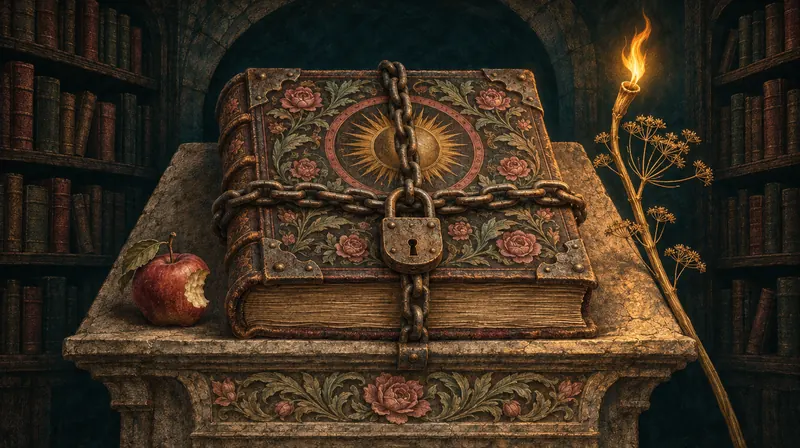
What does Frankenstein say about forbidden knowledge and responsibility?
What it is
Victor Frankenstein, a student of natural science, finds out how to give life to dead matter, builds a living creature, and runs from it in horror on the night it first opens its eyes. Left alone, the creature teaches itself to speak and to read, is driven off by everyone it meets, and at last turns on its maker's family. Mary Shelley subtitled the book The Modern Prometheus. Her turn on the old pattern is that the wrong lies less in the making than in the leaving: the maker will not answer for what he has made.
The teaching
As Mary Shelley's Frankenstein of 1818 and 1831 teaches it.
Walton's voyage
The novel is told in letters from Robert Walton, an Englishman sailing for the North Pole, to his sister at home. He hopes to find a passage through the ice and the secret of the power that draws the compass needle, and he longs for a friend who can share his ambition. On the ice his crew sees a giant figure on a sledge, and next day they take aboard a dying man, Victor Frankenstein, who, when he learns what Walton seeks, tells him his own story as a warning.
Victor's education
Victor grows up in Geneva, loved by his parents, his adopted cousin Elizabeth and his friend Henry Clerval. At thirteen he finds a volume of Cornelius Agrippa, and his father calls it sad trash without saying why; so the boy reads on, through Paracelsus and Albertus Magnus, dreaming of the philosopher's stone and the elixir of life. At fifteen he sees lightning blast an old oak to splinters and turns to electricity. His mother dies of a fever caught while nursing Elizabeth, and he leaves for the university at Ingolstadt.
There one professor, Krempe, scorns the old masters he has read. Another, Waldman, wins him. The ancient teachers, Waldman says, promised impossibilities and did nothing; the modern masters promise very little, yet “they penetrate into the recesses of nature, and shew how she works in her hiding places,” and “they can command the thunders of heaven, mimic the earthquake, and even mock the invisible world with its own shadows.” Victor resolves to go further, to explore unknown powers and unfold to the world the deepest mysteries of creation.
The secret of life
For two years he studies anatomy and the decay of the body in charnel houses and vaults, until he discovers the cause of generation and life and becomes able to give animation to lifeless matter. He decides to build a human being, and because the small parts are hard to work, he makes it of gigantic size. He dreams that a new species will bless him as its creator, and that no father could claim a child's gratitude as he would deserve theirs. He works in secret, neglects his family and friends, and grows pale and feverish.
The older Victor, telling the tale, draws the lesson in his own words. A person in perfection, he says, should always keep a calm and peaceful mind, and the pursuit of knowledge is no exception: “If the study to which you apply yourself has a tendency to weaken your affections, and to destroy your taste for those simple pleasures in which no alloy can possibly mix, then that study is certainly unlawful, that is to say, not befitting the human mind.”
The dreary night of November
“It was on a dreary night of November that I beheld the accomplishment of my toils.” By the light of a dying candle he sees the dull yellow eye of the creature open. He had chosen its features as beautiful, but the yellow skin scarcely covers the muscles and arteries beneath, and the watery eyes and straight black lips make the rest horrible. Breathless with horror and disgust, he runs from the room. That night he dreams of kissing Elizabeth and finding her changed into the corpse of his dead mother, and wakes to see the creature at his bedside, holding up the curtain, one hand stretched out as if to keep him. He flees into the street and abandons it.
The creature's own story
Long afterwards, on the ice of the Montanvert above Chamonix, the creature finds him and asks to be heard. “Remember, that I am thy creature: I ought to be thy Adam; but I am rather the fallen angel.” Alone from his first hour, he learned heat by burning his hand in a fire, and food by hunger. Hidden in a hovel against a cottage, he watched a poor and loving family, the De Laceys, learned their speech through a chink in the wall, the faster when they began to teach it to an Arabian girl, Safie, and secretly gathered their firewood. He learned history from the book they read to her, and from three books he found, Paradise Lost, Plutarch's Lives and The Sorrows of Werter, he learned what a soul and a society are. In a pocket of the coat he had taken from Victor's room he found his maker's journal, and read how he was made, with loathing.
He hoped the family would love him, and spoke first to the blind old father, who welcomed him; when the son came in and struck him, he fled, and later burned the cottage. He saved a girl from drowning and was shot for it. Then, meeting a small boy who turned out to be Victor's brother William, he killed him and laid the boy's locket on a sleeping servant, Justine, who was hanged for the murder. “I was benevolent and good; misery made me a fiend. Make me happy, and I shall again be virtuous.”
The companion and the broken promise
His demand is simple. Make him a companion, a female of his own kind with the same defects, and they will go to the wilds of South America and live on acorns and berries, harming no one. Victor agrees, and sets up a laboratory on a bare island in the Orkneys. But as he works he imagines a race of devils spreading over the earth, and with the creature watching at the window he tears the half-finished female apart. “You are my creator, but I am your master; obey!” the creature tells him, and as he leaves: “I shall be with you on your wedding-night.”
The cost
The creature kills Clerval, and Victor is held for the murder in Ireland until he is cleared. He marries Elizabeth, sure the threat is against his own life, and on the wedding night the creature strangles her. His father dies of grief. Every death follows from Victor's two silences: he never told anyone what he had made, not even to save Justine, and he never answered for it to the creature itself. Left with nothing, he swears revenge at his family's graves and follows the creature across Europe and Russia into the Arctic ice.
The last pages
On Walton's ship Victor's last counsel looks both ways: “Seek happiness in tranquillity, and avoid ambition, even if it be only the apparently innocent one of distinguishing yourself in science and discoveries. Yet why do I say this? I have myself been blasted in these hopes, yet another may succeed.” Walton, whose crew demands to turn for home, gives way and turns back, the one listener who learns. Victor dies, and Walton finds the creature weeping over the body.
The creature asks Victor's pardon and mourns him, and then judges himself more harshly than anyone could: he has killed the innocent, and he will now go to the farthest north, build his own funeral pile and burn, so that nothing of him is left to guide another to make such a being. He leaps from the cabin window onto his ice raft. “He was soon borne away by the waves, and lost in darkness and distance.”
The pale student
In her introduction of 1831 Mary Shelley tells how the story came to her in a waking dream: “I saw the pale student of unhallowed arts kneeling beside the thing he had put together,” and the thing stirring with an uneasy, half living motion. Frightful it must be, she wrote, for supremely frightful would be any human attempt to mock the mechanism of the Creator. The title page answers from Paradise Lost with Adam's complaint to God: “Did I request thee, Maker, from my clay / To mould me man? Did I solicit thee / From darkness to promote me?” Between the maker's reach and the made one's cry the book sets its teaching: knowledge sought without love makes what it will not answer for.
How it is practised
Read the creature's own account, the middle chapters, before judging anyone. Then a reader puts the book's question to their own work: what have I made, begun or set in motion, a project, a household, a piece of code, a rumour, and do I still answer for it? One written line on what that thing now needs from its maker is the whole exercise. The novel is often read in just this way where science and engineering are taught.
Where it comes from
Mary Shelley began it in June 1816, at eighteen, during a wet summer by Lake Geneva, when Lord Byron proposed that each of the company write a ghost story. It was published without her name in 1818 and revised in 1831. The science was of its day: Luigi Galvani had made the legs of frogs twitch with electricity, and in 1803 his nephew Giovanni Aldini applied galvanism to the body of an executed man in London. The flat-headed, wordless monster comes from the film of 1931 and not from the book, where the creature is eloquent and has no name.
What is known, and what is not
The circumstances of the writing are documented in Mary Shelley's own introduction of 1831 and in the journals of the party. The experiments of Galvani and Aldini are a matter of record. The reading of the novel as a warning against abandoning what one has made is common among critics, and others read it as a warning against the experiment itself. It is a novel: no dead body has been brought to life.
Its words
- Galvanism
- The moving of muscle by electric current, shown by Luigi Galvani in the 1780s: the science Mary Shelley names behind Frankenstein.
- Prometheus
- The Titan of Greek myth who stole fire from the gods for humankind and was chained to a rock for it. The Greeks took his name to mean forethought.
- Frankenstein
- Mary Shelley's novel of 1818, and the name of the student in it who makes a living creature and deserts it. The creature itself has no name.
Ask the Oracle further
Is Frankenstein a warning against playing god, or against walking away from what we make?How did the mad scientist of the films grow out of Mary Shelley's very different book?
Before you practise
These are stories, told with their sources. The Oracle will never tell you that you have made a pact, lost your soul or crossed a line that cannot be uncrossed. If that fear stays with you, speak with someone you trust in your own tradition.
Its other branches
PrometheusThe tree in EdenFaustWhat they shareThe whole artSearch the tree

