
Faust
The scholar who signs away his soul to know.
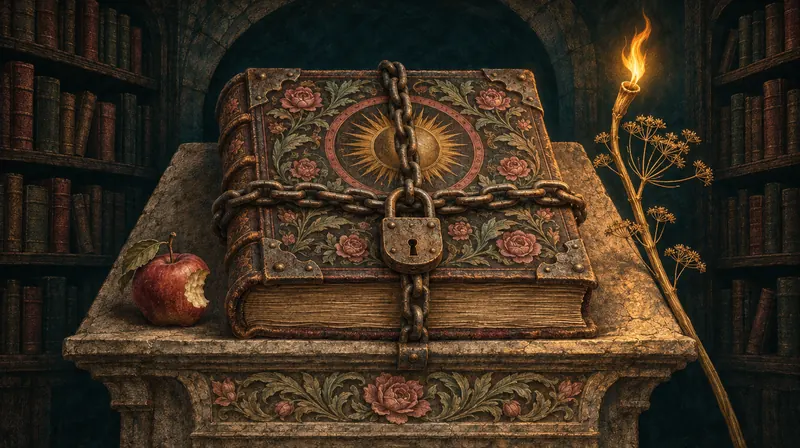
What is the story of Faust and his pact with the devil, and where does it come from?
What it is
Faust is the scholar who has learned everything the schools can teach and wants more. He calls up a spirit, Mephistopheles, and seals a pact with the devil in his own blood: twenty-four years of knowledge, travel and pleasure, and after them his soul. In the first printed telling the years run out and he is carried off. It is the forbidden knowledge story of the age of print and universities, and what it fears is the learned man who will pay any price to know.
The teaching
As the Faust book of 1587 with Marlowe and Goethe teaches it.
The doctor who took eagle's wings
The Faust book of 1587 tells of Johann Faust, a peasant's son from near Weimar, raised by a well-to-do cousin at Wittenberg, who studied theology and became a doctor of it. But he had a proud and reckless mind, the book says: he took to himself eagle's wings and wished to search out all the grounds of heaven and earth. He turned to physic, astrology and magic, and one night, at a crossroads in a forest near Wittenberg, he drew his circles and called up the devil.
The articles of the pact
The spirit who came to serve him was Mephostophiles. Faust set out his terms: that the spirit should serve and obey him, bring him whatever he asked, and come whenever he called, in whatever shape he wished. The spirit set out the price: that after twenty-four years Faust would belong to him, body and soul; that he would deny the Christian faith and be the enemy of all Christians; and that he would never let himself be turned back to God. Faust cut his hand and wrote the pact in his own blood.
Twenty-four years
The years are spent in questions and wonders. Faust disputes with the spirit about hell, the fall of the angels and the order of the heavens. He is carried to see hell, and borne among the stars in a chariot drawn by dragons. He travels through Europe and the East, plays tricks on the pope in Rome, raises Alexander the Great before the emperor Charles V, and at last takes Helen of Greece as his companion, who bears him a son. A godly old neighbour, a physician, begs him to repent while there is time, and Faust is moved; but the spirit falls on him with threats, and he writes a second pact in his blood.
The last night
On the last day of the twenty-four years he gathers his students in the village of Rimlich near Wittenberg, confesses what he has done, and begs them to live godly lives and to pray for him. Between midnight and one a great wind shakes the house, with hissing, and Faust's cries for help grow faint. In the morning the room is spattered with blood, and his body lies torn on the dung heap outside.
The book makes plain what damned him: not the pact alone but despair, the belief that his sin was too great to be forgiven, which kept him from asking. It is offered as a warning, with the words of James: “Submit yourselves therefore to God. Resist the devil, and he will flee from you.”
Marlowe: the misread verse
Christopher Marlowe's Doctor Faustus opens with the scholar weighing the learning of his time and dismissing it, logic, medicine, law and then divinity. He reads in Jerome's Bible that the reward of sin is death, and that if we say we have no sin we deceive ourselves, and concludes that we must sin and so must die: what will be, shall be. Both verses go on, to the gift of God that is eternal life and to the forgiveness of those who confess, but Faustus stops before he reaches the mercy. The tragedy begins in a half-read text.
Marlowe: hell and the last hour
Mephistophilis, who comes in a friar's habit, tells him the truth from the start. Asked how he is out of hell, he answers, “Why, this is hell, nor am I out of it,” and later, that hell has no limits and is no one place, for where the damned are is hell. When Faustus signs, his blood congeals, and the words Homo fuge, fly, man, appear on his arm. A Good Angel and a Bad Angel speak at his ears, and the good one never stops telling him he may repent, but Faustus answers that his heart is so hardened he cannot.
He summons Helen and kisses her: “Was this the face that launch'd a thousand ships, / And burnt the topless towers of Ilium?” In his last hour he begs time to stop, sees Christ's blood streaming in the firmament, one drop of which would save his soul, and cannot reach it; his last cry is “I'll burn my books!” The chorus mourns the branch cut down that might have grown full straight, and bids the wise only wonder at unlawful things, whose deepness entices forward wits to practise more than heavenly power permits.
Goethe: the wager in heaven
Goethe's Faust begins in heaven. Mephistopheles complains of humankind, and the Lord gives him leave to try Faust while he lives, for, the Lord says, man errs as long as he strives, and a good man in his dark urge still knows the right way. On earth Faust sits in his study, having mastered philosophy, law, medicine and theology, and is no wiser than before. He calls up the Spirit of the Earth and is struck down by it; on Easter night he is on the point of ending his life when the bells and choirs of Easter stay his hand.
Walking among the people, he confesses that two souls live in his breast, one clinging to the world with all its senses, the other striving to rise to the high fields of its forebears. A black poodle follows him home and turns into Mephistopheles, who names himself the spirit that always denies, a part of that power which always wills evil and always works good.
Goethe: the moment
This Faust does not sell his soul for a term of years. He makes a wager: if ever he lies down content, if ever pleasure can fool him into being pleased with himself, if ever he says to the passing moment, Stay, you are so beautiful, then Mephistopheles may have him. He signs with a drop of blood, a very special juice, says the devil.
Then comes the tragedy of Gretchen. Made young in a witch's kitchen, Faust seduces her; a sleeping draught he gives her for her mother kills the mother; her brother falls to Faust's sword; and Gretchen, abandoned, drowns her newborn child and is condemned. Faust comes to free her from prison, but she gives herself to God's judgement. She is judged, says Mephistopheles; a voice from above answers, She is saved.
Goethe: striving redeemed
In the second part Faust passes through the emperor's court, calls Helen out of the ancient world and loses the son she bears him, and turns at last to work, winning land from the sea for people to live on. Greedy for a last plot, he brings about the deaths of an old couple, Philemon and Baucis, whose cottage Mephistopheles' men burn. Care breathes on him and he goes blind. Hearing the spades of the lemurs digging his grave, he takes them for his labourers, imagines a free people on free ground, says that to such a moment he could say, Stay, you are so beautiful, and dies.
Mephistopheles claims him, but angels scatter roses and carry off his immortal part, singing that whoever strives with constant effort, him they can redeem. Gretchen, among the penitents, asks to teach him in the new light, and the play ends with the Chorus Mysticus: all that passes is only a likeness, and the eternal feminine draws us on high.
How it is practised
The story is best read as a question about price. A reader lists what they have wanted to know or to master badly enough to give something up for it, and what in fact they gave: time, health, a friendship, a principle. Then they set two endings side by side, the Faust book's and Goethe's, and ask which one the story needs. Nothing here is a rite. The pact is a device of the plot, and the house treats it only as that.
Where it comes from
A real man stands behind it. Johann Georg Faust was a wandering astrologer and alchemist of the early sixteenth century, named with scorn in letters of his time, who died about 1540. The Faust book, printed at Frankfurt in 1587, gave him the pact and the bad end, and was in English within a few years. Christopher Marlowe put it on the London stage about 1592. Goethe worked at his Faust for most of his life and published its two parts in 1808 and 1832; in his telling Faust is saved. Thomas Mann returned to the story in 1947.
What is known, and what is not
The historical Faust is thinly but genuinely documented, in a handful of letters and town records. Everything about the pact is legend, first printed nearly fifty years after his death, and legends of the same shape, such as that of Theophilus, were told centuries earlier. No pact of this kind has ever been shown to be more than a story, and no one makes one by reading, wishing or speaking carelessly.
Its words
- Pact with the Devil
- The bargain of the Faust story: a soul promised in return for knowledge or power. It is a device of legend and literature.
- Mephistopheles
- The spirit who serves and tempts Faust. The name first appears in the Faust book of 1587, and its origin is unknown.
- Faust
- The scholar of German legend who signs away his soul to know more. A real astrologer of that name died about 1540; the pact was first printed in 1587.
- The Sorcerer's Apprentice
- Goethe's comic ballad of 1797, after a tale in Lucian: a pupil sets a broom to carry water and cannot make it stop. The master comes home and ends it.
Ask the Oracle further
Why does Goethe save Faust when the first Faustian story sends him to his ruin?What is a Faustian bargain in ordinary life, and how would I recognise one?
Before you practise
These are stories, told with their sources. The Oracle will never tell you that you have made a pact, lost your soul or crossed a line that cannot be uncrossed. If that fear stays with you, speak with someone you trust in your own tradition.
Its other branches
PrometheusThe tree in EdenFrankensteinWhat they shareThe whole artSearch the tree

