
Faust legend and literature
Mephistopheles
Direct answer
Mephistopheles is primarily a figure of the Faust legend, not a stable demon from the Bible or an original member of the Ars Goetia. The character’s motives and theology change substantially from one adaptation to another.
Mephistopheles is the demonic tempter and companion of Faust in the German Faust tradition, transformed into distinct literary characters by Marlowe, Goethe, and later artists.
$0 today, then $12/month after 7 days. Cancel anytime.
Quick facts
| Question | Direct answer |
|---|---|
| Early major source | The 1587 German Faustbuch, using a variant such as Mephostophiles. |
| English dramatic form | Mephistophilis in Christopher Marlowe’s Doctor Faustus. |
| Most influential later form | Mephistopheles in Goethe’s Faust. |
| Biblical name? | No. The name does not occur in the Bible. |
What does your own chart say about you?
Choose love, work or purpose. Your reading is written from your chart. Your reading uses your own birth details.
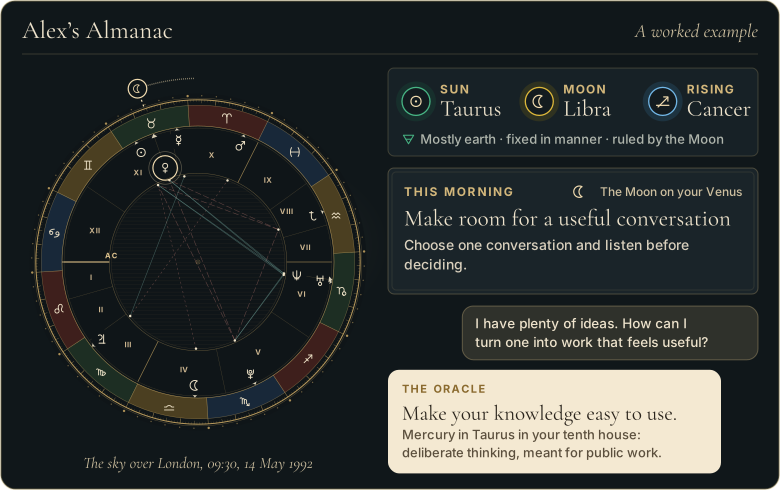
Walk through Alex’s whole example first
 The Road of AgesSee the turning points of your whole life, from your birth date
See your road's shape
The Road of AgesSee the turning points of your whole life, from your birth date
See your road's shape
Prefer to explore first?
 The Road of AgesThe turning points of your whole life, from your own chart
Walk my road
The Road of AgesThe turning points of your whole life, from your own chart
Walk my road
Free, by email
Your daily Almanac letter
One short letter at 7 each morning: the day’s theme read for your own chart, and one thing to do with it.
The demon in the early Faust legend
The printed Historia von D. Johann Fausten of 1587 tells of a learned magician who makes a pact and is served by a spirit whose name appears in variant spellings. The story belongs to Reformation-era arguments about forbidden knowledge, pride, repentance, and damnation. It combines folklore about a historical Georg or Johann Faust with literary moralization. Mephistopheles is not introduced as a richly independent ancient deity; the figure functions within Faust’s bargain. The unstable spelling reflects early transmission and helps explain why claims of one certain Hebrew or Greek etymology remain debated.
Marlowe’s Mephistophilis
Christopher Marlowe’s Doctor Faustus gives the spirit memorable dramatic depth. Mephistophilis answers questions, performs wonders, tempts, and enforces the pact, yet also speaks of hell as separation from divine presence. Those moments can make the demon appear both agent of damnation and witness to what Faust refuses to understand. Different early texts of the play vary, so quotations should identify an edition. Marlowe’s character is not identical to Goethe’s later ironic companion, and neither should be flattened into a generic occult profile assembled from modern demon lists.
Goethe’s spirit of negation
Goethe reshaped the legend across Faust Part One and Part Two. His Mephistopheles is witty, skeptical, mobile, and associated with negation, yet participates in a wager whose outcome differs from the older damnation tale. He moves through tavern comedy, seduction tragedy, court spectacle, classical fantasy, and philosophical argument. The character exposes vanity and illusion while causing or enabling grave harm. Because Goethe’s drama is complex, slogans such as “the Devil’s advocate” capture only one function. Reading the scenes and their changing contexts is more useful than assigning a single occult office.
Opera, art, psychology, and popular culture
Composers including Gounod and Boito, visual artists, novelists, filmmakers, and musicians turned Mephistopheles into a recognizable symbol of temptation, cynical intelligence, bargains, and self-deception. “Faustian bargain” now describes trading a fundamental value for short-term gain even without supernatural belief. Psychological readings may treat Mephistopheles as projection, shadow, negation, or the voice that rationalizes desire. These are interpretations of literature, not proof that the character is an objectively encountered being. Modern images (red costume, pointed beard, elegant nobleman) often owe more to theater than early textual description.
How to evaluate claims about Mephistopheles
Claims about Mephistopheles should be tied to a dated text, object, author, or community rather than presented as timeless fact. Names and images often accumulate new meanings as they move between languages, religions, literature, art, and popular culture. Etymology does not by itself determine later symbolism, and a resemblance between traditions is not proof that one secretly derived from the other. A useful interpretation identifies the historical layer being discussed, distinguishes evidence from speculation, and acknowledges competing readings. Personal reflection may begin with a cultural symbol, but it should not erase the people, texts, or circumstances that gave that symbol its documented forms.
Sources and editorial method
Research and editorial references used for this page include:
- Project Gutenberg: Faust by Johann Wolfgang von Goethe - Public-domain primary text of Goethe’s drama in translation.
- Encyclopaedia Britannica: Faust - Reference history of the Faust legend and its major literary adaptations.
These references support the factual, historical, textual, or interpretive claims on this page. Interpretive traditions are identified as such, and factual claims are kept separate from symbolic claims.
Related reading
Question the bargain
A definition tells you what it is; your own birth chart tells you what it means for you. The Oracle casts your real chart and answers for your love, your work, and your year ahead, in conversation. It opens with the 7-day Seeker trial.
Speak with the OracleThe Cosmic Codex offers a reflective map of your year, written from your chart, never a prediction. Open the Cosmic Codex
More in Demons & Fallen Beings
From the reference page to your own chart
Every word here
is in your own chart.
- A personal reading about love, work or purpose, written from your chart
- A practical next step to consider
- It opens with 7 days free, with the AI Oracle and daily guidance
$0 today, then $12/month after 7 days. Cancel anytime.
Common questions
Is Mephistopheles Satan?
Adaptations relate him to the Devil in different ways, but he is a specific Faustian dramatic figure rather than a biblical name for Satan.
Is Mephistopheles in the Ars Goetia?
No. He is not one of the standard seventy-two Goetic catalogue entries.
What does a Faustian bargain mean?
A costly exchange in which immediate power, knowledge, or pleasure is purchased by sacrificing a deeper value.
Free, by email
The Almanac, in your inbox at 7
One short letter at 7 each morning: the day’s theme read for your own chart, and one thing to do with it.
