
Prometheus
Fire stolen for humankind, and its price.
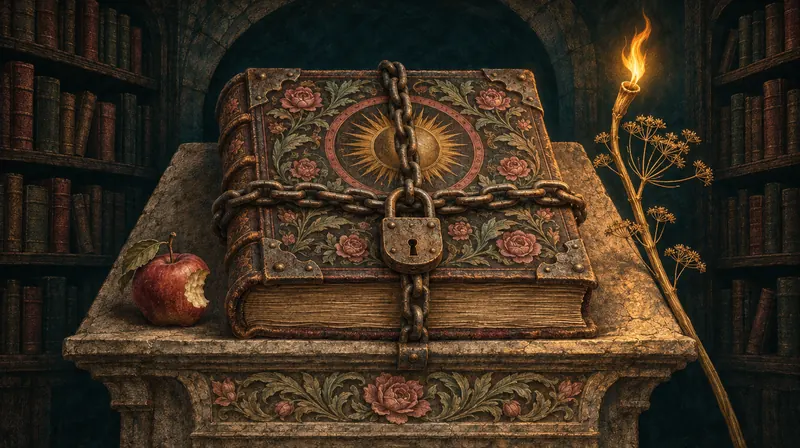
What does the story of Prometheus say about forbidden knowledge?
What it is
Prometheus is a Titan, one of the older gods, who takes the side of humankind against Zeus. In the oldest telling he tricks Zeus over the sharing of a sacrifice, Zeus withholds fire in anger, and Prometheus steals it back hidden in a hollow fennel stalk. Zeus has him chained to a pillar, where an eagle tears at his liver each day, and sends Pandora to humankind as the price of the gift. It is the Greek picture of what skill costs: every art that lifts people above the animals was first taken, and then paid for.
The teaching
As Hesiod with Prometheus Bound and Plato's Protagoras teaches it.
The Titan of forethought
Prometheus is a Titan, a son of Iapetus and the ocean nymph Clymene, of the older race of gods that Zeus overthrew. His brothers are Atlas, who holds up the sky, Menoetius, struck down by Zeus for his arrogance, and Epimetheus. The Greeks heard forethought in his name and afterthought in his brother's: Prometheus sees what is coming, and Epimetheus understands only when it has come. Of all the gods he is the one who takes the side of humankind, and every telling of him is about the price of that loyalty.
The trick at Mekone
Hesiod's Theogony tells how it began. When gods and mortals met at Mekone to settle what each should have of a sacrifice, Prometheus divided a great ox. On one side he put the meat and the rich inner parts, hidden inside the ox's stomach; on the other the white bones, wrapped in shining fat. He offered Zeus the choice. Zeus, whose wisdom never fails, saw the trick, Hesiod insists, and chose the bones, and ever since mortals burn the bones for the gods on their altars and eat the meat themselves.
Zeus answered by withholding fire. Fire here is more than warmth: it is the hearth, the cooked meal, the sacrifice and every craft that works metal and clay. Without it, mortals would live like beasts.
The theft of fire
Prometheus stole it back. He carried the far-seen gleam of unwearying fire down to mortals in a hollow fennel stalk, whose dry pith smoulders slowly inside the green rind, so that fire can be carried in it unseen. When Zeus saw fire shining among men he was stung to the heart, and he set a price on it.
Pandora and the jar
Hesiod tells of the price twice. In the Theogony, Hephaestus moulds from earth the likeness of a modest maiden and Athena adorns her, and Hesiod calls her a beautiful evil, from whom comes the race of women. In the Works and Days each god gives her something: Hephaestus a voice and a face like the goddesses, Athena skill at the loom, Aphrodite grace and aching desire, Hermes a shameless mind, lies and coaxing words; the Graces and Persuasion hang her with gold, and the Hours crown her with flowers. Because all the Olympians gave her a gift, she is called Pandora.
Prometheus had warned his brother never to take a gift from Zeus, but Epimetheus took her in and understood too late. Until then mortals had lived free of evils, hard toil and sickness. Pandora lifted the great lid of a storage jar and let them out to wander the earth and the sea, and diseases now come to people by day and night, silently, for Zeus took away their voices. Only Hope stayed inside, under the rim, because she put the lid back first. The jar became a box much later, in a Latin retelling of the sixteenth century.
This is Hesiod's view, and a hard one: the gift of fire is paid for in labour and grief, and he lays the grief at a woman's door. Why Hope was in a jar of evils at all, and whether keeping her there saved her for us or kept her from us, Hesiod does not say, and readers have asked ever since.
The eagle and the pillar
Zeus bound Prometheus with unbreakable chains driven through a pillar, and sent a long-winged eagle to eat his immortal liver, which grew back each night as much as the bird had eaten by day. In Hesiod he is freed at last by Heracles, who shoots the eagle with Zeus's consent, so that his son's glory might grow. Hesiod's lesson is plain: no one can deceive or get round the mind of Zeus, and even the clever son of Iapetus did not escape his anger.
Prometheus Bound: the giver of the arts
In Prometheus Bound, the play handed down as the work of Aeschylus, the story turns. Power and Force, the servants of Zeus, bring the Titan to a crag at the edge of the world, and Hephaestus, ashamed and pitying, nails him to it. His crime, they say, is his love of humankind, and the Greek word they use for it is the one that became philanthropy. Left alone, he tells what he gave. He stopped mortals from foreseeing their own deaths by planting blind hopes in them, and he gave them fire, the teacher of every art.
Then he counts the arts. Before him, people had eyes and saw to no purpose, and ears and did not hear; they lived like ants in sunless caves and did not know winter from spring or summer. He showed them the risings and settings of the stars; number, the chief of all devices; and the putting together of letters, the memory of all things. He yoked beasts to bear their burdens, harnessed horses to chariots and gave sailors ships with linen wings. He taught them to mix mild remedies against disease, and every kind of prophecy, from dreams and chance words to the flight of birds, the signs in entrails and the shapes in the sacrificial flame. He found for them the bronze, iron, silver and gold hidden in the earth. In a word, he says, every art that mortals have comes from Prometheus.
The secret Prometheus keeps
Prometheus also knows the future, taught by his mother, and he holds one secret: Zeus is moving towards a marriage that will bear a son stronger than his father, and will fall unless he is warned. Io comes to the crag, a girl Zeus loved and Hera turned into a heifer and drove across the world with a gadfly, and Prometheus foretells her wanderings and that a descendant of hers, thirteen generations on, will set him free. Hermes comes to demand the secret; Prometheus refuses and mocks the new tyrant. The play ends in thunder and earthquake as the crag is hurled into the depths, with the Titan calling on the sky and on his mother to see how he suffers wrong.
Plato's telling: justice and shame
In Plato's Protagoras the story becomes a lesson about cities. When the gods had moulded the mortal kinds from earth and fire, they told Prometheus and Epimetheus to give out their powers. Epimetheus begged to do it alone, and gave speed to some, strength to others, wings, fur, hooves and claws, so that each kind could survive; and he had used up every gift before he came to human beings, who were left naked, unshod, unbedded and unarmed.
Prometheus, at a loss, stole from the workshop of Hephaestus and Athena the skill of the arts together with fire, and gave them to humankind. So people could build, speak, farm and worship, but they lived scattered, and when they gathered into cities they wronged one another and scattered again, for they lacked the art of living together, which Zeus kept in his own citadel. Fearing for the race, Zeus sent Hermes with shame and justice. Should he give them out like the other arts, Hermes asked, one doctor for many people? No, said Zeus, to all, for there could be no cities if only a few had them; and let it be law that whoever cannot share in shame and justice be put to death as a sickness of the city. Skill, in Plato's telling, is the stolen gift; justice is the one that must be given to all.
The maker of humankind
Later writers make Prometheus our maker as well as our benefactor. In Ovid he mixes earth with fresh rain water and shapes it in the image of the gods, and gives humans, alone among the animals, an upright face to look at the stars. In Apollodorus he shapes people from water and earth, gives them the stolen fire, and warns his son Deucalion of the flood Zeus is sending, so that Deucalion builds a chest, rides out the waters with his wife Pyrrha, the daughter of Pandora, and peoples the earth again.
How it is practised
The story is read by asking what the fire is. A reader names one real ability they have gained, a trade, a training or a piece of hard knowledge, and writes down what it cost to get and who else bears part of that cost. Then they read Hesiod's short account beside the scene in the play where Prometheus counts over his gifts, and note where the two tellings disagree about whether he did right. The disagreement is the lesson.
Where it comes from
Hesiod tells it twice, about 700 BCE, and has little sympathy for the thief. Two centuries later the play Prometheus Bound, handed down under the name of Aeschylus, turns him into the champion who gave people numbers, writing, medicine and every craft, and who will not bow to a tyrant. Plato has a version of his own in the Protagoras. The Romantics made him their hero: Goethe, Byron and Percy Shelley all wrote of him, and in 1818 Mary Shelley took his name for the subtitle of Frankenstein.
What is known, and what is not
The texts survive and their dates are roughly agreed, though whether Aeschylus wrote Prometheus Bound is disputed among classicists. Nothing suggests that the myth records an event. Its meanings are interpretations: Hesiod's caution, the play's defiance and the Romantic rebel are three different stories told about one figure, and none of them is a ruling on what any person may learn.
Its words
- Prometheus
- The Titan of Greek myth who stole fire from the gods for humankind and was chained to a rock for it. The Greeks took his name to mean forethought.
- Pandora
- The first woman in Hesiod's telling, sent as the price of the stolen fire. Her jar let loose the ills of life and kept hope inside.
- Icarus
- The boy of Greek myth who flew on wings of wax and feathers, climbed too near the Sun and fell. His father had warned him against flying too low as well.
- Tantalus
- The king who dined with the gods and abused their trust, and stands for ever beside water and fruit that draw away from him. The word tantalise comes from his name.
Ask the Oracle further
Why did Hesiod blame Prometheus when he stole fire, while later poets praised him?What is the fire in the forbidden knowledge story of Prometheus, if I read it for my own life?
Before you practise
These are stories, told with their sources. The Oracle will never tell you that you have made a pact, lost your soul or crossed a line that cannot be uncrossed. If that fear stays with you, speak with someone you trust in your own tradition.
Its other branches
The tree in EdenFaustFrankensteinWhat they shareThe whole artSearch the tree

