
The tree in Eden
The telling most readers know first.
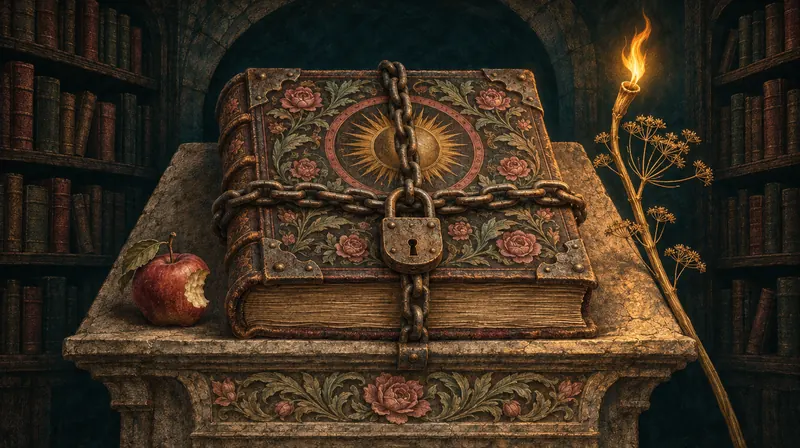
What does the story of the tree of knowledge in Eden say about forbidden knowledge?
What it is
Genesis 2 and 3 tell of a garden with two trees at its centre, the tree of life and the tree of knowledge. The first man and woman may eat from every tree but the second. A serpent questions the command, the woman eats and gives to the man, and their eyes are opened: they see that they are naked, and hide. They are sent out of the garden so that they do not eat from the tree of life as well. It is the telling of forbidden knowledge that most readers in the West meet first, and the one most often retold.
The teaching
As the book of Genesis with its Jewish and Christian readers teaches it.
The garden and the two trees
Genesis tells how “the LORD God formed man of the dust of the ground, and breathed into his nostrils the breath of life; and man became a living soul.” The Hebrew plays on the words: the man, adam, is taken from the ground, adamah. God plants a garden eastward in Eden and sets the man in it to dress it and keep it, with every tree pleasant to the sight and good for food, and in the midst two trees: the tree of life, and the tree of the knowledge of good and evil.
Then comes the one command: “Of every tree of the garden thou mayest freely eat: But of the tree of the knowledge of good and evil, thou shalt not eat of it: for in the day that thou eatest thereof thou shalt surely die.” God brings the beasts and the birds to the man to see what he will call them, and whatever he calls each, that is its name. No help meet for him is found, so God casts him into a deep sleep and builds a woman from one of his ribs, and the man says: “This is now bone of my bones, and flesh of my flesh.” They are both naked, and are not ashamed.
The serpent's question
“Now the serpent was more subtil than any beast of the field which the LORD God had made.” It asks the woman: “Yea, hath God said, Ye shall not eat of every tree of the garden?” She answers that of the tree in the midst God said, “Ye shall not eat of it, neither shall ye touch it, lest ye die.” The command said nothing of touching, and the rabbis noticed: the serpent, they say, pushed her against the tree, and when she did not die of touching it, told her she would not die of eating. Whoever adds to a word, the Talmud teaches, takes away from it.
Then the serpent speaks plainly: “Ye shall not surely die: For God doth know that in the day ye eat thereof, then your eyes shall be opened, and ye shall be as gods, knowing good and evil.” The woman sees that the tree is good for food, pleasant to the eyes, and “a tree to be desired to make one wise”. She eats, and gives to her husband with her, and he eats. “And the eyes of them both were opened, and they knew that they were naked; and they sewed fig leaves together, and made themselves aprons.”
Where art thou?
They hear “the voice of the LORD God walking in the garden in the cool of the day”, and hide. God calls, “Where art thou?”, and asks, “Who told thee that thou wast naked?” The man answers, “The woman whom thou gavest to be with me, she gave me of the tree, and I did eat,” and the woman, “The serpent beguiled me, and I did eat.” Each passes the fault along, and the story lets the passing speak for itself.
The sentences and the going out
The serpent is cursed to go upon its belly and eat dust, with enmity between its seed and the woman's: “it shall bruise thy head, and thou shalt bruise his heel.” The woman will bring forth children in sorrow, and her husband shall rule over her. The ground is cursed for the man's sake: “In the sweat of thy face shalt thou eat bread, till thou return unto the ground; for out of it wast thou taken: for dust thou art, and unto dust shalt thou return.”
The man names his wife Eve, “because she was the mother of all living”, and God clothes them in coats of skins. Then God says: “Behold, the man is become as one of us, to know good and evil: and now, lest he put forth his hand, and take also of the tree of life, and eat, and live for ever.” So they are sent out to till the ground, and east of the garden God sets cherubims “and a flaming sword which turned every way, to keep the way of the tree of life.”
What the knowledge of good and evil is
The text never defines the knowledge, and its readers have taken it four ways. Some read it as the power to decide for oneself what is good and what is evil, a rule that belongs to God. Some read good and evil as a pair that means everything, as we say from top to bottom. Some read it as the knowing of grown-ups: Deuteronomy speaks of children “which in that day had no knowledge between good and evil”, and old Barzillai asks, “can I discern between good and evil?” Others read it as knowing evil by doing it, which cannot be had without being changed.
The fruit and the day of death
Genesis names no fruit. The rabbis of the Talmud proposed the vine, since nothing brings woe like wine; wheat, since a child cannot say father and mother until it has tasted grain; and the fig, whose leaves were at hand to cover them. The apple came later, in the Latin West, where the words for evil and for apple are spelled alike. Nor do the two die that day. The Book of Jubilees answers that a thousand years are one day in heaven, and Adam died at nine hundred and thirty, within the day; others read the death as mortality begun, or as the loss of the life that might have been.
The rabbis' reading
Jewish teaching reads the garden without an inherited stain. Each person stands where Adam stood, with two inclinations, the good and the evil, and the freedom to choose: “sin lieth at the door”, God tells Cain in the next chapter, “and thou shalt rule over him.” Nor is the evil inclination simply bad; without it, a midrash says, no one would build a house, marry or have children. The task is to rule it, and the commandments are given for that.
The church's reading
Christian teaching reads the garden through Paul: “by one man sin entered into the world, and death by sin”, and “as in Adam all die, even so in Christ shall all be made alive.” Augustine taught that pride came before the eating, as the root of the first sin, and that its guilt and disorder pass to every descendant: this is original sin, from which grace alone frees. Irenaeus, earlier, saw Adam and Eve as children, made to grow by degrees into the likeness of God, who reached too soon for what would have been given in time. The Easter liturgy of the Latin church sings O felix culpa, O happy fault, that won so great a Redeemer.
The Qur'an's telling
The Qur'an tells the garden in its own words. God tells the angels He will set a deputy on the earth, teaches Adam the names of all things, and bids the angels bow to him; Iblis refuses in pride. Adam and his wife may eat freely but must not approach one tree. Satan whispers to them both, promising the tree of immortality and a kingdom that never decays; they eat, and their nakedness appears to them. Both repent, God turns to them in mercy, and they go down to the earth with guidance promised, so that no stain passes to their children.
Milton's garden
John Milton gave English readers the garden they picture. Paradise Lost begins “Of man's first disobedience, and the fruit / Of that forbidden tree, whose mortal taste / Brought death into the world, and all our woe”. Its Satan enters the serpent and flatters Eve alone; Adam eats knowingly, “not deceived, / But fondly overcome with female charm.” Yet the poem ends in hope. The angel Michael tells Adam that if he adds deeds, faith, patience and love to his knowledge he will possess “a paradise within thee, happier far”, and the pair go out hand in hand: “The world was all before them, where to choose / Their place of rest, and Providence their guide”.
How it is practised
Read the two chapters slowly, in a translation with notes, and mark three things: what is actually commanded, what the serpent actually says, and what actually changes after the eating. Then write one sentence on what kind of knowing the story seems to mean, whether moral judgement, grown-up awareness or the wish to know everything. A reader who belongs to a tradition reads it next with that tradition's own commentary, since the story is theirs first.
Where it comes from
The text is short and leaves much unsaid. It does not name the forbidden fruit: the apple comes from later Latin tradition and from painters. It does not call the serpent the devil, an identification made in later Jewish and Christian writing. Readers have differed widely. Augustine, about the year 400, drew from it the teaching of original sin. Jewish tradition reads it without that teaching. Some of the texts found at Nag Hammadi turn the story round and make the serpent a bringer of insight. Milton retold it at epic length in Paradise Lost in 1667.
What is known, and what is not
The story is scripture for Jews and Christians and is treated here as a text with a long history of reading, not as a claim for the house to weigh. Scholars agree on what the Hebrew says and disagree on what the knowledge of good and evil means. That the fruit was an apple and that the serpent was Satan are later readings and are not in Genesis. The story is told of a first pair, and the house draws from it no verdict on any reader.
Its words
- Tree of Knowledge
- The tree in the garden of Genesis 2 and 3 whose fruit the first pair were told not to eat. The text does not say what fruit it bore.
- Forbidden Fruit
- What the first pair eat in Genesis 3 against the command. The text names no kind of fruit; the apple is later tradition, and the phrase now means any banned delight.
- Tower of Babel
- The tower of Genesis 11 that a people of one language begin to build towards heaven, until their speech is confused. Its likely model is the ziggurat of Babylon.
Ask the Oracle further
Does the forbidden knowledge story of Eden name the fruit, and where does the apple come from?How do Jewish and Christian readers each understand the forbidden knowledge of Eden?
Before you practise
These are stories, told with their sources. The Oracle will never tell you that you have made a pact, lost your soul or crossed a line that cannot be uncrossed. If that fear stays with you, speak with someone you trust in your own tradition.
Its other branches
PrometheusFaustFrankensteinWhat they shareThe whole artSearch the tree

