

Second Temple Jewish literature
Watchers
Direct answer
Genesis 6 mentions “sons of God,” human women, and the Nephilim but does not call those figures Watchers. The detailed names, oath, illicit teachings, giants, and angelic judgment come from 1 Enoch and related Second Temple traditions.
The Watchers are heavenly beings in the Book of the Watchers, the opening portion of 1 Enoch, whose descent, forbidden unions, teachings, and punishment expand the brief Genesis 6 story.
$0 today, then $12/month after 7 days. Cancel anytime.
Quick facts
| Question | Direct answer |
|---|---|
| Principal source | 1 Enoch 1-36, commonly called the Book of the Watchers. |
| Biblical point of contact | Genesis 6:1-4. |
| Central plot | Heavenly beings descend, take wives, teach forbidden arts, and generate destructive giants. |
| Canonical status | 1 Enoch is canonical in the Ethiopian Orthodox Tewahedo Church but not in most Jewish or Christian canons. |
Watchers are Enochic angelic beings associated with descent, forbidden knowledge, and the Nephilim.
A lineage map for books and systems; it avoids presenting symbolic traditions as literal fact.
What does your own chart say about you?
Choose love, work or purpose. Your reading is written from your chart. Your reading uses your own birth details.
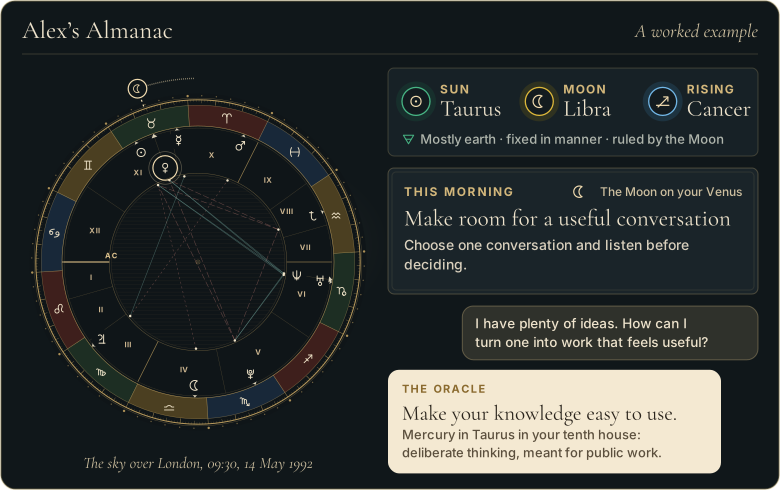
Walk through Alex’s whole example first
 The Road of AgesSee the turning points of your whole life, from your birth date
See your road's shape
The Road of AgesSee the turning points of your whole life, from your birth date
See your road's shape
Prefer to explore first?
 The Road of AgesThe turning points of your whole life, from your own chart
Walk my road
The Road of AgesThe turning points of your whole life, from your own chart
Walk my road
Free, by email
Your daily Almanac letter
One short letter at 7 each morning: the day’s theme read for your own chart, and one thing to do with it.
The brief Genesis passage
Genesis 6:1-4 describes the “sons of God” taking human women and mentions the Nephilim, but it is terse and leaves major questions unanswered. The Hebrew term often translated “sons of God” has produced several interpretations: heavenly beings, royal rulers, or the line of Seth, among others. The passage itself does not provide the Watcher leaders’ names, a mountain oath, a list of forbidden teachings, or a full origin story for evil spirits. Those details belong to later interpretive literature. Reading them back into Genesis without attribution hides the difference between source and expansion.
The Book of the Watchers narrative
In 1 Enoch, a group of heavenly Watchers sees human women, descends, and binds itself by an oath. Leaders such as Semyaza and Asael are associated with teachings that cross divinely set boundaries, including weapons, adornment, enchantments, and celestial knowledge in various textual forms. Their unions produce giants whose violence devastates the earth. Human complaint rises to heaven, archangels receive instructions, the Watchers are bound for judgment, and the giants’ deaths become part of an explanation for harmful spirits. The narrative develops themes of corrupted knowledge, violence, cosmic order, and accountability.
Second Temple setting and manuscript evidence
The Book of the Watchers took shape in the centuries before the Common Era. Aramaic fragments among the Dead Sea Scrolls show that Enochic traditions circulated in ancient Judaism, while the complete work survives chiefly in Ge‘ez manuscripts. New Testament texts such as Jude and 2 Peter share motifs with Enochic judgment traditions, though interpreters debate the precise relationships. This evidence makes the Watchers important for understanding Second Temple Jewish ideas; it does not make every modern demonology claim ancient. Translation and manuscript history should be consulted before building doctrine from a name list.
Watchers are not proof of aliens or targeted surveillance
Modern books sometimes identify the Watchers with extraterrestrial engineers, prehistoric technology, secret bloodlines, or spirits assigned to monitor individual people. Those claims are not what the ancient narrative demonstrates. The text works in an apocalyptic religious world of rebellion, illicit revelation, judgment, and restoration. Reading “heavenly” as “space alien” imports a modern category, while equating Watchers with today’s “monitoring spirits” ignores the narrative’s specific actors and setting. Readers may compare interpretations, but the comparison should begin after accurately describing the surviving text rather than replacing it.
Reading The Watchers with textual care
A sound account of The Watchers distinguishes the wording of the relevant ancient text from later interpretation, popular preaching, fiction, and internet folklore. Translation choices, genre, historical setting, and differences among Jewish and Christian canons can materially change what a passage appears to say. The text should be read in context rather than converted into a code for identifying strangers, predicting a date, or diagnosing an unseen attack. Churches and scholars may disagree in good faith, so major interpretations should be named rather than presented as the only possible reading. Spiritual concern does not cancel ordinary evidence: immediate danger, abuse, illness, or severe distress calls for qualified help and concrete safeguarding.
Sources and editorial method
Research and editorial references used for this page include:
- Bible Gateway: Genesis 6:1-4 - Primary biblical passage associated with later Watcher traditions.
- Internet Sacred Text Archive: 1 Enoch - Public translation of the Enochic text for direct comparison.
These references support the factual, historical, textual, or interpretive claims on this page. Interpretive traditions are identified as such, and factual claims are kept separate from symbolic claims.
Related reading
Discern forbidden knowledge
A definition tells you what it is; your own birth chart tells you what it means for you. The Oracle casts your real chart and answers for your love, your work, and your year ahead, in conversation. It opens with the 7-day Seeker trial.
Speak with the OracleThe Cosmic Codex offers a reflective map of your year, written from your chart, never a prediction. Open the Cosmic Codex
More in Nephilim, Enoch & Hidden Books
From the reference page to your own chart
Every word here
is in your own chart.
- A personal reading about love, work or purpose, written from your chart
- A practical next step to consider
- It opens with 7 days free, with the AI Oracle and daily guidance
$0 today, then $12/month after 7 days. Cancel anytime.
Common questions
Are the Watchers named in Genesis?
No. Genesis gives a short “sons of God” passage; the developed Watcher story and names appear in 1 Enoch.
Are all watchers evil in ancient literature?
No. “Watcher” can describe vigilant heavenly beings; 1 Enoch focuses on a group that transgresses.
Is 1 Enoch in the Bible?
It is canonical in the Ethiopian Orthodox tradition but outside the canon of most Jewish and Christian communities.
Free, by email
The Almanac, in your inbox at 7
One short letter at 7 each morning: the day’s theme read for your own chart, and one thing to do with it.
