
Tommaso Campanella
1568 to 1639
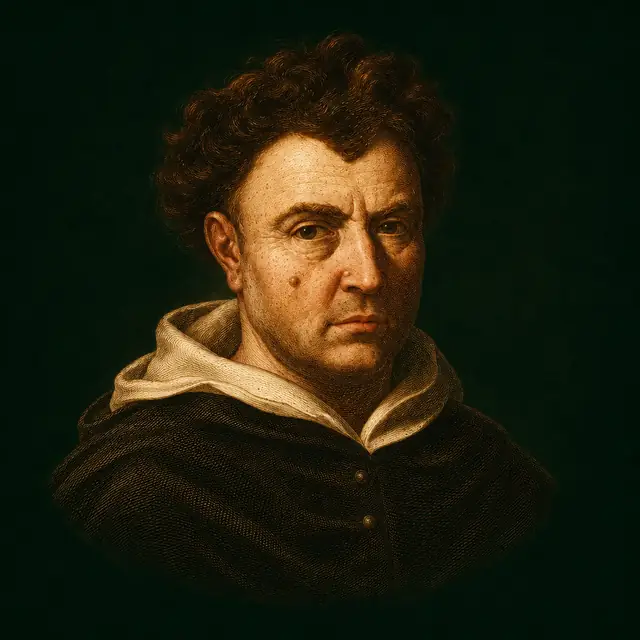
Who was Tommaso Campanella, and what is truly known of them?
What is known
Italian Dominican, philosopher and poet, born at Stilo in Calabria. His first book defended the philosophy of nature of Telesio against Aristotle, and he was tried for heresy several times in the 1590s. In 1599 he was arrested as a leader of a plot to throw off Spanish rule in Calabria. He kept up a show of madness through a day and a half of torture, which saved him from the stake, and was held in the prisons of Naples for twenty-seven years. There he wrote most of his books, among them The City of the Sun (1602), a dialogue on a commonwealth ruled by a priest-philosopher, where children learn from pictures on the city walls and the stars time every act. Freed in 1626, he performed rites against a threatening eclipse with Pope Urban VIII in 1628, fled to France in 1634, and died in Paris.
The teaching
Taught from his own books, above all The City of the Sun, On the Sense of Things and on Magic, and his poems.
All things feel
Campanella teaches that everything that exists can feel. Nothing could keep itself in being unless it sensed what harms it and what helps it: fire feels the cold and flees it, the magnet feels the iron and draws it, the plant feels the sun and turns toward it. Sensing is a being acted on, and knowing is a kind of becoming like what is known. The world is one great living creature, the statue and living image of God, and all its parts feel together.
Power, Wisdom and Love
Every being is made of three first principles: power, by which it can be; wisdom, by which it knows its being; and love, by which it loves its being and keeps itself in it. In God the three are infinite and pure. In creatures they are mixed with not being, with lack of power, ignorance and hate, so that every finite thing is a weave of being and nothing. The love by which each thing keeps itself is the root of nature, and in a human being it must widen into love of the whole and of God.
Magic, the art of sympathy
Magic is the practical science of that common feeling. Natural magic works by the sympathies and antipathies between things, as medicine and farming do, using the powers of herbs, stones, scents, sounds and lights; it is honest and belongs to philosophy. Above it is the divine magic of the saints, which works by God's grace; below it, the demonic magic that works by evil spirits and deceit, which is forbidden. Music and words move the spirit directly, because the spirit is a warm, fine air that sound and breath can stir.
The world is a book
In one of his sonnets the world is the book in which the eternal Wisdom wrote its own thoughts, and the living temple it painted with its deeds and filled with living statues. People should read that book, he says, and not the dead books copied from it, which are full of error. His first book, in defence of Telesio, gives the method: nature is to be studied through the senses, which are touched by the things themselves, and not through the authority of Aristotle. Telesio's two principles, heat and cold working on a passive matter, became the ground of his whole philosophy of nature and of his astrology.
God's two books
In his Defence of Galileo he holds that God wrote two books, Scripture and nature, and that they cannot contradict each other, since they have one author. Scripture teaches the way to salvation and speaks of nature in the language of the people; it does not settle questions that the senses can test. A theologian who condemns a philosophy of nature without having studied it errs, as the old writers erred who denied that anyone could live on the far side of the earth. The freedom to study nature does faith no harm.
The City of the Sun
The City of the Sun is his picture of a commonwealth that lives by these teachings, told by a Genoese sea captain. It stands on a hill within seven circles of walls named for the seven planets, and the walls are painted inside and out with everything that can be known: the figures of mathematics, the stones and metals, the seas and rivers, the plants, the fish, the birds and the beasts, the mechanical arts and the great founders of laws and sciences. The children walk round them with their teachers and learn by seeing and by play, so that by ten they know the outline of every science.
The ruler is a priest called the Sun, the Metaphysician, and beside him stand three princes: Power, who governs war; Wisdom, who governs the sciences; and Love, who governs birth, food, clothing and the rearing of children. Everything is held in common, because a house, a wife and children of one's own breed the self-love that ruins a city. Each works four hours a day, no work is thought shameful, and honour goes to the most skilled. The officers of Love even decide which couples may have children, and the astrologers fix the hour, as Plato's Republic had proposed for its guardians.
Times set by the stars
In the City every act is timed by the heavens: sowing, building, setting out on a journey and the begetting of children. Its people worship God, whose living image is the Sun, and never the Sun itself, in a round temple open on every side, with seven lamps that bear the names of the planets, and they pray toward the four quarters of the sky. The captain ends with the signs he sees of a new age: the great conjunctions of the planets, and the printing press, the guns and the magnet's needle, by which the last hundred years have seen more history than the four thousand before them.
Escaping the fate of the stars
The stars act by heat and light; they incline and do not compel, and what they threaten can be met. The last of his books of astrology teaches how, and tells the rite he performed when an eclipse seemed to threaten. A room is closed against the outside air and sprinkled with rose vinegar and sweet scents; laurel, myrtle, rosemary and cypress are burned; the walls are hung with white silk and green branches; two lamps and five torches are lit for the seven planets, so that the room keeps the light the eclipse takes from the sky; music of Jupiter and Venus is played; and those present hold the stones and colours of the kindly planets and keep company with people born under good stars.
It is told here as a record of what he did and held, not as a counsel. A closed room with flames and burning leaves is a danger to life, and no rite takes the place of reason, prayer or a doctor.
Orders and memberships
A Dominican friar from about 1582 until his death in the order’s house in Paris. No secret order is documented. The Calabrian rising of 1599 was a political plot, for which he was tried. His manuscripts were carried to Germany and printed by Tobias Adami, a friend of Johann Valentin Andreae.
The legend
That his madness was real: most historians hold that he feigned it, and his later writings bear them out. That he foretold the reign of the Sun King: he cast a horoscope and wrote a poem for the birth of the future Louis XIV in 1638, as court astrologers were paid to do. That The City of the Sun is the plan of a secret brotherhood.
Their works
- The City of the SunBook, written 1602, printed 1623
A dialogue written in a Naples prison, in which a sailor describes a city ruled by a priest philosopher called the Sun, where goods are held in common, children learn from pictures on the walls, and the stars set the times of every act. Tobias Adami printed it in Latin at Frankfurt.
Ask the Oracle about it - On the Sense of Things and on MagicTreatise, printed 1620
His book teaching that all things feel, that the world is a living creature, and that magic is the art of using the sympathies between things. Written in the 1590s and confiscated, it was rewritten in prison and printed by Adami.
Ask the Oracle about it - Philosophy Demonstrated by the SensesBook, printed 1591
His first book, written in his early twenties, defending the natural philosophy of Bernardino Telesio, who taught that nature should be studied through the senses, against the followers of Aristotle. It drew the first charges of heresy upon him.
Ask the Oracle about it - Defence of GalileoTreatise, written 1616, printed 1622
Written in prison when the Church first moved against Copernicus, it argues that the freedom to study nature does not threaten Scripture. It was printed at Frankfurt while Campanella was still in prison.
Ask the Oracle about it - Astrologicorum libriBook, printed 1629
Seven books of astrology, reformed after the teaching of Telesio. The last, on escaping the fate written in the stars, describes the rites of candles, scents and music he performed with Urban VIII against a threatening eclipse, and was printed without his consent.
Ask the Oracle about it - Philosophical poemsPoem, printed 1622
A selection of his sonnets and songs, many written in prison, on the world as the living book of God, the misery of the age and his own sufferings, printed in Germany by Adami.
Ask the Oracle about it
How the house tells a life
This life is told from the record, with what is documented, what is legend and what was forged kept apart. A membership in an order is stated only where documents show it. A person’s chart explains none of their deeds.
The arts it feeds
The Hermetic principlesForbidden knowledgeTarot, runes, I Ching
Lives near it in time
Thinkers and teachers
Ignatius of LoyolaTeresa of ÁvilaJohn of the CrossTycho BraheGiordano BrunoFrancis BaconJohannes KeplerJakob BöhmeAthanasius KircherRobert BoyleEmanuel SwedenborgThe Baal Shem TovThe whole tree

